

Table of Contents
- Quick Comparison: Best Fish Finders for Great Lakes Salmon Fishing
- What a Fish Finder for Great Lakes Trolling Actually Needs
- Humminbird Fish Finder for Salmon Fishing: HELIX and APEX Picks
- Garmin Fish Finder for Salmon Fishing: The GPSMAP 8610xsv
- Side Imaging vs Live Sonar: Which Finds More Salmon?
- Transducer Mounting and Sonar Settings at Trolling Speed
- Matching the Unit to Your Boat, Budget, and Home Port
- Frequently Asked Questions
Last Updated: October 17, 2026
Quick Comparison: Best Fish Finders for Great Lakes Salmon Fishing
The right fish finders for Great Lakes salmon fishing hold bottom at trolling speed, separate a salmon from the bait ball it's chasing, and keep a chart locked in on long offshore lanes. At Elliott's Tackle & Rigging, we've rigged boats from the Pacific Northwest to the Great Lakes, and these are the units we'd bolt to our own transoms.
Here's the short list before the details:
| Unit | Price | Best For |
|---|---|---|
| Humminbird HELIX 7 GPS CHIRP SI G4 | $649.99 | Budget trolling setups |
| Humminbird HELIX 7 CHIRP MEGA DI GPS G4 | $699.99 | Down-view structure work |
| Humminbird HELIX 7 CHIRP MEGA DI GPS G4N | $799.99 | Networked small boats |
| Humminbird HELIX 7 GPS CHIRP MSI G4 | $849.99 | MEGA imaging on a budget |
| Garmin GPSMAP 8610xsv | $2,108.99 | Live sonar upgrade path |
| Humminbird XPLORE 10 CMSI+ | $2,299.99 | Maps included out of the box |
| Furuno FCV 295 | $3,504.99 | Dedicated sounder purists |
| Humminbird APEX 13 VX MSI+ | $3,699.99 | Serious trolling cockpits |
| Humminbird APEX 16 VX MSI+ | $4,199.99 | Big-water charter boats |
| Humminbird APEX 19 VX MSI+ | $4,699.99 | Full glass helm builds |
What a Fish Finder for Great Lakes Trolling Actually Needs
A fish finder for Great Lakes trolling needs reliable depth readings at speed, clean target separation in the top 100 feet, and GPS that holds a lane when the wind pushes you around.
Most buying guides obsess over screen resolution and skip what actually costs you fish: a unit that loses bottom at trolling speed is useless, no matter how sharp it looks in the showroom.
Here's what we tell customers to prioritize:
- CHIRP sonar with a real Low-Q transducer, so fish arches stay distinct instead of smearing into one blob
- Dual Spectrum or high-wide CHIRP, because Wide Mode covers more water when you're running a spread and Narrow Mode pins detail when you slow down
- Built-in GPS and mapping, since suspended salmon move and you need waypoints that stick
Humminbird Fish Finder for Salmon Fishing: HELIX and APEX Picks
Humminbird fish finder for salmon fishing buyers split into two camps: HELIX for value, APEX for a networked cockpit. Both use Dual Spectrum CHIRP and MEGA imaging, so the sonar language stays consistent.
Start with the HELIX 7 family if you're outfitting a smaller trolling boat. The HELIX 7 GPS CHIRP SI G4 at $649.99 gives you CHIRP Side Imaging out to 800 feet side-to-side plus AutoChart Live, useful when you're mapping a contour the chart card doesn't cover well. Step up to the HELIX 7 GPS CHIRP MSI G4 at $849.99 for MEGA Side Imaging and MEGA Down Imaging with up to 3X the detail of standard imaging.
The APEX 13 VX MSI+ at $3,699.99 is where trolling cockpits get serious: a 13.3-inch Full-HD display, dual Ethernet, HDMI in and out, and One-Boat Network compatibility let you tie the finder to a Minn Kota and Cannon downriggers and run the whole spread from one screen.
Pros: Consistent sonar across the line, strong mapping, One-Boat Network integration. Cons: The stock transom transducer is a starting point, not a finish line.
Garmin Fish Finder for Salmon Fishing: The GPSMAP 8610xsv
The Garmin fish finder for salmon fishing that earns the most attention in our shop is the GPSMAP 8610xsv at $2,108.99: a 10-inch full HD IPS touchscreen with built-in dual-channel 1 kW traditional CHIRP, CHIRP ClearVü, and CHIRP SideVü scanning sonar, plus Ultra High-Definition scanning support without a black box.

The reason it matters for salmon: it's the cleanest upgrade path to live sonar. Preloaded Garmin Navionics+ charts cover the Great Lakes ports and offshore areas you'll actually run.
Pros: Sunlight-readable IPS screen, excellent chart coverage, live sonar ready. Cons: Transducers are sold separately, so budget for that on top of the head unit.
Side Imaging vs Live Sonar: Which Finds More Salmon?
Side imaging and live sonar answer different questions, and most Great Lakes salmon boats need side imaging first and live sonar second.
The real skill most buying guides skip is interpreting what those returns mean for salmon, a mark on the screen is not a fish until you know what you're looking at. Here's how to read the three most common scenarios trolling for kings, cohos, and lake trout.
Reading Bait Clouds vs. Suspended Salmon
A bait ball shows up as a soft, fuzzy cloud, "popcorn" or "static", because thousands of small targets blur together. When a salmon works that bait, you'll see distinct, larger arches on the periphery, often with a hard leading edge; on side imaging, a suspended salmon is a bright, comma-shaped mark with a clear shadow while the bait looks like a smudge.
Distinguishing Bottom-Hugging Lake Trout
Lake trout sit tight to the bottom in deeper water and can look like part of the structure on standard 2D sonar. The tell is a hard, bright return that separates slightly from the bottom line, often a short, thick arch rather than a long, thin one; on down imaging they show as bright white streaks against the darker bottom.
Using Side Imaging to Find the Bait Ball Holding Kings
Side imaging is a search tool: run a zigzag or grid pattern over known structure, humps, drop-offs, and current seams, until you mark bait. MEGA Side Imaging on a Humminbird like the HELIX 7 GPS CHIRP MSI G4 at $849.99 gives a wide swath with enough resolution to tell a bait ball from whitefish or alewives. Live sonar, like Panoptix or LiveScope on the Garmin GPSMAP 8610xsv at $2,108.99, works best after you've marked fish, it tells you whether a salmon is following, turning away, or committing.
Our rule of thumb: side imaging and down imaging for finding, live sonar for confirming. If your budget only covers one, buy the imaging unit and add live sonar next season.
Transducer Mounting and Sonar Settings at Trolling Speed
Transducer mounting is where most trolling sonar problems start, and it's the cheapest thing to fix.
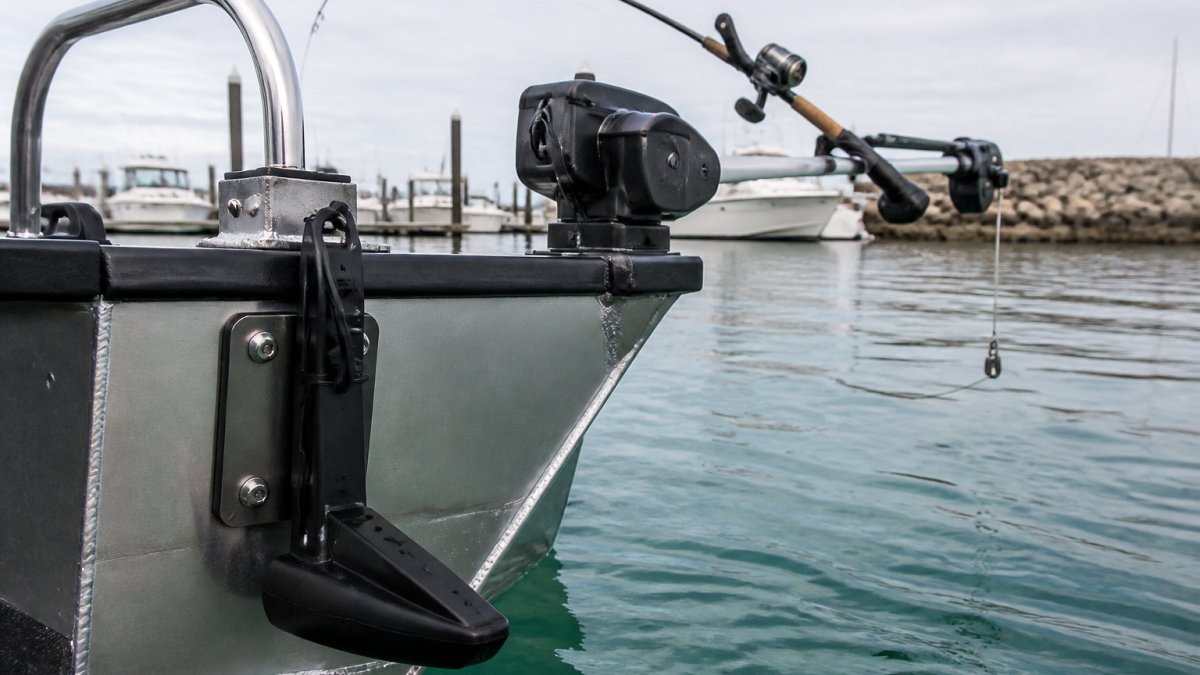
Mount the transducer low enough that the face stays in clean water at trolling speed, but high enough that it doesn't drag or get knocked off on the trailer.
For settings at trolling speed:
- Run Wide Mode on Dual Spectrum CHIRP while you're covering water, then switch to Narrow Mode when you slow to work a mark
- Set the depth range manually rather than letting auto-range hunt, so the bottom doesn't jump on the display
- Turn on fish ID only if you're new; the arches teach you more once you're comfortable reading returns
Matching the Unit to Your Boat, Budget, and Home Port
The right unit depends on how big your boat is, what you can spend, and how far offshore you run from your home port. A 16-foot aluminum tiller doesn't need an 18.5-inch glass helm, and a charter boat on long trolling lanes doesn't want a 7-inch screen it can't read from the helm chair. Great Lakes salmon fishing adds a fourth variable general guides ignore: conditions.
Small Boats and Tight Budgets (Under 18 Feet)
For smaller boats and tight budgets, the HELIX 7 CHIRP MEGA DI GPS G4 at $699.99 is our pick, simple, readable in sun, with MEGA Down Imaging to 125 feet, plenty for most inland salmon water. The G4N version at $799.99 adds Ethernet, Bluetooth, NMEA 2000, and Wi-Fi for a second station. For budget side imaging, the HELIX 7 GPS CHIRP SI G4 at $649.99 gives CHIRP Side Imaging out to 800 feet side-to-side plus AutoChart Live for mapping contours the chart card misses.
Mid-Size Boats and Mixed Use (18-24 Feet)
Mid-size boats that want maps included should look at the XPLORE 10 CMSI+ at $2,299.99, which ships with LakeMaster and CoastMaster cards covering 13 regions. For a dedicated sounder, the Furuno FCV 295 at $3,504.99 lets you dial in any two frequencies between 28 and 200 kHz, control salmon trollers chasing suspended fish appreciate. If you plan to add live sonar later, the Garmin GPSMAP 8610xsv at $2,108.99 is the cleanest upgrade path, compatible with Panoptix and LiveScope.

Big-Water Charter Boats and Long Trolling Runs (24 Feet and Up)
Big-water charter boats running long lanes should look at the APEX line. The APEX 16 VX MSI+ at $4,199.99 and APEX 19 VX MSI+ at $4,699.99 give 15.6- and 18.5-inch Full-HD displays, dual sonar ports up to 2 kW, and One-Boat Network downrigger control. The APEX 13 VX MSI+ at $3,699.99 is the entry point: 13.3-inch Full-HD, dual Ethernet, HDMI in and out, and One-Boat Network compatibility.

Great Lakes-Specific Buying Criteria
Before you buy, run this checklist, the same one we use when rigging a boat for salmon water:
- Bottom holding at trolling speed: Can the unit keep a clean bottom reading at 2.5-3.5 mph in chop? If not, the transducer or power output is the weak link.
- Target separation in the top 100 feet: Salmon often suspend in the top 60-80 feet over deep water; you need CHIRP with a real Low-Q transducer to keep arches distinct.
- Chart coverage for your home port: Does the unit include or support charts for the Great Lakes ports and offshore areas you run? LakeMaster and CoastMaster are the Humminbird standard; Garmin Navionics+ covers coastal and inland waters.
How to decide, quickly:
| If your situation is... | Buy this | Why |
|---|---|---|
| Boat under 18 ft, tight budget | HELIX 7 GPS CHIRP SI G4 | Side imaging at the lowest price |
| Want networking on a small boat | HELIX 7 CHIRP MEGA DI G4N | Ethernet, Wi-Fi, NMEA 2000 |
| Mid-size boat, want maps included | XPLORE 10 CMSI+ | LakeMaster and CoastMaster in the box |
| Plan to add live sonar later | Garmin GPSMAP 8610xsv | LiveScope-ready platform |
| Charter boat, long trolling lanes | APEX 16 or 19 VX MSI+ | Big display, 2 kW sonar port |
| Dedicated sounder, no chartplotter | Furuno FCV 295 | Free-selectable frequencies |
The best unit for Great Lakes salmon fishing is the one that holds bottom at trolling speed, separates fish from bait in the top 100 feet, and keeps a chart locked in when the wind picks up. Match those three to your boat and budget, and you'll fish more effectively than the angler who bought the biggest screen.
Frequently Asked Questions
What's better for salmon fishing, Garmin or Humminbird?
Both brands make capable units, and the right call depends on how you fish. Humminbird's HELIX and APEX lines pair MEGA Side Imaging+ and MEGA Down Imaging+ with One-Boat Network control of Minn Kota and Cannon gear, which suits trollers running downriggers. The Garmin GPSMAP 8610xsv brings a 10-inch full HD IPS touchscreen, built-in Ultra High-Definition scanning sonar, and preloaded Navionics+ charts. Match the unit to your transducer, network, and budget rather than the logo.
What features matter most in a fish finder for Great Lakes trolling?
A fish finder for Great Lakes trolling needs CHIRP sonar with strong target separation, a transducer that holds bottom at trolling speed, and GPS with mapping that covers your ports. Screen readability in sunlight and a fast processor matter on long runs. Networking is worth planning for: Humminbird's One-Boat Network ties compatible units to Minn Kota and Cannon products, so downrigger and boat control live on the same display.
Is side imaging or live sonar better for salmon fishing?
They answer different questions. Side imaging sweeps a wide band to either side of the boat, so it covers water fast and shows bait, suspended fish, and structure you would otherwise run past. Live sonar shows fish reacting in real time, which helps when you are working a pod. Most salmon trollers get more from side imaging on the move and add live sonar when they want to watch a presentation. Budget for both only if you fish often.
Do you need GPS and chartplotting for Great Lakes salmon fishing?
Yes, GPS and chartplotting earn their place on big water. Waypoints mark productive troll lines and bait stacks, and mapping shows depth contours, hazards, and port approaches when weather closes in. Every combo in this guide includes internal GPS and a basemap, and several accept LakeMaster, CoastMaster, or Navionics charts for finer detail. AutoChart Live on the Humminbird units also lets you map contours in real time as you troll.
Can a fish finder show salmon at trolling depth?
A properly set unit shows salmon and bait at trolling depth, but the display depends on frequency, gain, and transducer placement. Lower frequencies reach deeper water; higher frequencies render finer detail. Salmon holding tight to bottom show best with good target separation, which is where CHIRP and digital filtering help. Mark the depth your downriggers run, then read arches against that line rather than guessing.
0 comments