

Last Updated: November 3, 2026
Quick Summary
Coho vs chinook identification comes down to the gum line and tail: chinook have a black gum line and spots on both tail lobes, while coho show a pale or white gum line and spots on the upper lobe only. Coho also troll faster and ride higher, while chinook sit deeper and prefer a slower presentation.
- Chinook mouths trend dark, often black inside, while coho mouths read lighter with a white or gray cast.
- Run your coho lines high and your chinook lines low in the same spread.
- A hatchery fin clip is a healed scar where the adipose fin was removed, and it changes your decision at the net.
- In clear water, coho flash bright silver with a green-blue back and move fast and erratic.
- If you cannot identify the fish before it reaches the net, do not net it.
Table of Contents
- Coho vs Chinook Salmon Identification: Field Marks That Decide It
- How Fast to Troll for Coho Salmon (and Why Chinook Want It Slower)
- Chinook Salmon Trolling Depth: Reading the Water Column
- Coho Salmon Trolling Lures and Flasher Setups That Get Bit
- Hatchery vs Wild Salmon: Fin Clips and What They Change on the Water
- Catch and Release Identification: Reading Salmon Underwater
- Gear Up for Your Next Salmon Trolling Run
- Frequently Asked Questions
Coho vs Chinook Salmon Identification: Field Marks That Decide It
Trolling for coho vs chinook salmon differences starts with a hard truth: you often have seconds to decide, and the wrong call costs you a fish, a release, or a citation. The 2026 preseason forecast from the Washington Department of Fish and Wildlife salmon blog projected 636,500 adult Chinook and 358,700 adult coho returning to the Columbia River mouth, so both species will share your spread.
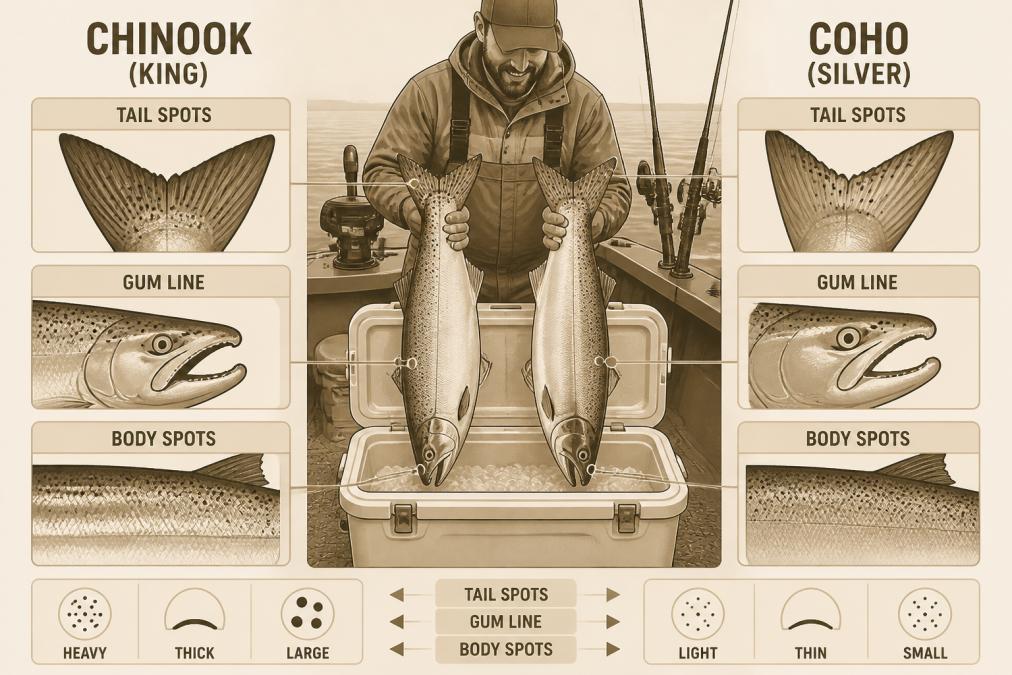
Coho vs chinook identification is the practice of reading mouth color, gum line, jaw shape, and tail spotting to separate the two species before you net, handle, or keep a fish. Get those marks right and the rest of the trolling decisions, from speed to depth, fall into place.
Gum Line, Mouth Color, and Jaw Structure
Chinook carry a black gum line at the base of the teeth on the lower jaw. Coho show a pale or white gum line. That single mark is the fastest field test we know.
Mouth color reinforces it. Chinook mouths trend dark, often black inside. Coho mouths read lighter, with a white or gray cast. Jaw structure tells the rest of the story.
Tail Spotting, Body Shape, and Size
Tail spotting is the mark anglers trust most, and it's the one that fools them. The Oregon Department of Fish and Wildlife identification guide notes coho occasionally carry spots in both lobes, so never lean on tail spots alone.
Body build separates them fast. Chinook are heavier through the shoulders with a thick caudal peduncle. Coho are leaner, more simplified, with a slimmer wrist before the tail.
| Field Mark | Coho | Chinook |
|---|---|---|
| Gum line | Pale or white | Black |
| Mouth interior | Light | Dark to black |
| Tail spots | Upper lobe only | Both lobes |
| Body shape | Simplified, slim wrist | Deep, thick peduncle |
| Jaw | Short, clean | Hooked snout, kype |
| Anal fin | Longer base | Shorter base |
How Fast to Troll for Coho Salmon (and Why Chinook Want It Slower)
Coho want speed. Chinook want patience. Coho gear often performs best at a faster pace, while Chinook tend to feed more deliberately and follow a flasher longer before committing.
Coho are fast, mid-column hunters. King salmon are ambush-minded and lazy in cold water. For a deeper look at dialing in speed, depth, and presentation, read our Lake Michigan salmon trolling speed, depth and presentation guide.
Chinook Salmon Trolling Depth: Reading the Water Column
Chinook salmon trolling depth matters a great deal to a successful spread. Chinook often sit deeper, hugging structure and temperature breaks. Coho generally ride higher in the water column, especially early and late in the day.
Read your electronics, not your habits. Mark bait, find the thermocline, and put a downrigger ball just above the fish. Run your coho lines high and your Chinook lines low in the same spread.
Luhr-Jensen Money Roll Flasher - 11" - Blue Kamikaze UV →
Coho Salmon Trolling Lures and Flasher Setups That Get Bit
Our pick for coho is the Luhr-Jensen Money Roll Flasher - 11" - Blue Kamikaze UV at $23.99.

The Chrome Ladder and Glow Blue Crush patterns cover bright and dark days. Before you buy, read how to choose the right salmon trolling flasher and our guide to using dodgers and flashers with salmon spoons.


Best for: coho spreads run fast and high. Skip if: you're targeting deep kings only.
Hatchery vs Wild Salmon: Fin Clips and What They Change on the Water
A hatchery fin clip is a healed scar where the adipose fin was removed, and it changes your decision at the net. Check your local harvest regulations before you wet a line, because rules vary by fishery.
Watch out: assuming a fish is hatchery because it's small gets anglers cited. Look for the adipose fin, confirm the clip, and know the rules for the water you're on.
How Mass Marking Actually Works
Hatchery salmon are often marked by removing the adipose fin, which heals into a smooth scar. That scar is the only external cue you get.
The clip is your only on-the-water signal. Do not assume a missing adipose fin means the fish is legal to keep, the clip tells you it came from a hatchery, not that your specific water allows retention.
Regional Regulatory Nuances That Change Your Decision
Fin-clip rules are not national. They are set fishery by fishery, and the same clipped coho can be legal in one river and illegal in the next.
- Pacific Northwest saltwater: Retention rules for clipped and unclipped coho vary by marine area. Check the current marine area rules before you launch, since closures and mark-selective rules can change mid-season.
- Columbia River and tributaries: Fishery-specific rules can override general statewide minimums. Check the current rules published by the relevant state wildlife agency.
- Great Lakes: Fishery rules, size minimums and season dates vary by state. Confirm the current rules for the water you fish.
Reading a Clip in Poor Light
A healed adipose scar reads as a smooth, slightly concave line on the back. Run your thumb along the dorsal ridge, a wild fish gives you a small fleshy bump, a clipped fish gives you a flat gap. In low light, backlight the fish against the sky and look at the outline. If you still cannot tell, treat it as wild and release it.
What the Clip Does Not Tell You
A clip does not tell you the species, the size class, or whether the fish is legal on your water. A clipped Chinook and a clipped coho both show the same scar. Use the gum line and tail spotting from the identification section first, then use the clip to make the retention call. For a full breakdown of the flashers and releases that keep clipped fish coming to the net, see our guide to using dodgers and flashers with salmon spoons.
Catch and Release Identification: Reading Salmon Underwater
In clear water, watch the fish behind your flasher before it commits. Coho flash bright silver with a green-blue back and move fast and erratic. Chinook read darker, with a purple-black back, and track steadier. Body depth shows at distance: kings are deep-bodied, coho are torpedo-shaped.
Catch and release gets easier when you never net a fish you can't identify. A 2025 study from Scordino et al. on coho hook mortality found no significant difference in average length among pink, coho, and Chinook caught on 1/0 versus 6/0 hooks, so hook size alone won't tell you the species.
Luhr-Jensen Money Roll Flasher - 11" - Blue Kamikaze UV →
Seasonal Color Timeline: What You See in July vs. October
Salmon appearance changes drastically during migration, and the fish you see in July is not the fish you see in October. Build a mental timeline before you leave the dock.
- Early season (July-August): Both species are bright silver in saltwater. Coho show a green-blue back and a clean white belly. Chinook show a darker, purple-tinged back but are still bright. At this stage, gum line and tail spotting are your only reliable marks.
- Mid-season (September): Coho begin to darken along the back and the lower jaw starts to color. Chinook backs go from purple to near-black, and the kype on mature males starts to show. Tail spots on Chinook remain visible across both lobes; coho spots stay on the upper lobe.
- Late season (October-November): Spawning-phase fish are the hardest to identify. Coho turn red or maroon with green heads and backs, and males develop a pronounced kype. Chinook turn dark brown to black, often with a reddish cast, and the gums stay black. A late-season coho can look darker than an early-season Chinook, which is why the gum line matters more than body color late in the year.
If you fish a mixed spread in October, expect dark fish of both species and lean on the gum line first.
Reading Fish at Depth and in Low Light
Underwater, color fades with depth. Red disappears first, then orange, then yellow. At 40 feet, a coho's green-blue back reads as gray, and a Chinook's purple back reads as near-black. Use shape and motion instead of color when you are deep.
- Body depth: Chinook are deep-bodied with a thick caudal peduncle. Coho are torpedo-shaped with a slim wrist before the tail. At distance, the depth-to-length ratio is the fastest read.
- Motion: Coho move fast and erratic, often chasing and slashing at the flasher. Chinook track steadier and follow longer before committing. A fish that tracks your flasher for 30 feet without striking is more likely a king.
- Light angle: In flat morning light, backlight the fish against the surface. The silhouette shows body depth and tail shape better than color does.
Release Mechanics That Protect the Fish You Can't Identify
If you cannot identify the fish before it reaches the net, do not net it. A fish that stays in the water has a far better survival chance than one that is lifted, handled, and released.
Watch out: a long fight can stress a fish even when it swims away. Match your gear to the species you expect, and if you hook a fish you cannot identify, shorten the fight rather than prolonging it for a better look.
Gear Up for Your Next Salmon Trolling Run
The throughline here is simple: identify first, then rig for the fish in front of you. Coho vs chinook decisions drive your speed, your depth, and your flasher choice, and getting them right is the difference between a full cooler and a long ride home.
At Elliott's Tackle & Rigging, every product is hand-selected by a captain with forty years of fishing experience, and we won't sell gear we wouldn't run on our own boat. Add a Scotty Power Grip Plus Release Leader W Cable Snap Scotty Grp 0002 to finish your trolling setup.
Frequently Asked Questions
How can I tell the difference between a Chinook salmon and a coho salmon?
Start at the mouth. A Chinook has a black gum line at the base of its teeth and a dark mouth interior, while a coho's gum line is white or pale. Then check the tail: Chinook have spots on both lobes of the tail, and coho usually have spots on the upper lobe only. Coho can occasionally show spots in both lobes, so never rely on tail spotting alone. Combine mouth color, tail spots, and body shape before you make the call.
How fast do you troll for coho?
Coho often respond to a faster presentation than Chinook, because coho are active feeders that chase bait. Chinook typically want a slower roll. The Luhr-Jensen Money Roll Flasher is built to rotate and thump at speeds down to 1 mph, so it keeps working when you slow down for Chinook or back off into a turn. Match speed to the species you are targeting, not to a single number.
Is Chinook salmon better than coho?
They are different fish for different purposes. Chinook carry more fat and oil, which makes them rich on the grill and forgiving if you overcook them. Coho are leaner with a firmer, milder flesh that rewards careful handling and holds up well for smoking. Neither is objectively better. If you want a big, oily fillet for the barbecue, Chinook wins. If you want a bright, mild fillet that freezes cleanly, coho is the better pick.
How should trolling depth differ for coho and Chinook salmon?
Chinook usually sit deeper and tighter to structure, so run gear deeper and follow where your sonar marks fish. Coho feed higher in the column, especially early and late in the day. Watch your electronics and adjust. If you are marking fish at 40 feet and nothing is hitting a 100-foot spread, bring the gear up before you change lures.
Do coho and Chinook salmon require different trolling gear?
The rods and reels overlap, but the terminal end differs. Chinook take a heavier leader and a slower, harder-thumping flasher fished deep. Coho take a longer, lighter leader and a faster presentation near the surface. An 11-inch flasher like the Luhr-Jensen Money Roll in Chrome Scale or Blue Kamikaze UV covers both jobs because it starts rotating fast and still thumps at 1 mph. Rig two setups, one deep and slow, one shallow and fast, and let the fish tell you which is right.

0 comments