

Table of Contents
- Dodger vs Flasher for Salmon: Understanding the Difference
- How to Rig a Flasher for Salmon Trolling
- Leader Length for Flasher and Spoon Combinations
- Trolling Speed for Salmon Flashers and Dodgers
- When to Run Spoons Clean Without an Attractor
- Common Rigging Mistakes to Avoid
- Conclusion
- Frequently Asked Questions
Last Updated: October 10, 2026
Dodger vs Flasher for Salmon: Understanding the Difference
Choosing between using dodgers and flashers with salmon spoons depends on water conditions and salmon behavior. Both create vibration and flash, but in different ways.
A flasher is a wide, blade-shaped attractor that spins rapidly around a swivel, creating intense light reflection and water disturbance. A dodger is narrower and wobbles side-to-side rather than spinning, producing a more subtle action that still attracts fish but with less commotion. The spoon trails behind either one, riding in the attractor's wake and mimicking an injured baitfish.
How Flashers Attract Salmon
Flashers spin to reflect light and generate pressure waves that salmon detect from a distance, making them effective in low-light, murky, or deep water. Salmon rely on lateral line detection to sense vibrations, and a spinning flasher triggers aggressive responses. Faster trolling speeds increase flasher rotation, making them ideal for moderate to faster speeds.
The Luhr-Jensen Money Roll Flasher line represents modern flasher design built for serious trolling applications. Models like the 11" Chrome Scale Money Roll deliver a quick-start, thumping rotation that works even at slow speeds down to 1 mph, with premium ball bearing swivels that keep the action smooth and consistent throughout the day.

How Dodgers Create Lure Action
Dodgers wobble side-to-side instead of spinning, creating a gentler action that works in clear water and with cautious salmon. They're efficient at slow speeds and preferred in spring when water temperatures are cold.
How to Rig a Flasher for Salmon Trolling
Setting up a flasher correctly means paying attention to hardware, spacing, and the connection points that hold everything together under load.
Flasher Setup and Hardware
Use ball bearing swivels rated 200+ pounds on both ends of your flasher. Connect a 12-18 inch monofilament or fluorocarbon leader between your mainline and the flasher's top eye to prevent fouling. Connect the flasher's bottom eye to your spoon leader with a quality snap or knot.
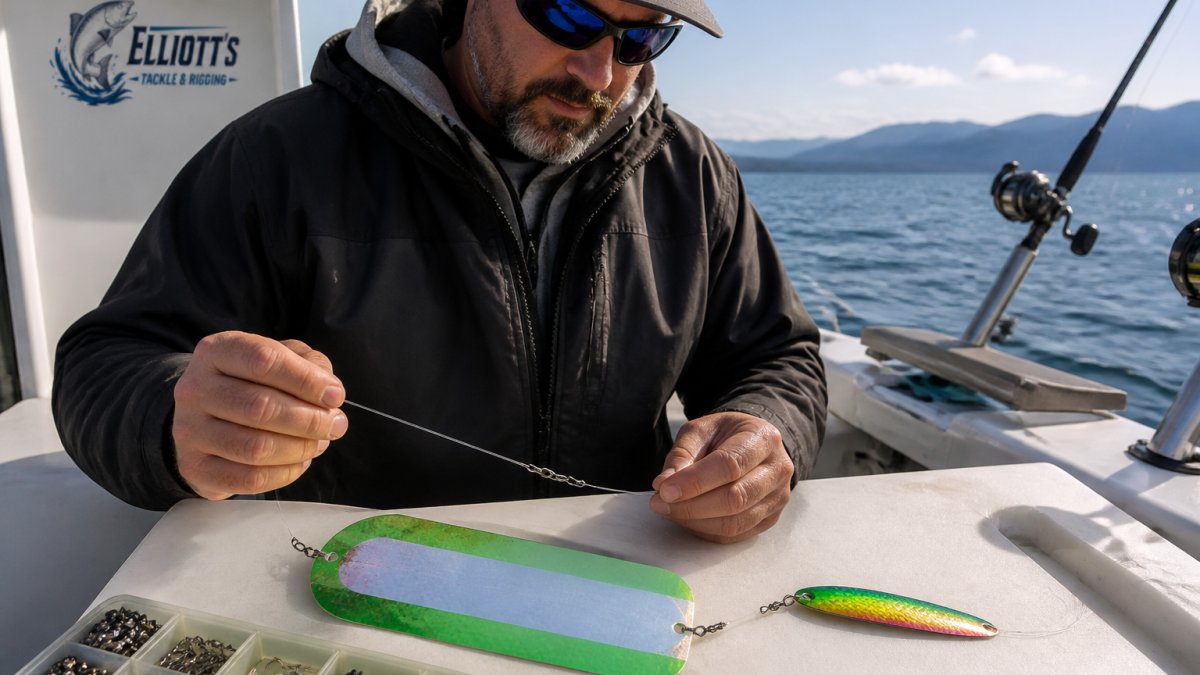
Running Spoons Behind a Flasher
The spoon rides in the flasher's slipstream, gaining additional action from the attractor's spin. Match spoon size to flasher size: an 11" flasher pairs with 3.5"-4.5" spoons; smaller 8" flashers work with 2.5"-3.5" spoons. The spoon should ride straight without twisting; if it spins or rolls, shorten the leader or use a heavier spoon.
Leader Length for Flasher and Spoon Combinations
The distance between your flasher and spoon determines how much additional action the spoon receives and how far apart the two attractors appear to the salmon.
Distance Behind the Attractor
Run the spoon 24-36 inches behind the flasher. In clear water, use 30-36 inches; in murky or deep water, use 24-28 inches. Use monofilament or fluorocarbon for your spoon leader; monofilament is more forgiving, fluorocarbon less visible.
Trolling Speed for Salmon Flashers and Dodgers
Trolling speed and lure action are inseparable. Most anglers never verify their spoon's actual action at the boat, assuming it's working when it may not be.
Speed Ranges for Flashers and Dodgers
Flashers require rotational momentum to spin cleanly. Most flashers work best at 1.5 to 3 mph. Below 1.5 mph, many flashers struggle to start rotating or produce a sluggish, incomplete spin that creates drag instead of attraction. Above 3 mph, the flasher spins so fast that the spoon gets pulled sideways, loses its natural wobble, and may begin to spin itself, a condition called "fouling" that kills strikes.
Luhr-Jensen Money Roll Flasher - 8-1/4" - Nuclear Carbon Glow →
The Luhr-Jensen Money Roll Flasher in Nuclear Carbon Glow is engineered to deliver effective rotation down to 1 mph, making it one of the few flashers reliable in very slow-speed applications. However, even premium flashers perform best in the 1.5-2.8 mph range for consistent, clean action.

Dodgers are more forgiving of slow speeds because they wobble rather than spin. They produce effective action from 0.8 mph up to 2.5 mph. This wider speed range makes dodgers ideal for cold-water spring fishing when you want to move slowly and give salmon time to react to your presentation. Dodgers also excel when you're fishing deep structure and need precise speed control.
Clean spoons work best at 1.2 to 2.2 mph. Slower speeds allow the spoon to flutter and wobble naturally; faster speeds cause the spoon to spin, which introduces line twist and reduces the natural baitfish-like action.
How to Verify Spoon Action at the Boat
Before deploying, verify your spoon's action. Troll at target speed with 20-30 feet of line out and watch the spoon: healthy action shows steady, rhythmic wobbling; dead action means the spoon hangs straight or moves erratically; fouled action means the spoon spins or rolls. Stop and adjust if you see dead or fouled action.
Your rod tip shows steady, rhythmic pulsing when properly tuned. Steady pulsing means the rig is correct. Dead rod (no pulsing) means speed is too slow or the spoon leader is too long, increase speed by 0.2 mph or shorten the leader by 3-4 inches. Erratic twitching means speed is too fast or the spoon is fouling, decrease speed or lengthen the leader. Violent jerking means the rig is severely fouled; bring it in and inspect.
Systematic Speed Tuning
Start at 1.5 mph and watch your rod tip for 30 seconds. If the rod is dead, increase speed by 0.2 mph increments until you see steady pulsing. If the rod shows steady pulsing, increase speed by 0.2 mph and stop when pulsing becomes erratic. Record your working speed range and adjust within it based on salmon behavior.
Speed Adjustments for Conditions
Cold Water: Run at the lower end of your speed range (1.2-1.8 mph for flashers, 0.8-1.5 mph for dodgers). Warm Water: Run at the mid to upper end (2.0-2.8 mph for flashers, 1.5-2.3 mph for dodgers). Deep Water: Slow to 1.2-1.8 mph and retune at depth. Current: Strong current increases effective speed; slow your boat by 0.3-0.5 mph if your rod becomes erratic.
Common Speed-Related Mistakes
Don't run the same speed all day, adjust for changing water temperature and light. Watch your rod tip; if action changes, investigate and correct. Faster isn't better; match speed to your rig and salmon mood. Account for current; a 1.5 mph boat speed in 0.5 mph current gives 2.0 mph effective speed.
When to Run Spoons Clean Without an Attractor
Deciding whether to run a clean spoon depends on water clarity, salmon species, light conditions, and feeding behavior. Understanding when to abandon the attractor separates consistent anglers from those who default to the same rig all day.
Condition-Based Decision Framework
Clear Water (8+ feet visibility): Salmon rely on visual cues; a clean spoon mimics natural baitfish without artificial commotion. Shallow Structure (under 40 feet): A clean spoon's natural wobble is sufficient; attractors can spook fish. Light-Bite Behavior: If salmon tap gently or follow without hooking, switch to a clean spoon. High-Light Periods: Clean spoons work better than flashers in bright midday sun. Species: Coho respond better to clean spoons in clear water; Chinook benefit from flashers in deep water; pink and chum are less selective.
Rigging a Clean Spoon Setup
A clean spoon rig is simple but requires attention to detail. Connect your spoon directly to your mainline using a quality ball bearing swivel or snap. The swivel prevents line twist as the spoon wobbles. Use 12 to 18 inches of monofilament or fluorocarbon between your mainline and the spoon to absorb shock and allow the spoon to move freely.
Keep your trolling speed between 1.2 and 2.2 mph. Slower speeds let the spoon flutter and wobble naturally; faster speeds make it spin, which can trigger line twist and reduces the natural action. Watch your rod tip for steady, rhythmic pulsing. If the rod goes dead, increase speed slightly. If it twitches erratically, slow down or check for line twist.
Two-Rod Strategy
Many successful anglers rig one rod with a flasher and one with a clean spoon, then fish both simultaneously. This lets you test which presentation the salmon prefer without stopping to re-rig. Start the day with both in the water. If one rod consistently outfishes the other, switch the second rod to match the winner. This adaptive approach eliminates guesswork and lets the salmon tell you what works.
When NOT to Run Clean
Do not run a clean spoon in murky water, at night, or in deep water (below 60 feet) where visibility is limited. Salmon rely on vibration and flash to locate prey in low-light conditions. A clean spoon produces minimal vibration and may go undetected. In these scenarios, a flasher or dodger is the better choice.
Luhr-Jensen Money Roll Flasher - 8-1/4" - Nuclear Carbon Glow →
Common Rigging Mistakes to Avoid
Even experienced anglers slip up. Here are the mistakes that cost fish.
Leader too short between mainline and flasher. This causes the flasher to foul on your line during turns or in current. Keep that connection 12-18 inches minimum.
Spoon leader too long. Beyond 48 inches, the spoon loses the attractor's benefit and becomes a separate presentation. The salmon sees two unrelated things instead of a coordinated pair.
Mismatched spoon size to flasher. A tiny spoon behind a large flasher looks wrong and gets pulled off-balance. A heavy spoon behind a small flasher bogs down the action. Match proportions, large flashers with larger spoons, smaller flashers with smaller spoons.
Ignoring rod tip feedback. Your rod tells you everything. Dead action means something is wrong. Erratic twitching means the rig is fouling or speed is off. Watch the rod and adjust.
Using worn or damaged flashers. A bent flasher won't spin true and creates drag instead of action. Replace flashers that have taken hits or show visible damage.
Not testing knots before deployment. A failed knot at depth costs time and gear. Tie your connections on the dock, pull hard, and verify they hold.
Conclusion
Using dodgers and flashers with salmon spoons comes down to matching the attractor to your water conditions and the salmon's mood. Flashers create maximum flash and vibration for aggressive fish and low-light situations. Dodgers produce subtle wobble for clear water and cautious salmon. Clean spoons work best when you need a natural presentation without added commotion.
At Elliott's Tackle & Rigging, we stock the Luhr-Jensen Money Roll Flasher line in multiple sizes and finishes, including the 11" Blue Kamikaze UV for maximum visibility in varied light conditions. Every flasher is hand-selected for reliable, consistent action. Start with proper spacing, match your speed to your rig, and watch your rod tip. The salmon will tell you when you've got it right.

Frequently Asked Questions
Do you use a flasher with a salmon spoon?
Yes, many salmon trollers run flashers or dodgers ahead of spoons to increase attraction and visibility. Flashers and dodgers create vibration and flash that draw fish toward your spoon. However, clean spoons without attractors work well in certain conditions, particularly in clear water or when salmon are aggressive. The choice depends on water clarity, depth, and fish behavior on any given day.
What is the recommended trolling speed for salmon flashers?
Quality salmon flashers like the Luhr-Jensen Money Roll are engineered to work effectively at speeds as low as 1 mph, making them ideal for deep trolling and slow presentations. Most anglers troll flashers between 1.5 and 3 mph depending on water conditions and target species. Slower speeds work best in cold water or when fish are inactive, while faster speeds can trigger strikes in warmer conditions. Adjust your trolling speed to match the spoon action you see behind the boat.
How far behind a dodger or flasher should you run a salmon spoon?
Standard leader length between the flasher or dodger and your spoon ranges from 18 to 36 inches, with 24 inches being a common starting point for most trolling setups. Shorter leaders (18-24 inches) keep the spoon closer to the attractor's action, while longer leaders (30-36 inches) allow the spoon more independent movement. Experiment with different distances to find what produces best in your fishing conditions. The spoon should maintain a natural wobble without tangling in the flasher.
What is the difference between using a dodger and a flasher with a spoon?
Flashers like the Luhr-Jensen Money Roll rotate on their axis with a thumping, vibrating action that creates strong water disturbance and reflected light. Dodgers have a side-to-side wobble that generates a gentler, more subtle lure action and allows trailing spoons to move more independently. Flashers work well in deeper water, low-light conditions, and when you need maximum attraction. Dodgers excel in clearer water and when salmon prefer a more natural, less aggressive presentation. Both are effective attractors that increase your chances of strikes.
0 comments