

Last Updated: November 7, 2026
Quick Summary
Tie effective salmon trolling leaders by matching fluorocarbon leader to your main line, using a solid tie for swivels and hooks, a loop knot for spoons and plugs, and a slip tie for adjustable hook spacing. Keep leaders 24 to 48 inches and wet every knot before tightening.
- Fluorocarbon is the default leader material because it sinks faster and nearly disappears underwater.
- Use 12-20 lb leader for coho and 20-40 lb for Chinook and big-water fish.
- A flasher leader runs 36-48 inches from swivel to flasher, then 24-36 inches to the lure.
- A tight knot kills lure action, so use a loop knot on spoons and plugs.
- A clean curl at the tag end means the knot slipped; a frayed end means abrasion.
Table of Contents
- Salmon Trolling Leader Setup: The Components That Matter
- Best Knot for Salmon Fishing: Slip Tie, Solid Tie, and Loop Knots
- Salmon Leader Length: Matching Your Setup to Trolling Conditions
- How to Tie a Flasher Leader for Salmon
- Tandem-Hook and Single-Hook Rigs for Herring and Hoochie
- Testing Knots and Diagnosing Break-Offs
- Stock Your Leader Bench at Elliott's Tackle & Rigging
- Frequently Asked Questions
Salmon Trolling Leader Setup: The Components That Matter
A salmon trolling leader is the short length of line between your main line and your lure, flasher, or bait, and getting it right is the difference between a hooked fish and a quiet rod. Too many anglers lose fish to a leader built out of whatever was left on the spool. The fix starts with understanding what each piece does.
Your setup has three zones:
- Main line: the long spool line, usually braid or mono, that runs from reel to release.
- Leader: the terminal section that carries the lure, flasher, or bait.
- Hardware: swivels, snaps, rings, and release clips that connect everything.
Each zone fails differently. Braid rarely breaks. Leaders break constantly when they're too light, too stiff, or tied with the wrong knot. Hardware fails when it's undersized or corroded.
That's the whole game in one sentence: build the leader and hardware to survive the fight, and the main line will take care of itself.
Main Line, Leader, and Hardware
Braid main line lets you feel a strike and sets hooks fast, but it has almost no stretch. That means your leader absorbs every head shake and run. A mono or fluorocarbon leader gives you that cushion.
Hardware has to match. A swivel rated below your leader strength becomes the weak link. So does a snap that's too small for the lure's action.
A simple setup is braid main line, a quality swivel, and a leader that's a step lighter than the main line. That way, if something has to break, it breaks at the leader, not at the rod tip.
Choosing Leader Material and Test Strength
Fluorocarbon is the default for salmon trolling leaders. It's denser than mono, sinks faster, and nearly disappears underwater, which matters when fish are pressured. It also shrugs off abrasion better around downrigger cables and rocky structure.
Monofilament still earns a place. It's cheaper, has more stretch for shock absorption, and ties easily in cold, wet hands.
For material, Daiwa J-FLUORO fluorocarbon leader is a strong option. It comes in test strengths from 2 lb to 150 lb, holds diameter consistency across the spool, and resists abrasion. For a lighter, softer option, Sufix Advance Fluorocarbon delivers the same invisibility with low memory.

Test strength depends on your target and conditions:
- Coho and smaller salmon: 12-20 lb leader
- Chinook and big-water fish: 20-40 lb leader
- Abrasive structure or heavy flashers: step up one size
Match leader to your main line, not to the fish you hope to catch.
Best Knot for Salmon Fishing: Slip Tie, Solid Tie, and Loop Knots
The best knot for salmon fishing is the one you can tie correctly in a rocking boat with cold hands.
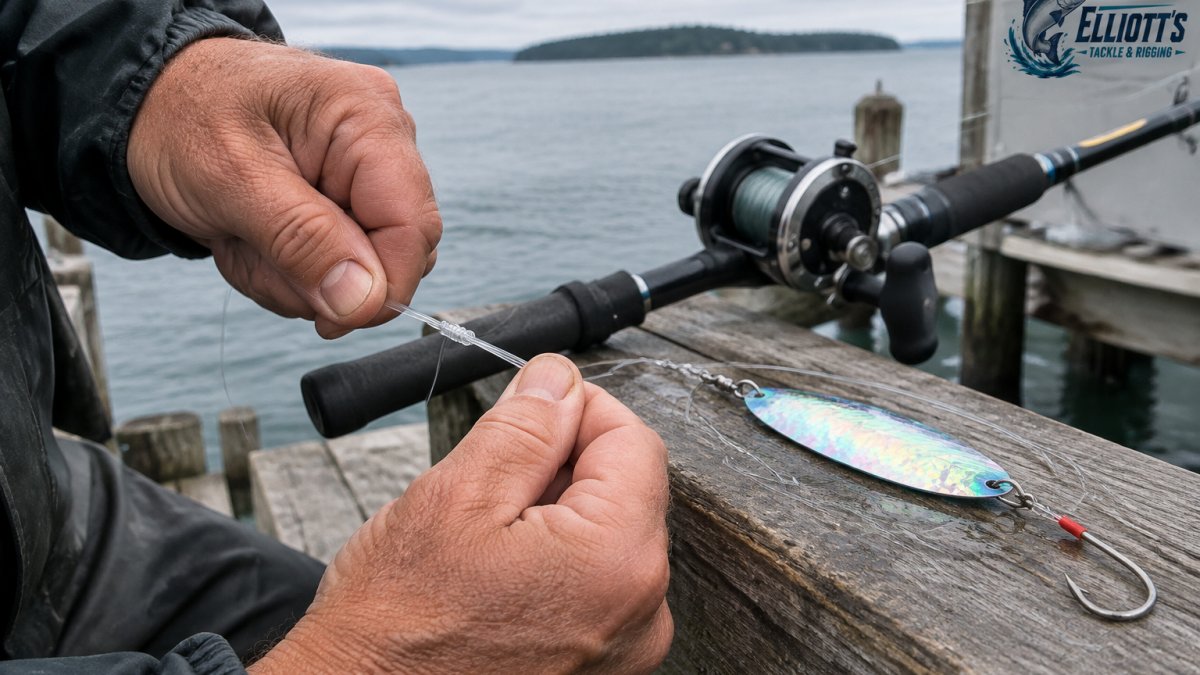
Three knots cover nearly every salmon trolling leader you will build:
- Slip tie: an adjustable loop that slides to set hook spacing on tandem rigs.
- Solid tie: a fixed, snug connection for swivels and single hooks.
- Loop knot: a non-slipping loop that lets a lure or flasher swing freely.
Here is where most anglers go wrong: they tie a solid knot to a lure that needs to swim. A tight knot kills the action. Use a loop knot on spoons and plugs, and a solid tie on swivels and hook eyes.
Step-by-Step: Tying the Slip Tie and Solid Tie
Slip tie (for adjustable hook spacing):
- Thread the tag end through the hook eye.
- Wrap the tag around the standing line 4-5 times.
- Pass the tag back through the loop nearest the hook eye.
- Moisten, then pull the standing line to slide the loop tight.
- Adjust the loop size before you seat it.
Solid tie (for swivels and fixed hooks):
- Pass the tag end through the eye twice.
- Wrap the tag around the standing line 5-6 times.
- Pass the tag back through both eye loops.
- Moisten the knot with saliva or water.
- Pull slow and steady until it seats flush.
Loop knot (for spoons and plugs):
- Tie an overhand knot in the standing line, leaving a loop large enough for the lure eye.
- Pass the tag end through the lure eye and back through the overhand knot.
- Wrap the tag around the standing line 3-4 times.
- Pass the tag back through the overhand knot.
- Moisten and pull the standing line to close the knot while keeping the loop open.
Wet every knot before you tighten it. Dry fluorocarbon burns and weakens at the friction point. Trim the tag close, but leave a hair of margin.
Watch out: a knot that slips under load usually means the tag was too short or the wraps crossed. Retie rather than testing your luck. After a fish or a snag, run a thumbnail down the leader to feel for nicks and retie any knot that looks rough. A clean curl at the tag end means the knot slipped; a frayed end means abrasion; a break mid-leader means the line was damaged. Each tells you what to fix.
Salmon Leader Length: Matching Your Setup to Trolling Conditions
Salmon leader length usually runs 24 to 48 inches for most trolling setups, with shorter leaders for fast, deep presentations and longer leaders for spooky, clear-water fish. The right length depends on your flasher, your speed, and how the fish are behaving.
A flasher needs room to rotate without tangling the lure. That's why flasher leaders tend to run longer than bare-lure leaders. If your leader is too short behind a flasher, the lure loses action. Too long, and the flasher's motion never reaches the bait.
Adjust by conditions:
- Fast trolling, deep water: shorter leader, tighter action.
- Slow trolling, clear water, pressured fish: longer leader, more natural swing.
- Heavy current or big swells: shorter leader for control.
For a deeper look at how trolling setups change leader choices, our Lake Ontario king salmon trolling gear guide breaks down full rigs.
Leader length and test strength should be matched to your presentation and conditions.
| Situation | Leader length or test | Note |
|---|---|---|
| Most trolling setups | 24 to 48 inches | Shorter for fast, deep; longer for spooky fish |
| Fast trolling, deep water | Shorter leader | Tighter action |
| Slow trolling, clear water, pressured fish | Longer leader | More natural swing |
| Heavy current or big swells | Shorter leader | For control |
| Coho and smaller salmon | 12-20 lb leader | Match leader to main line |
| Chinook and big-water fish | 20-40 lb leader | Match leader to main line |
| Abrasive structure or heavy flashers | Step up one size | , |
How to Tie a Flasher Leader for Salmon
A flasher leader connects your main line to the flasher, then a second leader runs from flasher to lure. Get the first connection wrong and the whole rig twists.
Build it in two parts:
- Tie your main line to a quality ball-bearing swivel.
- Run 36-48 inches of leader from the swivel to the flasher.
- Add a snap at the flasher so you can swap it fast.
- Run a second leader, 24-36 inches, from flasher to lure.
Use a ball-bearing swivel at the top to help reduce line twist.
For release hardware that holds your flasher rig at depth, a Scotty Snapper release leader snap is one option to consider.
Tandem-Hook and Single-Hook Rigs for Herring and Hoochie
Tandem-hook rigs outfish single hooks on bait because a trailing hook catches short-striking salmon. Single-hook rigs win on lures and hoochies where a second hook kills action or fouls.
For herring, a two-hook setup is standard. One hook sits near the head, one trails at the tail.
For hoochies, a single hook behind the skirt keeps the action clean. Some anglers run a tandem for big kings, but the second hook must sit far enough back to avoid tangling the skirt.
Rig choices also shift by species. Our guide to trolling for coho vs Chinook salmon explains how each fish strikes and why hook placement changes.
Watch out: a trailing hook that's too close to the lead hook causes foul hookups and tangles. Space them to match your bait, and test the rig in the water before you set lines.
Testing Knots and Diagnosing Break-Offs
Most break-offs aren't bad luck. They're a knot that wasn't seated, a leader that was nicked, or hardware that failed under load. Test before you fish.
Do this on the dock:
- Pull every knot hard, slowly, to full load
- Run a thumbnail down the leader to feel for nicks
- Check swivels spin freely
- Confirm snap gates close fully
- Retie any knot that slips or looks rough
When a fish breaks you off, inspect the tag end. A clean curl means the knot slipped. A frayed end means abrasion. A break mid-leader means the line was damaged. Each tells you what to fix.
Keep leaders fresh. Replace them after abrasion, after big fish, and after any hard contact with structure. Our salmon trolling gear maintenance steps cover the full routine for keeping terminal gear sound.
Stock Your Leader Bench at Elliott's Tackle & Rigging
Building reliable salmon trolling leaders comes down to three things: the right material, a knot you trust, and hardware that won't quit. Skip any one and you'll lose fish.
We stock fluorocarbon leader in the strengths that matter, plus the swivels, snaps, and release clips that hold your rig together. Every item is chosen by an experienced captain with forty years of fishing expertise. Free shipping and 30-day returns are available.
Stop guessing which leader and hardware will hold up to a charging king. Get your fluorocarbon, swivels, and release clips from Elliott's Tackle & Rigging, where every product is captain-curated and built for serious anglers. Search our leader lineup and rig your next setup with gear that's tested on the water.
Frequently Asked Questions
What pound-test leader should you use for salmon trolling?
Match leader test to the fish and the water. For most Great Lakes and coastal trolling, 20-30 lb fluorocarbon covers king salmon and steelhead, while 40-50 lb is common around structure or when big kings are in the mix. The Ice Strong Krunch Meat Rigs come pre-built with 50 lb fluorocarbon, which suits big-water predators. Daiwa J-FLUORO runs from 2 lb to 150 lb, so you can spool a range and swap leaders as conditions change.
How long should a salmon trolling leader be?
Most trolling setups run 3-6 feet from flasher to bait or lure. Shorter leaders (3-4 feet) give a flasher more action and work well in murky water or for aggressive kings. Longer leaders (5-6 feet) suit clear water and spooky fish. Adjust in one-foot increments until you find what the fish want that day, and keep a few pre-tied leaders on the boat so you can change fast.
Should you tie a salmon leader directly to the main line?
A swivel between main line and leader is the safer choice for trolling. It stops line twist from the flasher and lets you swap leaders without cutting into your main line. Tie your main line to one eye of a quality ball-bearing swivel and your leader to the other. That said, a direct main-line-to-leader connection works for light spoons and plugs where you want a clean, low-profile presentation.
How often should you replace a salmon trolling leader?
Inspect the leader after every fish and every snag. Cut back and retie if you feel nicks, rough spots, or flattened sections, and replace the whole leader after a few outings of hard use. Fluorocarbon hides nicks well, so run the line through your fingers and look closely in good light. Keeping spare pre-tied leaders aboard makes replacement a two-minute job instead of a lost fishing day.

0 comments