

Last Updated: November 9, 2026
Quick Summary
A solid trout trolling setup on the Great Lakes starts with a 7-foot, medium-light rod rated for 12 to 30 pound line and a line-counter reel for repeatable depth. Add a braided mainline with a 25 to 30-foot monofilament top shot, then a fluorocarbon leader behind a flasher or dodger.
- Pick a 7-foot, medium-light trolling rod rated for 12 to 30 pound line.
- Use a line-counter reel so you can repeat depths that produced strikes.
- Run a 25 to 30-foot monofilament top shot to cushion hookups and protect braid.
- Put a 50-pound fluorocarbon leader on a crush-proof ring swivel behind a flasher.
- Test your braid-to-mono knot under a hard pull before fishing it.
Table of Contents
- Essential Great Lakes Trolling Rods and Reels
- Mainline and Leader Setup: Braid, Monofilament and Fluorocarbon
- Salmon Trolling Setup With Downrigger
- Salmon Trolling Setup Without Downrigger
- Trolling Fishing Setup for Beginners: Lures, Speed and Spread
- Troubleshooting Your Trout Trolling Setup on the Water
- Building Your Great Lakes Trout Trolling Spread With Elliott's Gear
- Frequently Asked Questions
Essential Great Lakes Trolling Rods and Reels
Trout trolling on the Great Lakes starts with the right rod and reel, and the right rod and reel start with understanding what the water demands. Depth changes fast, fish move with the thermocline, and a rod that cannot handle a 30-pound braid under load will cost you fish.
Choosing a Trolling Rod: Action, Length and Line Rating
A 7-foot, medium-light trolling rod rated for 12 to 30 pound line covers most of what you will do on the lakes, and it is the cornerstone of any solid trout trolling setup. It is a good fit for anglers who run downriggers and small planer boards from the same boat.
Action matters more than most anglers expect. A softer tip absorbs head shakes from salmon and keeps hooks in place, while a stiffer backbone gives you the use to pull a rod out of a holder during a strike. Match the line rating on the blank to the line you actually spool.
Line-Counter Reels and Depth Control
A line-counter reel tells you how much line is out, which means you can repeat a depth you know worked. That repeatability is the whole point of trolling for trout and salmon. Run the same line-out count on the next pass and you will be fishing the same water column that produced strikes.
Pair the reel with a rod holder that keeps the spool visible. The Cisco Fishing Systems Reel-Up Rod Holder orients large line-counter reels face-up in an open cradle, so you can read depth without lifting the rod. The Cisco Short Cradle Rod Holder uses a similar open saddle sized for smaller line-counter reels.
Mainline and Leader Setup: Braid, Monofilament and Fluorocarbon
The mainline and leader decide how the spread behaves at speed. Braid alone can be harsh on a fish's mouth and does not absorb a violent strike, so most Great Lakes trollers add a shock section.
A 25 to 30-foot monofilament top shot is the common answer. It stretches under load, cushions hookups and protects the braid from abrasion where it meets the terminal rig.
Watch out: a braid-to-mono knot that slips under load will cost you the fish and the rig. Use a knot you have tested with a hard pull before you put the rod in the water.
Salmon Trolling Setup With Downrigger
A downrigger lets you put a lure at a precise depth and hold it there regardless of boat speed. That is the core advantage when salmon are holding in a narrow band of water.
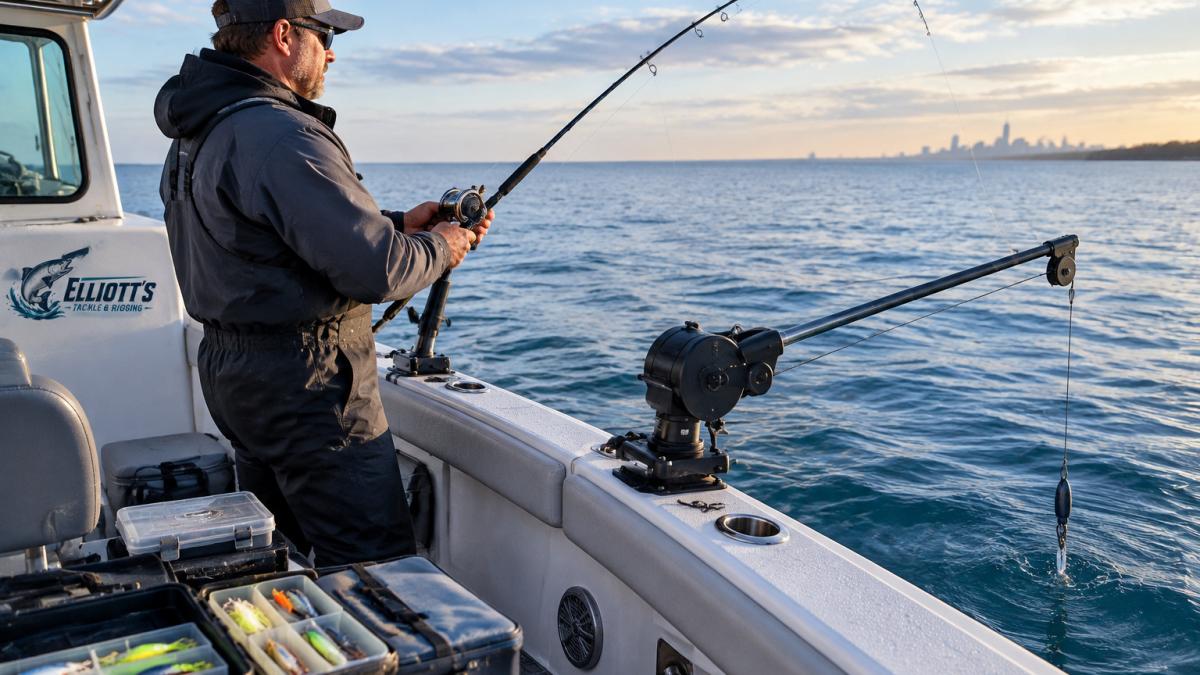
Add a flasher and a meat rig ahead of the lure. The 11" Dual Fin Flasher Series, painted and assembled in Michigan, pulls harder and throws more vibration than smaller flashers, which helps when fish are scattered or pressured. The Ice Strong Outdoors Krunch Meat Rig pairs a 48-inch length with a 50 lb fluorocarbon leader and 1/0 VMC hooks.
Salmon Trolling Setup Without Downrigger
Running a productive spread without a downrigger is entirely doable, you just need to control depth with diving devices and spread lines horizontally with planer boards. The two workhorses are in-line planer boards and directional divers (Dipsy Divers and similar), and each has a distinct job.
Planer Board Fundamentals
In-line planer boards clip onto your mainline and pull the line out to the side as you troll, keeping your lure away from the boat and from other lines. Run boards on braid or mono mainline with a 20- to 30-foot leader to the lure.
A common pattern is to run two boards per side, staggered so the outside board runs farther back and farther out. Keep the inside board's line shorter so the two do not cross when a fish makes a run.
Dipsy Diver Rigging and Depth Control
A Dipsy Diver is a directional diving planer that pulls down and to the side. The size (usually 0, 1, or 3) and the setting (0-3 on most models) determine how deep and how far out it runs. Use the dive chart that comes with your diver as a starting point, then verify with your fish finder.
Rig the Dipsy on a braided mainline (30- to 50-pound test) with a snubber to absorb shock, then a 6- to 10-foot fluorocarbon leader to the lure. The snubber is not optional, a big salmon on a braid mainline with no stretch will straighten hooks or tear out.
Speed and Spread
Speed at the lure matters more than speed over ground, currents and turns change it. A GPS speed sensor at the ball or a paddle-wheel speed indicator at the transom gives you a truer read than GPS alone.
Start with two boards and one diver per side, note the line-out counts and settings that produce strikes, and repeat them. For a deeper look at spreading lines across the water column, see our guide to planer boards for Great Lakes walleye trolling.
Watch out: a Dipsy Diver that is set too tight will not trip on a small fish, and you will troll it for an hour without knowing a fish is on. Test the release tension by hand before you set it.
Running a spread without a downrigger comes down to two diving tools, each with its own job.
| Tool | Main job | Key setting |
|---|---|---|
| In-line planer board | Pulls line out to the side | Release tension |
| Dipsy Diver | Dives down and to the side | Size and setting (0-3) |
| Snubber | Absorbs shock on the mainline | Keeps big fish from tearing out |
| Diver release | Trips when a fish strikes | Test by hand before setting |
Trolling Fishing Setup for Beginners: Lures, Speed and Spread
If you are new to Great Lakes trolling, start with two or three rods and one reliable depth-control method. Trying to run six lines with four different presentations on day one is how beginners tangle everything and catch nothing. The goal of your first few trips is to learn what a clean spread looks like and how fish respond to speed and depth changes, not to run a tournament spread.
Lure Selection: Spoons, Crankbaits, and Flashers
Three lure families cover most Great Lakes trout and salmon trolling, and each has a distinct action and speed window.
Spoons are the most forgiving trolling lure.
Crankbaits are diving plugs that run at a predictable depth based on line-out and speed. A size 5 to 7 shallow-running crankbait is a good starter; it will dive 8-12 feet on 100 feet of 12-pound mono at 2.5 mph.
Flashers and dodgers are attractors, not lures, they go ahead of a fly, meat rig, or spoon.
Speed and Spread for Beginners
Keep the spread simple: one flasher-and-meat-rig combination, one spoon or crankbait run deeper, and a line running at a different depth. Adjust speed in small increments, a quarter mile per hour at a time, and watch which rod goes off first.
A useful approach for learning the rhythm is to fish one setup for a full session before changing anything. Note the line-out count, speed, and depth for every strike, and repeat that setup on the next pass.
Watch out: a crankbait run on braid mainline without a mono or fluorocarbon leader will lose its action and may foul. Always run diving plugs on a stretchy leader.
Troubleshooting Your Trout Trolling Setup on the Water
Most trolling problems come from three sources: wrong depth, wrong speed or a tangled spread. If you are not getting strikes, check your line-out counts against where you last caught fish, then slow down or speed up by a quarter mile per hour and see whether the rods change.
If lines keep crossing, check that your outrigger clips are set to the right tension and that each rod holder is seated firmly. If a rig keeps fouling, shorten the leader or add a snap weight to keep the lure tracking straight.

Building Your Great Lakes Trout Trolling Spread With Elliott's Gear
A complete spread starts with a rod you trust, a reel with a line counter, a rod holder that keeps the spool visible and a rig that presents the lure correctly. At Elliott's Tackle & Rigging, we hand-select each piece because we would run it on our own boats.
The team behind the selection has spent decades on these waters. Visit the Elliott's Tackle & Rigging shop, pick your rods and rig components, and build a spread that holds depth when the fish are deep.
Frequently Asked Questions
What gear do you need to troll for trout on the Great Lakes?
A basic Great Lakes trout trolling spread needs medium-action trolling rods rated for 12 to 30-pound line, line-counter reels, a braided mainline with a monofilament or fluorocarbon leader, and a selection of spoons, flashers and meat rigs. Many anglers add a downrigger or planer board to reach the depth where trout are holding. Elliott's Tackle & Rigging carries rods, rod holders, flashers and rigs built for these setups, so you can assemble a complete spread from one source.
What rod and reel setup is best for Great Lakes trout trolling?
Most anglers pair a 7-foot medium-light trolling rod with a line-counter reel so they can track lure depth precisely. The Ice Strong Outdoors Manasseh AP7, rated 12 to 30-pound line, is a versatile option for downrigger and small planer board work at $99.99. Pair it with a reel that holds enough braid for the depths you fish, and check the drag before every outing.
What line should you use for trolling trout?
A common Great Lakes setup uses 30-pound braided mainline for depth precision and sensitivity, connected to a 25 to 30-foot monofilament top shot that absorbs shock on strikes. Fluorocarbon leaders, such as the 50-pound fluorocarbon used in Krunch Meat Rigs, are often added below the lure to reduce visibility. Replace leaders regularly, since abrasion from fish and structure weakens them quickly.
How do you set up a downrigger for trout trolling?
Lower the downrigger weight to the depth where you have marked fish or thermocline activity, then clip the release to the downrigger cable and set your rod in a rod holder. Use the same depth and speed consistently so you can repeat results. Rod holders such as the Cisco Short Cradle or Reel-Up Rod Holder keep the line counter visible and the rod secure when waves pick up.
Can you troll for trout without a downrigger?
Yes. Planer boards, dipsy divers and leadcore line all place lures at different depths without a downrigger. Dipsy divers run lures outward from the boat, while leadcore sinks a fixed distance per color. Planer boards spread lines to the side. Each method suits different water depths, so mix them on the spread to find where trout are feeding.
How far behind the boat should you troll a lure?
Lure distance depends on the method. Downrigger releases commonly place lures 30 to 60 feet back, while dipsy divers and planer boards often run farther to clear the boat's wake. Trolling speed in late summer and fall commonly falls between 2.2 and 2.8 mph, and you should adjust based on how fish respond. Check lure action at each setting before committing to a spread.
What lures work well for Great Lakes trout trolling?
Spoons, flashers paired with meat rigs, and small crankbaits are the most common producers. An 11-inch dual fin flasher in a UV or glow finish, sold at $23.99, adds flash and vibration that trout notice from a distance. Match lure color to water clarity: brighter colors suit stained water, while natural tones work better in clear conditions.
What should a beginner buy first for trout trolling?
Start with one or two trolling rods, a reliable line-counter reel, braided mainline, a monofilament top shot and a small assortment of spoons and flashers. Add a downrigger or planer boards once you understand how depth affects your catch. Elliott's Tackle & Rigging offers curated starter components so you can build a working spread without buying more gear than the water requires.

0 comments