

Last Updated: November 5, 2026
Quick Summary
Planer boards let Great Lakes walleye anglers spread lines to the side of the boat, away from the wake and engine noise, covering water a single line would miss. Start with inline planer boards, space each line in its own lane, and check board behavior and release tension before every trip.
- Inline planer boards are simpler and cheaper to start with than mast-mounted systems.
- Stagger a four-board spread with inside boards at 30 to 40 feet and outside boards at 60 to 80 feet.
- Slow down in choppy conditions so your boards keep tracking cleanly.
- Set release clip tension so lines hold while trolling but free easily when a walleye strikes.
- Reel in outside boards first when a fish hits to avoid crossing lines.
Table of Contents
- Why Planer Boards Work for Great Lakes Walleye
- Inline Planer Boards for Walleye: How They Compare to Mast-Mounted Systems
- Walleye Trolling Speed With Planer Boards: Setting Your Pace
- How to Use Planer Boards for Walleye: Setup, Spread and Tangle Prevention
- 50-2 Method Trolling: Running Boards Over a Deep Spread
- Planer Board Release and Mast Gear Picks From Elliott's Tackle & Rigging
- Start Building Your Walleye Spread With the Right Planer Gear
- Frequently Asked Questions
Why Planer Boards Work for Great Lakes Walleye
Planer boards let you spread your walleye lines out to the side of the boat, away from the wake and the noise of the engine. For anglers trolling the Great Lakes, that spread can mean the difference between a slow day and a full cooler. Elliott's Tackle & Rigging carries planer board gear selected by a captain with forty years of fishing experience, and a well-rigged spread can make a real difference in what you catch.
The basic idea is simple. A board rides off to the side, pulling your line outward while your lure runs at a depth you control. Walleye often hold in specific zones, and a board lets you cover water that a single line straight behind the boat would miss. We recommend starting with a clear plan for where your lines should run before you ever drop a lure in the water.
Boards can also help reduce tangles when each line has its own lane. Watch out: if your boards are set too close together, the lines will cross and you will lose more time than you save.
Inline Planer Boards for Walleye: How They Compare to Mast-Mounted Systems
Inline planer boards attach to your line with a release clip and tow out to the side as you troll. Mast-mounted systems hold the line off a rigid mast on the boat rail, using reels and pulleys to set the spread. Each approach has a place, and the right choice depends on your boat and how you fish.
Inline boards are simpler to set up and easier to store. They work well when you want a quick, flexible spread without permanent hardware on the boat. Mast systems cost more but offer control over spread width and line placement.
Our pick for most Great Lakes anglers is to start with inline boards and add a mast system once you know how you want your spread to look. Cisco's Electric and Manual Planer Mast, available at $662.99 at https://www.elliottstackleandrigging.com/products/cisco-electric-and-manual-planer-mast, is a mast option for anglers ready to make that jump.

Walleye Trolling Speed With Planer Boards: Setting Your Pace
Speed is the variable that most often decides whether your boards track cleanly or turn your spread into a tangled mess. Inline boards are sensitive to speed because they generate their own drag and rely on a balanced pull to stay upright and outward. Walleye trolling speeds vary, and the right number for your boat depends on board size, line diameter, and how many boards you are running.
Start at the low end and watch each board individually. A board that rides flat and pulls steadily is working. A board that skips, dives, or rides too high is telling you something. Skipping usually means too much speed or too little line out. Diving often means the board is too small for the weight or speed you are running. Pulling inward toward the boat suggests the board is starved for clean water, often because it is running too close to the prop wash or another board.
On the Great Lakes, wind and waves change the picture quickly. A two-foot chop on Lake Erie will slow your boards relative to the boat and can make them toss if you push speed. Slowing down somewhat in choppy conditions can help keep boards tracking. On calm mornings, you can often run at the upper end of the range without losing board behavior.
Current adds another layer. When trolling with the current, your boards may need more speed through the water to maintain the same lure action. Against the current, you may need less. Watch your board angle relative to the boat rather than relying only on GPS speed. A board that sits at a consistent angle is working even if your speed number looks different from yesterday.
Cisco Fishing Systems Electric and Manual Planer Mast →
Watch out: if one board consistently runs differently from the others at the same speed, check the release clip tension and the line diameter on that rod before you change your trolling speed for the whole spread.
How to Use Planer Boards for Walleye: Setup, Spread and Tangle Prevention
Setup is where most of the success or frustration happens. Start by deciding how many boards you will run and how far apart you want them. A common approach is to space boards so each line runs in its own lane, leaving room for lures to work without crossing. For a two-board spread, run one board 40 to 60 feet back on one side and the other 60 to 80 feet back on the opposite side.
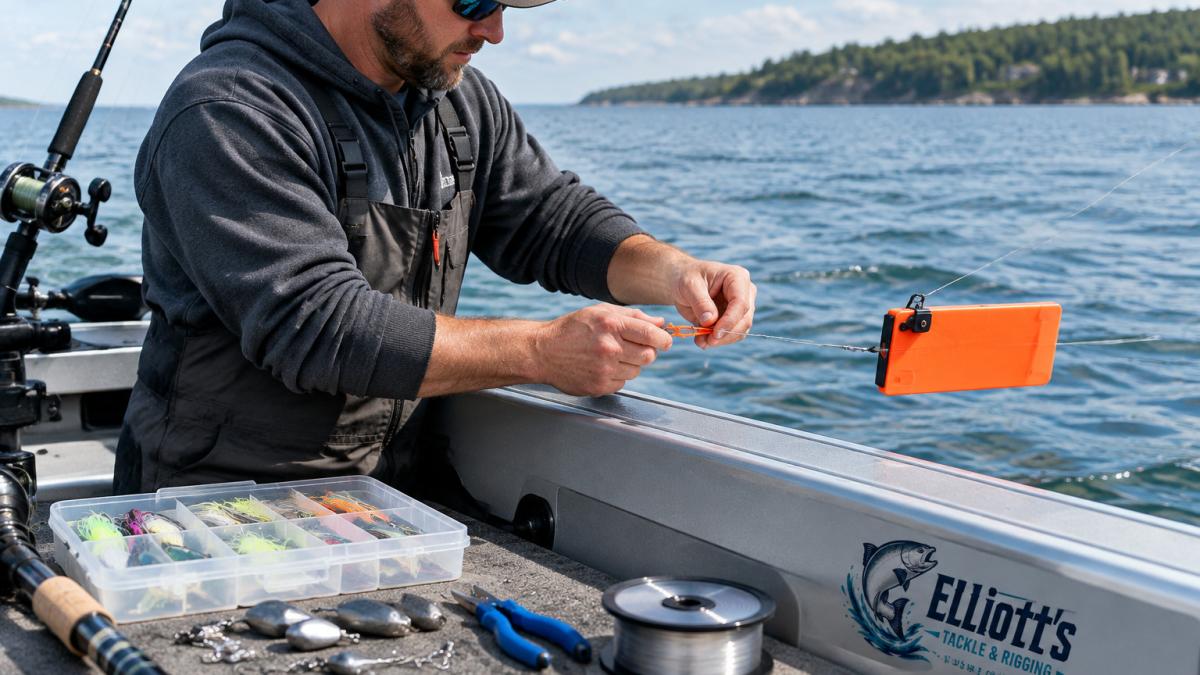
For a four-board spread, run two boards per side. On each side, set the inside board shorter and the outside board longer. A typical layout is inside board at 30 to 40 feet, outside board at 60 to 80 feet. This creates a staggered pattern that reduces tangles and lets you cover more water. For a six-board spread, add a third board per side at 90 to 110 feet, again keeping the longest line on the outside.
Attach each board to its line with a release clip. The Scotty Power Grip Plus Planer Board Release, priced at $7.99 at https://www.elliottstackleandrigging.com/products/scotty-power-grip-plus-planer-board-release-1177, holds the line with soft pads and is adjusted by positioning the line in the jaws. Set the tension so the line holds during trolling but frees easily when a walleye hits. A clip that is too tight will drag the board under when a fish strikes; too loose and the board will release on its own in waves.
Tangle prevention comes down to consistency. Keep your lines at roughly equal length within each lane, check that each release clip is seated properly, and make sure boards are not running into each other on turns. We recommend reviewing your spread after every turn, especially in crosswinds. When you turn, the inside boards slow down and the outside boards speed up. If your lines are not staggered, the inside board can cross the outside line.
Retrieval order matters too. When a fish hits an outside board, reel that board in first while the inside boards stay out. If you reel in an inside board first, you risk crossing lines with the outside board still under tension. Some trollers retrieve from the outside in, then reset from the inside out.
Troubleshooting board behavior is part of setup. A board that dives usually has too much weight or too small a board for the speed. A board that rides poorly may have a fouled clip or a line that is not seated in the release. A board that pulls inward is often running too close to the boat or another board.
When you need extra spread from your reel, the Cisco Extended Line Guide at $76.99 (https://www.elliottstackleandrigging.com/products/cisco-extended-line-guide) pushes your line farther outboard without new hardware. This is useful when you want to run a wider spread without adding boards or changing your mast setup.
Watch out: if your boards are set too close together, the lines will cross and you will lose more time than you save. Space them so each line has a clear lane and check your spread after every turn.
Here is a quick reference for the spread layouts covered in the setup guide.
| Spread size | Boards per side | Typical board distances |
|---|---|---|
| Two boards | One per side | 40-60 ft and 60-80 ft |
| Four boards | Two per side | Inside 30-40 ft, outside 60-80 ft |
| Six boards | Three per side | Add a third board at 90-110 ft |
50-2 Method Trolling: Running Boards Over a Deep Spread
The 50-2 method generally refers to running a weighted line roughly 50 feet back with boards to keep the spread wide, which can help reach deeper water.
Pair this method with a board that tracks well at the depth you need. The key is to balance the weight, line length, and board size so the lure runs where the fish are without fouling the spread. Expect to adjust more than once on a given day as fish move.
The 50-2 method can be useful in mid-summer when walleye move deeper. Plan your rod and board setup before you start trolling so you are not making changes while fish are biting.
Cisco Fishing Systems Electric and Manual Planer Mast →
Planer Board Release and Mast Gear Picks From Elliott's Tackle & Rigging
Here is what we recommend from our own shelves, organized by how you fish.
For inline boards, the Scotty Mini PowerGrip Plus Planer Board Release comes in a 4-pack at $15.99 (https://www.elliottstackleandrigging.com/products/scotty-mini-powergrip-plus-planer-board-release-4-pack-1182). It is a good starting point for anglers testing their first spread. The 40-pack of Scotty Power Grip Plus releases at $239.99 (https://www.elliottstackleandrigging.com/products/scotty-power-grip-plus-board-release-40-pack-1177-bucket).
For mast setups, the Cisco Electric Planer Board Reel at $444.99 (https://www.elliottstackleandrigging.com/products/cisco-electric-planer-board-reel) handles heavy line and reliable retrieval. If you prefer manual control, the Cisco Manual Planer Board Reel at $327.99 (https://www.elliottstackleandrigging.com/products/cisco-manual-planer-board-reel) offers the same solid build without the motor.


For the rod in your hand, the Ice Strong Outdoors Manasseh AP7 Trolling Rod at $99.99 (https://www.elliottstackleandrigging.com/products/ice-strong-outdoors-manasseh-ap7-trolling-rod-downrigger-walleye-small-planer) is listed for downrigger applications and trolling small or walleye planer boards.
Watch out: mixing release clips rated for different line weights can cause early releases or missed strikes. Match your clips to your line.
Start Building Your Walleye Spread With the Right Planer Gear
Building a spread is a process. Start with two boards, learn how they track at your normal speed, then add lines as you get comfortable. Each addition should have a clear lane and a clear reason.
Equipment matters, but so does how you use it. We recommend checking your releases, boards, and lines before every trip and keeping spare clips in your tackle box. Consistent gear and a repeatable setup make it easier to read what the fish are telling you.
Browse the full range of planer boards, masts, releases, and rods at https://www.elliottstackleandrigging.com/ and build your spread around gear we would run on our own boats.
Frequently Asked Questions
What is the best planer board for walleye fishing?
For most Great Lakes walleye trolling, inline boards paired with a release and a reel suited to your line can work well. Elliott's Tackle & Rigging stocks Cisco Fishing Systems planer mast and reel options, including the Cisco Electric Planer Board Reel at $444.99 and the Manual Planer Board Reel at $327.99, which are listed with line capacities for different line weights. Choose a board size that tracks well at your target speed, and match the release to your line weight so hookups are clean and repeatable.
How fast should you troll with planer boards?
Walleye trolling with planer boards is often done at slower speeds, where lures can track cleanly without the boards skating or flipping. Watch the boards at the start of each pass. If they lean hard, slow down; if they sit flat and lose their wake, speed up slightly. Lure choice and depth change the ideal speed, so adjust in small increments and note what the fish respond to that day.
How far behind the boat should planer boards run?
Run boards far enough out to clear the boat's wake and keep your lines out of the prop wash, which usually means spreading them well to the side and back. The Cisco Single Planer Pulley with Clamps, available at $95.99, is a rail-mounted pulley for planer board lines. Check each board after a few minutes of trolling to confirm it is tracking, not dragging the rail.
How do you prevent tangles when trolling with planer boards?
Keep line lengths consistent, release boards in the same order every time, and avoid letting lines cross when you deploy or retrieve. A Scotty Power Grip Plus Planer Board Release, priced at $7.99, uses soft pads to grip the line, with release tension adjusted by line position in the jaws. Retrieve in a set sequence and inspect each line for twist before you put the spread back in the water.

0 comments