

Table of Contents
- Garmin vs Humminbird for Saltwater 2026: Overview and Key Differences
- Feature Comparison Table: Garmin and Humminbird Saltwater Models
- Imaging Quality Comparison: Garmin LiveScope vs Humminbird MEGA Imaging
- Best Saltwater Fish Finder 2026: Selecting the Right Transducer
- Saltwater Signal Reliability and Interference Mitigation
- User Interface and Ease of Navigation
- Mapping, GPS Accuracy, and Nautical Charts
- Ecosystem Integration: Minn Kota, Autopilot, and Networking
Garmin vs Humminbird for Saltwater 2026: Complete Comparison
Last Updated: July 29, 2026
When choosing between fish finders for saltwater applications, the decision between Garmin vs Humminbird for saltwater 2026 comes down to imaging clarity, ecosystem integration, and real-world reliability in harsh marine conditions. At Elliott's Tackle & Rigging, we've spent decades testing marine electronics on the water, and we understand that saltwater fishing demands specialized hardware designed to withstand corrosion, signal interference, and unpredictable offshore environments. Both brands deliver exceptional performance, but they approach the problem differently.
The choice isn't simply about features on paper. It's about which system handles the specific challenges of saltwater fishing: salt spray corrosion on transducers, signal degradation in dense saltwater, and integration with trolling motors and downriggers that serious anglers rely on. This guide breaks down exactly where each brand excels and where it falls short.
Feature Comparison Table: Garmin and Humminbird Saltwater Models
Feature |
Garmin ECHOMAP Ultra 2 |
Humminbird APEX Series |
Humminbird HELIX 5 CHIRP/GPS G3 |
Winner |
|---|---|---|---|---|
Display Size |
7-12 inches |
13-19 inches |
5 inches |
Humminbird (larger options) |
Imaging Technology |
ClearVü + SideVü |
MEGA Imaging+ |
Humminbird (most advanced) |
|
LiveScope Support |
Full |
Limited |
No |
Garmin |
Transducer Durability (Saltwater) |
Excellent |
Excellent |
Good |
Tie |
Networking (One-Boat Network) |
Via Minn Kota |
Native integration |
Limited |
Humminbird |
GPS Accuracy |
Multi-band |
Standard |
Standard |
Garmin |
Best For |
Anglers wanting live sonar |
Tournament anglers, networking |
Budget-conscious saltwater anglers |
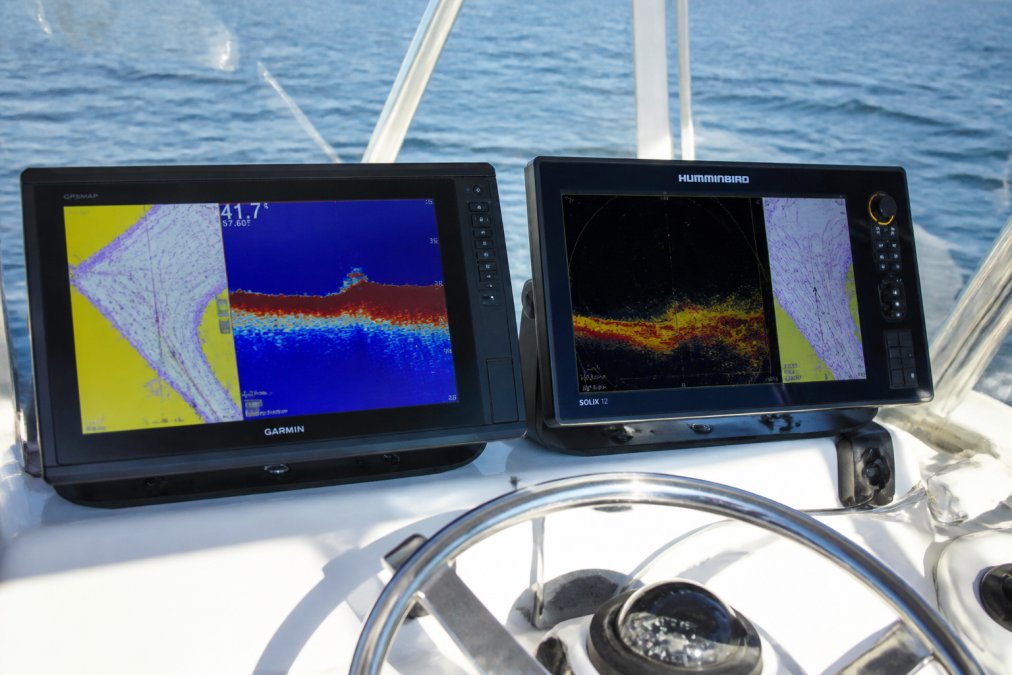
Humminbird offers larger, sharper full-HD displays and deeper ecosystem integration through the One-Boat Network, which connects seamlessly with Minn Kota trolling motors and Cannon downriggers. Garmin focuses on live sonar capability through LiveScope, which provides real-time underwater scanning that traditional sonar cannot match. For saltwater anglers, the question becomes: do you want the clearest static images of the bottom and structure, or do you want to see fish moving in real time?
Humminbird's MEGA Imaging technology produces sharper, more detailed images in saltwater environments because it uses higher-frequency sonar channels optimized for salt density. Garmin's approach prioritizes flexibility, you can add LiveScope later, which gives you options as your needs evolve.
Imaging Quality Comparison: Garmin LiveScope vs Humminbird MEGA Imaging
Imaging quality separates casual anglers from serious ones. In saltwater conditions, water density and mineral content create challenges that freshwater fish finders don't face. Garmin's LiveScope technology delivers real-time sonar showing fish movement as it happens, while Humminbird's MEGA Imaging+ produces photorealistic still images of underwater structure.
LiveScope scanning sonar transmits rapid pulses and displays results almost instantly. You see fish moving, baitfish fleeing, and structure details changing in real time. The advantage is obvious: you're watching live underwater footage. The limitation is that it requires a dedicated transducer (sold separately) and works best in depths under 200 feet. For nearshore saltwater fishing, LiveScope is transformative.
Humminbird's MEGA Imaging+ uses side and down imaging to create ultra-high-resolution pictures of the bottom, revealing bottom composition, vegetation, and fish with remarkable clarity. In saltwater, MEGA Imaging excels because higher-frequency channels cut through salt density better than traditional CHIRP sonar.
The practical difference: LiveScope is better for active presentations, you can watch a fish approach your lure and see if it strikes or turns away. MEGA Imaging is better for understanding structure and identifying productive zones before you cast.
Best Saltwater Fish Finder 2026: Selecting the Right Transducer
Choosing the best saltwater fish finder 2026 requires understanding that the display is only half the system, the transducer is where saltwater conditions hit hardest. A premium display paired with a corroded transducer becomes useless. Saltwater fishing demands transducers built for corrosion resistance, which means bronze or stainless steel construction and proper maintenance protocols.
Both Garmin and Humminbird offer saltwater-rated transducers. Garmin's GT56 transducer delivers excellent performance with titanium backing plates designed to resist salt corrosion. Humminbird's transducers use similar materials with frequency allocations optimized for their imaging processors.
For saltwater applications, frequency selection matters:
- 200 kHz (traditional CHIRP): Best for depths beyond 300 feet
- 455 kHz (medium frequency): Ideal for 50-300 feet, the sweet spot for most saltwater fishing
- 800+ kHz (high frequency): Exceptional detail in shallow water under 100 feet
Humminbird HELIX models support dual-frequency transducers that let you switch between frequencies based on depth, providing flexibility across different saltwater environments.
Transducer for Saltwater Fishing: Durability and Signal Reliability
A transducer for saltwater fishing must survive salt spray, temperature swings, and constant moisture exposure. Many anglers buy premium fish finders and see performance degrade within two seasons because they underestimated transducer maintenance.
Both Garmin and Humminbird transducers are rated for saltwater, but durability depends on installation and maintenance. A through-hull transducer mounted in stainless steel housing will outlast a transom-mounted transducer by years because it minimizes spray exposure and allows better drainage.
Signal reliability in saltwater is affected by water density, suspended particulates, thermal layers, and interference from other electronics. Humminbird's one-boat network reduces electromagnetic interference by integrating all electronics through a single backbone. Garmin's modular approach offers flexibility but requires more careful cable routing to minimize interference.
Saltwater Signal Reliability and Interference Mitigation
Signal reliability separates fish finders that work from those that frustrate you. Salt water conducts electricity better than freshwater, meaning your sonar signal travels farther but gets absorbed more quickly at depth.
Most interference comes from other boat electronics: VHF radios, GPS antennas, and autopilots all transmit signals that create noise on sonar displays. The solution is proper installation. Both brands provide detailed cabling guidelines, but many anglers skip them to save time.
Real-world saltwater interference mitigation requires three steps:
Step 1: Separate power sources. Run fish finder power from a dedicated battery circuit, not the main engine battery, to isolate sonar electronics from engine noise.
Step 2: Shield antenna cables. Use shielded coaxial cable for GPS and transducer connections, running them away from power cables with a 12-inch minimum separation.
Step 3: Ground properly. Both the fish finder and transducer need solid ground connections using marine-grade tinned copper wire connected directly to the boat's ground plane.
Humminbird's integrated networking reduces interference because all signals travel through a single backbone. Garmin's modular approach requires more careful installation but offers flexibility for future additions.
User Interface and Ease of Navigation
User interface separates fish finders you actually use from ones that frustrate you. Garmin uses touchscreen controls on most ECHOMAP models, which feels intuitive but can be problematic in rough water with accidental touches. Humminbird offers both touchscreen and keypad options, with HELIX models using hybrid control.
For saltwater fishing, keypad control has a real advantage: your hands are often wet, gloved, or occupied. A keypad doesn't respond to accidental contact the way a touchscreen does. This is why many charter captains prefer Humminbird HELIX models despite smaller screens, reliability matters more than screen real estate in heavy seas.
Navigation menus differ significantly. Garmin's interface is faster with instant processor response. Humminbird's interface is more intuitive, with menu structure mirroring how anglers think about fishing. Neither is objectively better; it depends on whether you value speed or logical organization.
The Humminbird HELIX 5 CHIRP/GPS Combo G3, available through Elliott's Tackle & Rigging, demonstrates this philosophy with a straightforward interface that gets beginners productive immediately. The [Humminbird XPLORE 10 Control Head Only](https://www.elliottstackleandrigging.com/products/humminbird-xplore-10-control-head-only-412010-1cho) scales up with a larger display while maintaining that same logical menu structure.


Mapping, GPS Accuracy, and Nautical Charts
Mapping quality determines whether your fish finder becomes a navigation tool or just a sonar display. Garmin uses Navionics+ mapping with detailed bathymetry and daily updates. For saltwater fishing, Navionics+ is exceptional, showing depth contours, structure, and known fishing spots. The subscription model means annual update fees but comprehensive coverage.
Humminbird uses its own Basemap covering over 10,000 lakes and US coastlines, included with no subscription fee. Basemap updates less frequently than Navionics+, but Humminbird's AutoChart Live feature lets you create your own depth contours in real time as you fish.
For saltwater fishing, GPS accuracy matters less than in freshwater when navigating open water. However, when marking waypoints on reefs or wreck structures, accuracy becomes critical. Garmin's multi-band GPS locks onto satellites faster and maintains accuracy in challenging conditions. Humminbird's standard GPS is adequate for most saltwater applications but can take longer to acquire initial lock.
If you fish the same saltwater areas repeatedly, Humminbird's AutoChart Live builds better maps over time. If you travel to new saltwater destinations, Garmin's Navionics+ gives you detailed maps immediately.
Ecosystem Integration: Minn Kota, Autopilot, and Networking
Ecosystem integration separates single-display fish finders from complete boat control systems. Humminbird's One-Boat Network integrates Minn Kota trolling motors, Cannon downriggers, and compatible autopilot systems into a single network. You control trolling motor speed and direction from the fish finder display and manage downrigger depth from the same screen.
Garmin integrates with Minn Kota Force trolling motors and some autopilot systems, but the integration is less seamless. The experience feels like separate systems talking to each other rather than a unified platform.
For serious saltwater anglers, this difference matters. When marking a productive depth and wanting to set your downrigger to that exact depth, Humminbird's integration lets you do it without looking away from the display. With Garmin, you're switching between systems.
Garmin's modular approach offers flexibility for upgrading individual components without replacing the entire system. Humminbird's integrated approach means everything works together perfectly, but replacing one component sometimes requires updating others.
For anglers running multiple downriggers or targeting structure-specific saltwater species (halibut, rockfish, lingcod), Humminbird's ecosystem integration delivers measurable advantages by reducing equipment management time.
Corrosion Resistance and Saltwater-Specific Hardware
Corrosion resistance is where saltwater fish finders succeed or fail over time. A fish finder rated for saltwater doesn't mean it won't corrode, it means the manufacturer has designed components to resist corrosion longer than non-rated models.
Garmin's saltwater models use titanium backing plates on transducers and stainless steel through-hull fittings. Displays use sealed connectors and conformal coating on circuit boards to resist salt spray. Humminbird uses similar materials with bronze and stainless steel on transducers and sealed connectors on displays. The difference is subtle: Humminbird's connector design allows slightly better drainage, reducing moisture buildup inside cable connections.
In practice, both brands hold up well in saltwater if maintained properly. The real protection comes from diligent maintenance: rinse your transducer with fresh water after every saltwater trip, apply dielectric grease to all connectors monthly, and store the boat with ventilation to reduce moisture buildup.
Choosing between Garmin vs Humminbird for saltwater 2026 ultimately depends on your fishing style and what you value most. If you want the clearest underwater images and seamless integration with trolling motors and downriggers, Humminbird delivers. If you want real-time sonar capability and lightning-fast touchscreen response, Garmin excels. Both brands build fish finders that survive saltwater environments when properly installed and maintained.
Elliott's Tackle & Rigging stocks both Humminbird and Garmin units, hand-selected by a captain with forty years of saltwater fishing experience. We've tested these systems on the water and stand behind every unit we sell. Browse our marine electronics selection and get your system installed right, because the best fish finder is the one you maintain properly and use confidently.
Frequently Asked Questions
Which Garmin vs Humminbird fish finder is best for saltwater fishing in 2026?
The best choice depends on your budget and priorities. Garmin's ECHOMAP Ultra 2 Series ($2,099.99+) excels with LiveScope live-scanning sonar and Navionics+ mapping, ideal for anglers wanting real-time underwater views. Humminbird's APEX Series ($3,699.99+) leads in MEGA Imaging+ clarity and One-Boat Network integration with Minn Kota trolling motors. For budget-conscious saltwater anglers, the Humminbird HELIX 5 CHIRP/GPS Combo G3 ($320.08) offers solid Dual Spectrum CHIRP sonar and GPS at entry-level pricing. Choose Garmin if LiveScope live sonar is essential; choose Humminbird if MEGA Imaging and Minn Kota integration matter most.
What are the key differences between Garmin LiveScope and Humminbird MEGA Imaging for saltwater?
Garmin LiveScope provides real-time, live-scanning sonar that shows fish movement as it happens—ideal for sight-fishing and structure location. It requires separate transducer purchase and integration. Humminbird MEGA Imaging+ delivers ultra-high-definition side and down imaging with exceptional clarity and target separation, built into most APEX and higher-end HELIX models. LiveScope excels for dynamic, real-time views; MEGA Imaging excels for detailed underwater photography-like images. Both handle saltwater density and signal challenges, but LiveScope is more reactive while MEGA Imaging is more detailed.
How do Garmin and Humminbird compare in saltwater durability and corrosion resistance?
Both brands engineer saltwater-specific hardware with corrosion-resistant materials and sealed connectors. Humminbird's APEX and HELIX series include stainless-steel hardware and conformal coating on circuit boards to resist salt spray. Garmin's ECHOMAP Ultra 2 uses similar protective measures with reinforced connector housings. The critical factor is maintenance: rinse your transducer and connectors with fresh water after each saltwater outing, inspect cable seals quarterly, and apply dielectric grease to connector terminals annually. Firmware updates from both manufacturers address signal interference issues common in saltwater environments, so keep your unit current.
What transducer should I choose for saltwater fishing with Garmin or Humminbird?
For saltwater, prioritize transducers rated for saltwater density and corrosion resistance. Garmin's GT56 transducer (included on select ECHOMAP Ultra 2 models) offers excellent saltwater performance with ClearVü and SideVü sonar. Humminbird's MEGA Imaging transducers are integrated into most units and deliver superior clarity in saltwater. Choose a transducer with CHIRP sonar frequency matched to your target species—typically 50/200 kHz for saltwater. Ensure the transducer housing is stainless steel or marine-grade aluminum, and verify it's rated for your boat's hull material (fiberglass, aluminum, wood). Fresh-water rinse after each use extends transducer life significantly.
Do Garmin and Humminbird offer better GPS lock and waypoint accuracy for saltwater navigation?
Both brands deliver excellent saltwater GPS performance. Garmin's ECHOMAP Ultra 2 uses multi-band GPS for improved position accuracy and faster GPS lock, especially valuable in offshore conditions. Humminbird's HELIX and APEX series also feature multi-band GPS with rapid waypoint marking and route storage. Garmin's Navionics+ charts update daily with depth contours and hazards; Humminbird's Basemap covers 10,000+ US lakes and coastlines with AutoChart Live for real-time bottom mapping. For saltwater navigation, both handle waypoint storage (typically 1,000+), route creation, and chart overlay seamlessly. Choose based on your preferred chart provider: Navionics+ (Garmin) or Humminbird Basemap (Humminbird).
0 comments