

Table of Contents
- Using Downriggers for Halibut: A Complete Setup Guide
- Can You Use Downriggers for Halibut?
- Downrigger Setup Configurations for Halibut
- Halibut Trolling Rigs and Terminal Tackle
- Trolling Speed for Halibut and Depth Control
- Downrigger Release Clips for Heavy Fish
- Managing Line Tangles and Preventing Common Failures
- Equipment Maintenance for Saltwater Conditions
- Frequently Asked Questions
Last Updated: September 28, 2026
Using Downriggers for Halibut: A Complete Setup Guide
Downriggers are one of the most effective tools for targeting halibut in saltwater conditions across the Pacific Northwest, Great Lakes, and East Coast. They allow precise depth control while trolling, critical because halibut hold at specific depths depending on water temperature and forage availability.
Downriggers let you present bait or lure at the exact depth where halibut feed without excessive main-line weight, resulting in better lure action, fewer tangles, and solid hooksets.
Can You Use Downriggers for Halibut?
Downriggers work exceptionally well for halibut because these fish are depth-specific hunters that stay close to the bottom or suspend at consistent depths based on bait concentration and water temperature, dramatically increasing your strike rate.
The primary benefit is separation of weight from your main line. The downrigger cable carries the weight while your main line remains light and free-swimming, producing more natural bait presentation. When a halibut hits, your line releases from the downrigger weight, so you fight the fish on your rod and reel alone.
Downrigger Setup Configurations for Halibut
Most halibut anglers use electric downriggers because they handle the heavy weights required for deep-water trolling and allow quick depth adjustments throughout the day.
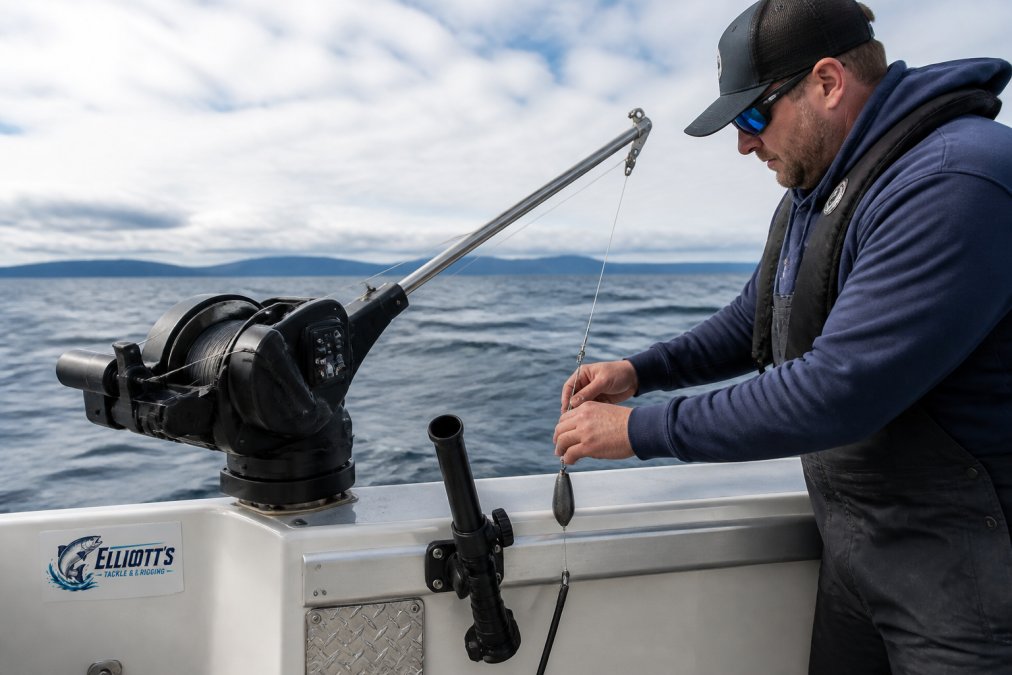
Choosing the Right Downrigger Model
For halibut depths of 150 to 300 feet, an electric downrigger is essential. The Scotty 1106 Depthpower 60" Telescoping Electric Downrigger is a popular choice, featuring a telescoping boom (36 to 60 inches), 250-foot stainless steel cable, and 235 ft./min. lift speed, critical when constantly adjusting depths to track halibut.

The Scotty 2116 HP Depthpower Electric Downrigger with Dual Rod Holders lifts 20-pound weights at 260 ft./min. and allows fishing two lines from a single downrigger, maximizing coverage.

Prioritize electric motors with fast descent/ascent speeds, stainless steel booms and cables, digital depth counters, rod holder mounting systems, and release clips rated for your weights.
Cable, Weight, and Release Clip Selection
Most halibut anglers use 10 to 20-pound weights on downrigger cables, depending on current speed. Heavier weights reach bottom faster and hold depth more reliably in strong current.
The downrigger cable must be marine-grade stainless steel (150 to 180-pound test) to handle shock loads from heavy weights and large halibut.
Release clips must hold your main line securely during trolling but release cleanly when a halibut strikes. Release clips must hold your main line securely during trolling but release cleanly when a halibut strikes.
Halibut Trolling Rigs and Terminal Tackle
Your terminal tackle, the spreader bars, dodgers, sinker slides, and bait presentation system, is where halibut trolling gets specific. These components determine whether your bait or lure looks natural and attractive to feeding halibut.
Scotty 1101 Depthpower 30" Electric →
Spreader Bars and Dodgers
Your terminal tackle, the sinker slides, and bait presentation system, is where halibut trolling gets specific. These components determine whether your bait or lure looks natural and attractive to feeding halibut.
Bait and Lure Presentation
The leader connecting your bait or lure should be 18 to 36 inches of 30 to 50-pound monofilament or fluorocarbon. A longer leader gives your bait more freedom to move naturally. The leader material should be strong enough to handle halibut's aggressive head shakes during the fight.
Trolling Speed for Halibut and Depth Control
Halibut respond best to trolling speeds between 1.5 and 3 knots. Slower speeds (1.5 to 2 knots) work well when bait is abundant and halibut are aggressive. Faster speeds (2.5 to 3 knots) cover more water and can trigger strikes from competitive fish.
Finding the Right Depth Window
Halibut depth preferences shift with season and water temperature. In spring and early summer, halibut move shallower as water warms and baitfish migrate. In midsummer, they drop to deeper, cooler zones. Fall brings them back to mid-range depths as forage moves again.
Use a depth sounder or fish finder to identify the bottom structure and any suspended fish. Halibut typically hold 10 to 30 feet above the seafloor, especially when bait is present. If your depth sounder shows bottom at 200 feet, start your trolling runs at 170 to 180 feet and adjust based on strike activity.
Depth control strategy:
- Identify bottom depth with your fish finder
- Set initial downrigger depth 20-30 feet above bottom
- Adjust up or down based on strikes
- Make passes at consistent depths to identify productive zones
- Mark GPS waypoints where you get bites
Managing Current and Tide
Current speed and tide direction dramatically affect halibut presentation and downrigger performance. Strong current pushes your rig sideways and can cause line tangles, especially when running multiple downriggers. Weak current allows your bait to settle more naturally.
During flood tide (rising water), halibut often move shallower and become more aggressive feeders. During ebb tide (falling water), they may move deeper or become less active. Plan your trolling runs to align with tide direction whenever possible. Trolling into the current keeps your bait in the strike zone longer and maintains better depth control.
Current speed also affects the weight you need on your downrigger. In strong current (over 1.5 knots), increase your weight by 5 to 10 pounds to maintain depth. In slack current, lighter weights work fine.
Downrigger Release Clips for Heavy Fish
A quality release clip is non-negotiable for halibut fishing. The clip must hold your main line securely during trolling but release instantly when a halibut strikes. Improper clip tension costs fish.
Adjusting Tension for Halibut Weight
Halibut are powerful, head-shaking fighters. A release clip set too loose drops your line in current or from turbulence. Set too tight, and the clip doesn't release when the fish bites, resulting in a missed hookset.
A quality release clip is non-negotiable for halibut fishing. The clip must hold your main line securely during trolling but release instantly when a halibut strikes. Improper clip tension costs fish.
Scotty 1101 Depthpower 30" Electric →
A properly tuned release clip means solid hooksets and fewer lost fish. Check your clip tension before every fishing day because temperature changes and salt corrosion can affect how the clip grips your line.
Managing Line Tangles and Preventing Common Failures
Line tangles are the enemy of productive halibut trolling. Tangled lines mean lost fishing time and missed opportunities. Most tangles occur when downrigger lines cross, when release clips slip, or when you're running too many lines too close together.
Back Trolling and Drift Fishing Techniques
Drift fishing works well when you want to cover large areas without running the engine. Drop your downrigger to bottom, disengage the motor, and let current drift your boat. This approach is quieter and allows halibut to feed more confidently. Drift fishing works best in moderate current (0.5 to 1.5 knots) where you maintain control.
Troubleshooting Equipment Issues
Common downrigger failures include:
- Cable fraying or breaking: Inspect cable regularly for corrosion or damage. Replace cable every 2-3 seasons in saltwater.
- Depth counter malfunction: Verify the counter reads zero when the weight is at the surface. If it drifts, recalibrate per the manufacturer's instructions.
- Release clip sticking: Salt buildup causes clips to stick. Rinse thoroughly after each use and apply a light lubricant.
- Motor running slow: Check battery voltage and amperage draw. Low battery voltage reduces descent speed.
- Rod holder loosening: Tighten rod holder bolts before each trip. Vibration causes them to loosen over time.
Equipment Maintenance for Saltwater Conditions
Saltwater is brutal on fishing gear. Downriggers, cables, clips, and rod holders need regular maintenance to perform reliably and last for years.
After each saltwater fishing trip:
- Rinse the entire downrigger system with fresh water
- Pay special attention to cable, boom joints, and release clip
- Dry thoroughly to prevent salt crystallization
- Apply a light corrosion inhibitor spray to stainless steel surfaces
Monthly maintenance:
- Inspect cable for fraying, kinks, or corrosion
- Check all bolts and fasteners for tightness
- Test release clip tension
- Verify depth counter accuracy
- Clean and lubricate rod holder pivot points
Seasonal maintenance (every 3-4 months):
- Replace cable if showing significant corrosion
- Inspect boom for cracks or bending
- Test motor amperage draw and descent speed
- Replace any corroded fasteners with stainless steel replacements
Frequently Asked Questions
How deep should you set your downrigger for halibut?
Halibut depth varies by season and location. In Pacific Northwest waters, target 80-150 feet during summer months; in deeper channels, fish 200-300 feet. Use a depth sounder to locate the bottom, then position your downrigger weights 10-20 feet above it. Start shallow and work deeper until you find active fish. Tide cycles and current speed affect optimal depth, so adjust as conditions change throughout the day.
What is the best rig for halibut fishing with downriggers?
A halibut trolling rig typically includes a 3-4 foot leader with a sinker slide and bait. Match your terminal tackle weight to your downrigger cable capacity and target depth.
Can you use downriggers for halibut in shallow water?
Yes, downriggers work in shallow water, but they're most effective in depths beyond 60 feet where halibut congregate on bottom structure. In shallower areas, bottom bounce or drift fishing may be more practical. If using downriggers in shallow water, set your release clip tension light and monitor line tension closely to avoid snagging. Always use a fish finder to confirm water depth and bottom composition before deploying downrigger weights.
What is the most effective way to fish for halibut?
Combine downrigger trolling with knowledge of halibut behavior. Fish during slack tide or slow current when halibut are most active. Maintain steady trolling speed and monitor your depth sounder constantly. Set your drag properly and keep line tension consistent to detect subtle bites and ensure solid hook sets on heavy fish.
0 comments