

Table of Contents
- Understanding Downrigger Weight Calculations
- The 100-Foot Rule and Cable Angle Basics
- Downrigger Blowback Chart: How Drag Affects Your Depth
- Trolling Speed and Depth Relationship
- Best Downrigger Weights for Salmon Fishing
- Environmental Variables and Depth Adjustments
- Equipment Maintenance and Weight Performance
- Frequently Asked Questions
Last Updated: September 27, 2026
Understanding Downrigger Weight Calculations
Downrigger weight calculations form the foundation of effective trolling. Get this wrong, and your lure sits too shallow or too deep. Get it right, and you're in the strike zone consistently.
Heavier weights pull deeper faster, but matching weight to conditions, water temperature, trolling speed, cable angle, and lure drag, determines your actual fishing depth.
Professional anglers calculate depth rather than guess. This guide covers the math and practical adjustments for consistent strike-zone positioning.
The 100-Foot Rule and Cable Angle Basics
The "100-foot rule", roughly 30 feet of depth per 100 feet of cable, assumes a vertical cable, which never occurs in real trolling.
Cable angle reduces actual depth significantly. A 45-degree angle cuts vertical depth by roughly 30 percent compared to a vertical cable.
Calculate true depth by multiplying cable length by the cosine of your cable angle, the difference between targeting salmon at 60 feet versus accidentally fishing at 40 feet.
Warm water pushes salmon deeper to find cooler layers; cold spring water allows shallower fishing. Adjust target depth based on seasonal patterns and sonar.
Downrigger Blowback Chart: How Drag Affects Your Depth
Blowback, the backward angle your cable takes while trolling, is caused by water resistance and directly affects your presentation depth. It's determined by trolling speed, weight, water density, current, lure drag, and equipment condition.
What Causes Blowback
Faster trolling increases blowback angle. Heavy, streamlined weights resist blowback better than light or ball-shaped weights.
Saltwater is roughly 2.5 percent denser than freshwater, creating greater drag force on your weight. The same weight-and-speed combination produces different blowback angles in Pacific Northwest saltwater versus Great Lakes freshwater.
Current increases relative water velocity around your cable. A 2 mph current plus 5 mph trolling speed creates 7 mph effective velocity. East Coast and Gulf of America anglers account for current when setting depth; ignoring it shifts actual depth by 10-20 feet.
Large spoons and flashers create substantial drag, increasing blowback; small shad imitations create minimal drag. Charter captains use identical lure sizes on multiple downriggers for consistent blowback and predictable depth management.
Frayed or kinked cable, corroded weights, and bent weights all increase drag and shift actual depth from calculated depth. Inspect equipment before each trip.
Reading and Adjusting Blowback Charts for Real Conditions
Standard blowback charts show trolling speed, weight, and cable angle under baseline conditions (freshwater, no current, clean equipment, standard lure).
Here's how to use one and then adjust for your actual conditions:
Step 1: Find baseline angle. Locate trolling speed and weight on the chart; read the resulting cable angle (e.g., 5 mph with 10 lbs = 35°).
Step 2: Adjust for water density. Saltwater increases blowback angle by 2-3 degrees.
Step 3: Adjust for current. Add current speed to trolling speed for effective water velocity (e.g., 5 mph trolling + 1.5 mph current = use 6.5 mph chart value).
Salmon Cannonball Weights 2lb Lead →
Step 4: Adjust for lure drag. Large spoon combos add 3-5°; small shad subtract 2-3°.
Step 5: Adjust for equipment condition. Kinked, corroded, or bent equipment adds 2-4°.
Step 6: Calculate true vertical depth. Multiply cable length by cosine of adjusted angle. Example: 5 mph, 10 lbs, saltwater, 1.5 mph current, medium spoon = 35° + 2° + 2° + 3° = 42°. With 150 feet cable: 150 × cos(42°) = 111 feet vertical depth.
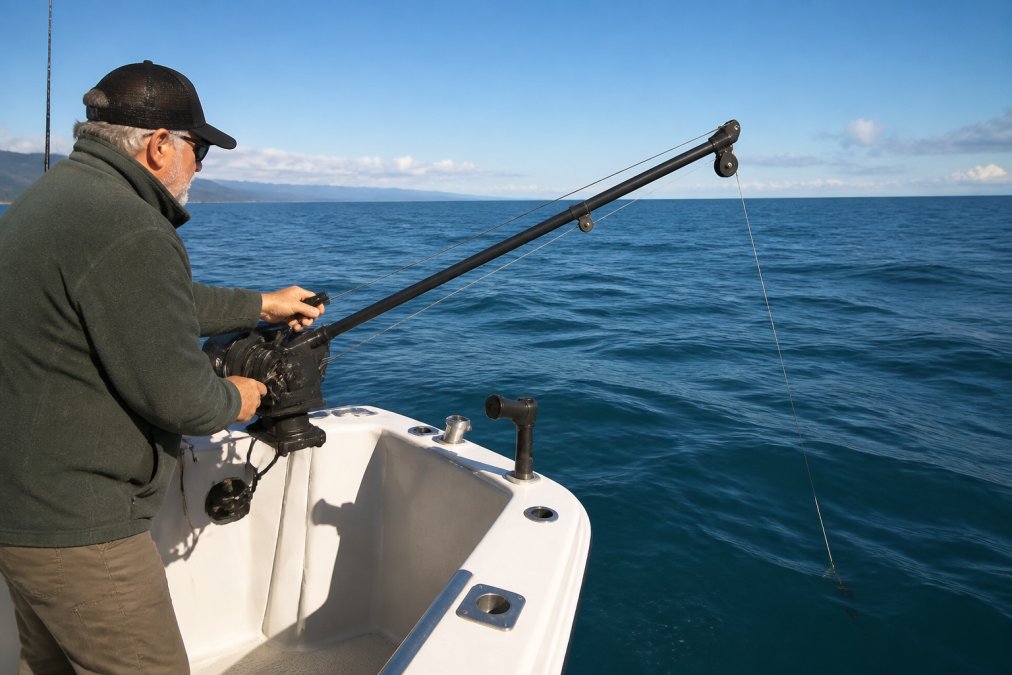
Practical Blowback Management
The Scotty electric downriggers from Elliott's Tackle & Rigging feature precise speed control and stainless steel construction that resists corrosion, reducing equipment-induced drag and making depth calculations more reliable.

Log trolling speed, weight, current, lure type, and observed cable angle. Build a personal blowback reference for your equipment and local waters.
Trolling Speed and Depth Relationship
Faster trolling increases blowback and reduces vertical depth; slower trolling decreases blowback and increases vertical depth.
This relationship is non-linear: small speed increases at low speeds create modest blowback changes, but higher-speed increases create dramatic changes.
Salmon anglers typically troll 3-6 mph. At 3 mph with 10 lbs, blowback is roughly 20°; at 6 mph, it reaches 40°+, a significant depth difference.
Trolling speed affects lure action. Balance lure performance with depth control by staying within optimal speed ranges.
The Scotty electric downriggers from Elliott's Tackle & Rigging offer precise speed control and adjustable descent speeds for simultaneous depth and lure-action optimization.
Best Downrigger Weights for Salmon Fishing
Weight selection depends on target depth, trolling speed, and water conditions, there is no universal best weight.
Weight Selection by Target Species
King salmon hold 80-120 feet deep in summer (Pacific Northwest and Great Lakes); use 12-15 lb weights.
Coho feed 30-80 feet deep; use 8-10 lb weights.
Sockeye school 20-40 feet deep; use 5-8 lb weights for sensitivity and water coverage.
Halibut fishing (East Coast and Gulf of America) requires 15-20 lb weights for bottom structure.
Start with a weight matching your target depth and trolling speed, then adjust based on sonar. Go lighter if overshooting; heavier if undershooting.
Braided Line vs. Steel Cable Performance
Stainless steel cable is the industry standard: durable, corrosion-resistant in saltwater, and reliable for depth control.
Salmon Cannonball Weights 2lb Lead →
Braided line is lighter and creates less drag, reducing blowback, useful for shallow-water and precision-presentation fishing.
Steel cable is stronger and more durable, justifying its weight penalty for heavy-use situations and charter operations.
The Scotty 1106 Depthpower from Elliott's Tackle & Rigging comes pre-spooled with 250 feet of 150 lb. test stainless steel cable, balancing durability and performance.
The Salmon Cannonball Weights from Elliott's Tackle & Rigging drop straight, prevent snagging, and work well for salmon and halibut fishing.

Environmental Variables and Depth Adjustments
Water temperature is the primary environmental variable affecting fish depth. Use it to adjust your downrigger setup before leaving the dock.
Water Temperature and Seasonal Depth Shifts
Cold water distributes oxygen throughout the column, spreading fish vertically. Warm water concentrates oxygen near the surface or in deep cool layers, concentrating fish at specific depths.
Spring/early summer (40-50°F): salmon feed 20-40 feet. Mid-summer (55-65°F): fish 80-120 feet. Late summer/fall (65-70°F): salmon drop to 120-160 feet for 50-55°F water.
Adjust weight selection by water temperature: 45°F use 6-8 lbs (shallower); 65°F use 12-15 lbs (deeper). Check temperature with a thermometer or sonar before deploying.
Seasonal Spawning Runs and Migration Patterns
Spawning runs push salmon to 15-40 feet near river mouths. Post-spawn fish move deeper. Adjust depth strategy accordingly.
Pacific Northwest: king salmon spawn July-September, coho August-October.
Current Speed and Its Effect on Blowback and Fish Location
Current affects fish location and downrigger performance. Strong current pushes fish to channel edges or structure; slack areas hold fish at various depths. Current increases blowback.
Light Penetration and Cloud Cover
Bright sunny days push salmon deeper; overcast days allow shallower feeding. Early morning and late evening produce shallower depths than midday.
Integration: Building a Pre-Trip Adjustment Checklist
Before you deploy your downriggers, gather these environmental data points:
- Water temperature (check with thermometer or sonar): Determines baseline depth range for your target species.
- Current speed (check tide tables or local reports): Increases blowback; adjust weight upward by 1-2 pounds if current exceeds 1.5 mph.
- Season and spawning window (check state fisheries reports): Spawning fish are 20-30 feet shallower than summer holding depths.
- Cloud cover and wind (observe conditions): Bright, calm conditions push fish deeper; overcast, rough conditions allow shallower fishing.
- Water salinity (saltwater vs. freshwater): Saltwater increases blowback by 2-3 degrees; adjust weight or target depth accordingly.
Equipment Maintenance and Weight Performance
Downrigger weights perform consistently only when your equipment is maintained properly. Corroded weights create drag and affect blowback calculations. Bent weights don't drop straight, creating inconsistent depth control.
Frequently Asked Questions
How heavy should my downrigger weight be for salmon fishing?
Weight selection depends on trolling speed, target depth, and water conditions. For salmon at 40-80 feet, 2-4 lb weights work in most conditions. Faster speeds (3-4 knots) require heavier weights to maintain depth; slower speeds (1.5-2 knots) need lighter weights. The best downrigger weights for salmon fishing balance your desired depth, cable angle, and blowback tolerance. Start with a 2 lb weight like Elliott's Tackle & Rigging Salmon Cannonball Weights and adjust based on your sonar readings and depth counter feedback.
What is the 100-foot rule for downrigger blowback?
The 100-foot rule estimates that for every 100 feet of cable deployed, you'll lose approximately 5-10 feet of actual depth due to blowback (the angle the cable pulls back from vertical). This loss increases with trolling speed and heavier weight drag. At 2 knots, blowback is minimal; at 3-4 knots, expect 8-15% depth loss. Use a downrigger blowback chart specific to your weight and speed to calculate true vertical depth and adjust your weight accordingly.
How does trolling speed affect downrigger weight requirements?
Trolling speed directly impacts the drag coefficient on your weight and cable. Slower speeds (1-2 knots) allow lighter weights to maintain depth; faster speeds (3-5 knots) increase water resistance and require heavier weights to reach the same depth. The trolling speed and depth relationship is not linear, doubling your speed more than doubles the drag force. Always verify your actual depth with sonar when changing speed, as blowback increases significantly above 3 knots.
What is the difference between cable depth and actual vertical depth?
Cable depth is what your downrigger counter reads, the length of cable deployed. Actual vertical depth is how far below the boat your weight truly sits. Blowback causes the cable to angle backward, reducing vertical depth by 5-20% depending on speed and weight. For example, 100 feet of cable at 3 knots might only put your weight 85-90 feet below the surface. Always use a downrigger blowback chart and sonar confirmation to know your true fishing depth, not just cable length.
0 comments