

Table of Contents
- Best Halibut Fishing Tackle 2026: What Separates Winners from the Rest
- Halibut Fishing Rods: Heavy Action vs. Sensitivity Trade-offs
- Halibut Fishing Reels: Conventional vs. Spinning for 2026
- Halibut Fishing Lures: Metal Jigs, Soft Plastics, and Swimbaits
- Halibut Fishing Rigs: Drop-Shot, Leaders, and Terminal Tackle Essentials
- Bait vs. Lure Fishing: Which Strategy Wins in 2026
- Budget vs. Pro-Level Halibut Tackle Setups
- Maintenance and Longevity: Making Your Best Halibut Fishing Tackle Last
Best Halibut Fishing Tackle 2026: Rods, Reels & Rigs
Last Updated: July 24, 2026
Best Halibut Fishing Tackle 2026: What Separates Winners from the Rest
Finding the best halibut fishing tackle 2026 means understanding the specific demands of one of the ocean's most powerful bottom dwellers. Halibut don't forgive weak equipment, they'll snap light line, bend inadequate rods, and expose any weakness in your terminal tackle. At Elliott's Tackle & Rigging, we've spent forty years curating gear specifically for this challenge, testing every component on the water before it reaches your boat.
The difference between a successful halibut trip and a frustrating one comes down to having tackle built for the job. A rod rated for general saltwater fishing will feel mushy when jigging in 200 feet of water. A reel without sufficient drag capacity will lock up when a 50-pound fish makes a run.
Why Tackle Selection Matters for Halibut Success
Halibut fishing demands precision because the fish are ambush predators that live on the bottom and respond to specific presentations. Your rod must be sensitive enough to detect subtle takes in deep water, yet powerful enough to drive a hook through a halibut's tough mouth. Your reel needs drag smooth enough to prevent line breakage during the initial run, but strong enough to maintain pressure against a fish that can weigh as much as a grown person.
A single fish represents hours of boat time, fuel costs, and effort. Losing a large halibut to tackle failure is expensive. Current strength, water depth, and seasonal conditions all influence which tackle setup will perform best on any given day.
Halibut Fishing Rods: Heavy Action vs. Sensitivity Trade-offs
The best halibut fishing tackle 2026 starts with a rod that matches your specific fishing method and target depth. Heavy-action rods for deep-water halibut typically measure 5.5 to 6.5 feet in length, with enough backbone to handle 2 to 8-ounce jigs in depths exceeding 150 feet. Nearshore and surf-fishing rods are slightly more forgiving, typically 6 to 7 feet long, designed for lighter jigs (1 to 4 ounces) with better casting distance and finesse.
Surf Fishing Rods vs. Deep Water Rods
Surf fishing for halibut requires different equipment than boat fishing. Surf rods are typically 7 to 8 feet long with moderate-to-heavy action, allowing you to cast 4 to 6-ounce jigs into breaking waves. Deep-water rods are shorter and stiffer, a 5.5-foot heavy-action rod becomes an extension of your arm when jigging vertically in 200 feet of water, providing better bottom contact and more precise jig control.
Rod Length and Power Recommendations by Depth
Water depth is the primary driver of rod selection. In depths under 60 feet, a 6.5 to 7-foot moderate-heavy action rod works well for both casting and vertical jigging. Between 60 and 120 feet, many experienced halibut anglers prefer a 6-foot heavy-action rod. Beyond 120 feet, a 5.5 to 6-foot heavy-action rod becomes the standard.
Halibut Fishing Reels: Conventional vs. Spinning for 2026
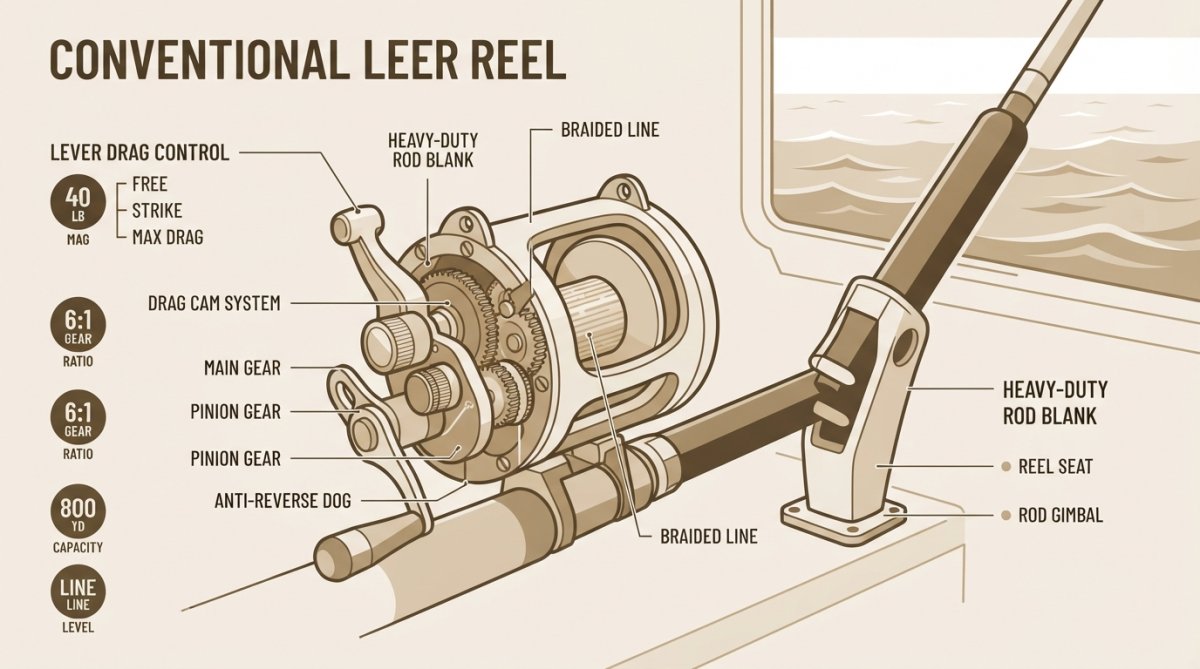
The choice between conventional and spinning reels for halibut is less about personal preference and more about the specific fishing situation. Conventional reels dominate halibut fishing because they excel at delivering power to fight large fish and maintaining precise control over jigging depth and lure action. They offer superior drag systems and provide the feedback needed to maintain precise depth control during jigging.
Conventional Reels: Penn, Daiwa, and Avet Performance Tiers
Penn International VI reels represent the gold standard for halibut fishing. These precision-machined reels feature the Dura-Drag system, which delivers smooth, consistent drag pressure throughout the fight. The Quick-Shift II two-speed system allows you to switch between high-speed retrieval for working lures and low-speed, high-torque retrieval for fighting deep fish. At $609.95, these reels are built to last decades.
Daiwa Saltiga reels occupy the middle ground at around $529.99, offering exceptional smoothness and the Ultimate Tournament Carbon Drag system. Avet Raptor reels are the value proposition, starting at $309.99 for the MXL 5.8 MC G2, delivering two-speed functionality and the Full Surface Caliper Brake System.
Spinning Reels: When and Why They Work for Halibut
Spinning reels have limited application in halibut fishing. The Shimano Saragosa SW spinning reel is the exception, offering lightweight, smooth performance capable of handling the line weights and drag pressures that halibut fishing demands. Spinning reels work best for nearshore halibut fishing in shallower water, typically under 80 feet.
Halibut Fishing Lures: Metal Jigs, Soft Plastics, and Swimbaits
Metal jigs dominate halibut fishing because they deliver a compact, flashy presentation that mimics the baitfish and squid that make up their diet. The best halibut fishing tackle 2026 includes a diverse jig selection because halibut respond differently to presentations based on season, water clarity, and current strength.
Metal Jigs: Weight Selection and Jigging Techniques
Jig weight selection is the single most important variable in halibut fishing success. Use the lightest jig that maintains bottom contact in the current you're fishing. In slack water or light current (under 1 knot), start with 2 to 3-ounce jigs in depths under 80 feet. As you move deeper or encounter stronger current, increase to 4 to 6-ounce jigs. In heavy current (2+ knots) or extreme depths (over 180 feet), 6 to 8-ounce jigs become necessary.
The Pitbull Tackle Killer Jig, available in 2, 4, 6, and 8-ounce sizes, covers this entire range and features a twin-tail swimbait and plastic hoochie skirt that halibut find irresistible. Pricing ranges from $4.99 to $24.99 depending on size.
The most productive jigging method is the lift-and-drop: raise your jig 3 to 5 feet with a sharp upward rod movement, then allow it to flutter back down on a controlled drop. The pause at the bottom, where you let the jig rest for 2 to 3 seconds before the next lift, is where most halibut takes occur.
Soft Plastics and Swimbaits: Action and Color Strategies
Soft plastics and swimbaits work for halibut because they provide a different action profile than metal jigs. The Pitbull Tackle Dead Eye Jig ($4.99 to $8.99) mimics natural baitfish with a fluttering action as it falls. Use slack line on the fall, letting the jig flutter naturally rather than maintaining constant tension.
In clear water with good visibility, natural colors like Green Mackerel, Black/Silver, and Scrambled Squid work best. In turbid water or low-light conditions, high-contrast colors and glow patterns trigger more strikes. Firetiger, 6X Glow, and Orange patterns are proven performers in these conditions.
| Jig Type | Best Depth | Best Current | Typical Weight | Best Condition |
|---|---|---|---|---|
| Metal Jigs | All depths | Slack to heavy | 2-8 oz | Clear water, aggressive feeding |
| Soft Plastics | 40-120 ft | Light to moderate | 2-4 oz | Natural action needed |
| Swimbaits | 20-100 ft | Light | 1-3 oz | Casting, nearshore fishing |
| Hoochie Skirts | All depths | All conditions | 2-6 oz | Year-round, versatile |
Halibut Fishing Rigs: Drop-Shot, Leaders, and Terminal Tackle Essentials
Drop-shot rigs are the standard for halibut jigging. The basic setup consists of a main line, a leader section, a hook, and a weight attached below the hook. The weight stays on the bottom while the hook floats above it, presenting your bait or soft plastic at the exact depth where halibut are holding.
Leader Material: Fluorocarbon vs. Braided Line Strength
Fluorocarbon is nearly invisible underwater and has lower stretch than braided line, which improves hook-setting power. However, fluorocarbon is more prone to abrasion on rocky bottoms and is more expensive. Braided leader material is stronger pound-for-pound and more durable on rocky bottoms, but more visible underwater.
For halibut fishing, use a hybrid approach: braided main line for its strength and durability, then attach a fluorocarbon leader section (typically 2 to 3 feet long) using a reliable knot like the Albright or FG knot. Leader strength should match the halibut you're targeting and the structure you're fishing. For halibut under 40 pounds in relatively clean bottom, 30-pound fluorocarbon leader is adequate. For larger fish or rocky structure, step up to 40 or 50-pound leader.
Hook Sizes, Circle Hooks, and Knot Strength for Big Fish
Circle hooks are increasingly popular for halibut because they hook in the corner of the mouth, which reduces the chance of gut-hooking and improves survival rates for catch-and-release situations. The Gamakatsu Big River Bait Hooks ($4.49 for a 5-pack) are forged for strength and feature a large gap ideal for halibut, available in sizes 4/0 to 8/0, with 6/0 and 8/0 being most popular.
Knot strength is non-negotiable. The Palomar knot, improved clinch knot, and Uni knot all provide 95%+ strength retention when tied correctly. The critical step is tightening the knot slowly and deliberately, ensuring that the line seats properly against the hook eye.
The Pitbull Tackle Halibut Rig ($2.99) is a pre-tied dead-bait trolling rig that eliminates the need to tie your own setup, featuring super-sharp hooks and 30-pound line suitable for halibut up to 50 pounds.
Bait vs. Lure Fishing: Which Strategy Wins in 2026
Lures outperform bait in most situations because they allow you to cover more water, maintain better bottom contact, and trigger strikes through active presentation. Bait works exceptionally well during early morning hours when halibut are most aggressive and when halibut are in a negative feeding mood.
The best approach is to bring both options and adapt based on what the fish are telling you. Start with lures to locate halibut and trigger aggressive strikes. If you're not getting bites, switch to bait and work specific areas more slowly.
Budget vs. Pro-Level Halibut Tackle Setups
Halibut fishing doesn't require you to spend thousands of dollars on equipment, but it does require you to spend money on the right equipment. A budget-conscious angler can build a functional halibut setup for under $800, while a professional-grade setup can easily exceed $3,000.
Entry-Level Gear That Actually Works
A functional entry-level halibut setup consists of a 6-foot heavy-action conventional rod ($150-250), an Avet Raptor reel ($309.99), 50-pound braided main line ($30-50), 40-pound fluorocarbon leader ($20-30), a selection of metal jigs in 2 to 6-ounce sizes ($50-100), and quality hooks and terminal tackle ($30-50). Total investment: approximately $600-800.
This setup will catch halibut. The Avet Raptor reel is genuinely good, it's not a compromise option, it's a legitimate choice used by many experienced anglers. The key to making budget gear work is selecting items that don't sacrifice function for price.
Professional-Grade Setups: When to Invest
A professional-grade halibut setup includes a Penn International VI reel ($609.95), a custom-built or high-end production rod ($400-600), premium braided main line ($50-80), quality fluorocarbon leader ($30-50), and a comprehensive jig selection ($150-250). Total investment: $1,500-2,000 or more.
The difference between entry-level and professional-grade gear becomes obvious during extended jigging sessions. Premium reels have smoother drag systems that reduce arm fatigue. Better rods transmit bottom feedback more clearly, allowing you to detect subtle takes.
Invest in professional-grade equipment if you fish halibut more than 20 days per year or if you're targeting trophy fish in challenging deep-water conditions. If you're a casual angler who fishes halibut a few times per year, entry-level gear that's been properly selected will serve you perfectly well.
Maintenance and Longevity: Making Your Best Halibut Fishing Tackle Last
Quality halibut tackle represents a significant investment, and proper maintenance determines whether it lasts years or decades. Saltwater is corrosive, and halibut fishing exposes equipment to constant salt spray, sandy bottoms, and the physical stress of fighting large fish. A maintenance routine takes 30 minutes per trip and adds years to your equipment's life.
Rinse your reel with fresh water immediately after fishing, paying special attention to the drag system and spool. Use a soft brush to remove salt crystals from the reel body. Apply a light coat of reel oil to moving parts, but avoid over-lubricating because excess oil attracts sand and salt.
Saltwater Corrosion Prevention and Reel Care
After each fishing trip, submerge your reel in fresh water for 5-10 minutes, then rinse with a spray bottle while working the handle and drag adjustment to flush out salt deposits. Never use high-pressure water because the force can drive saltwater deeper into the reel body. Gentle rinsing with a spray bottle or soaking in fresh water is far more effective.
Drag maintenance is critical because a corroded drag system loses smoothness and can fail suddenly under load. Once per season, clean the drag material by removing the spool and gently wiping the drag surfaces with a soft, damp cloth. If the drag has become rough or sticky, have the reel serviced by a professional. This service typically costs $75-150 and extends the reel's life significantly.
Rod Guides, Line Inspection, and Seasonal Storage
Rod guides accumulate salt deposits and sand that can damage your line. Inspect guides after each trip and clean them with fresh water and a soft cloth. If you notice a groove or rough spot developing on a guide, have it replaced before it damages your line.
Line inspection should happen monthly during fishing season. Run your fingers along the line, feeling for rough spots, fraying, or discoloration. Any line that feels compromised should be replaced immediately. Before storing tackle for extended periods, ensure everything is completely dry. Store reels in a cool, dry location away from temperature fluctuations. A sealed tackle box with silica gel packets helps maintain proper humidity levels during off-season storage.
Building the best halibut fishing tackle 2026 setup means matching equipment to the specific conditions where you'll fish and maintaining that equipment properly. Whether you're starting with entry-level conventional gear or investing in professional-grade components, the principles remain the same: prioritize strength and reliability, select tackle matched to your target depth and current, and maintain your equipment after every trip. At Elliott's Tackle & Rigging, every product we offer has been field-tested by experienced captains who fish halibut regularly. We focus on durability, performance, and the specific features that matter when you're fighting a large fish in deep water. Start with Elliott's Tackle & Rigging and experience gear selected by someone who refuses to sell anything they wouldn't use themselves.
Frequently Asked Questions
What kind of rod and reel should I use for halibut fishing?
For halibut, use a heavy-action rod (6-7 feet) paired with a conventional reel like the Penn International VI or Daiwa Saltiga for deep-water fishing, or a spinning reel like the Shimano Saragosa SW for inshore work. Conventional reels offer better leverage for fighting large fish, while spinning reels work well for lighter lures and bottom jigging. Match your setup to your fishing depth and technique.
What are the best lures for halibut fishing?
Metal jigs (2-8 oz) are highly effective for vertical jigging in deep water, while soft plastics and swimbaits work well for both inshore and offshore halibut. Proven options include Pitbull Tackle's Killer Jig and Dead Eye Jig, which feature realistic action and are available in sizes suited to various depths. Color selection matters, Firetiger, Glow, and Orange are proven halibut attractors.
What line and leader material should I use for halibut?
Use 30-50 lb braided mainline for better sensitivity and strength, with a fluorocarbon leader (40-80 lb) to resist abrasion on rocky bottoms and reduce visibility. Fluorocarbon is more durable in saltwater than monofilament and provides better knot strength. Ensure your leader-to-mainline knot is properly tied, a weak knot is often the first failure point when fighting large halibut.
How heavy should my jig weights be for halibut fishing?
Jig weight depends on depth and current. Start with 2-4 oz for shallow inshore halibut (under 100 feet) and 6-8 oz for deep water (200+ feet) or strong tide conditions. Heavier jigs maintain bottom contact in current but reduce sensitivity. Match your depth sounder readings to your current and adjust weight accordingly, too light and you'll lose bottom contact; too heavy and you'll miss subtle bites.
What tackle maintenance is essential for saltwater halibut fishing?
Rinse all gear with fresh water after every trip to prevent corrosion. Inspect rod guides for salt buildup and clean braided line regularly. Check your reel drag system quarterly and apply light reel oil to moving parts. Store reels in a cool, dry place and keep fluorocarbon leaders in airtight containers. Proper maintenance extends gear life by years and ensures reliability when you hook a trophy halibut.
0 comments