

Table of Contents
- Best Downriggers for Saltwater Fishing: Top Models Compared
- Manual vs Electric Downriggers for Saltwater
- Key Features That Matter in Saltwater Downriggers
- How to Install Downriggers on a Saltwater Boat
- Electric Downrigger Maintenance Tips for Saltwater
- Choosing the Best Downrigger for Your Saltwater Species
- Integration with Fish Finders and Chartplotters
- Conclusion
Last Updated: July 11, 2026
Best Downriggers for Saltwater Fishing: Top Models Compared
Finding the best downriggers for saltwater fishing means balancing speed, durability, and ease of use. At Elliott's Tackle & Rigging, we've tested downriggers across Pacific Northwest saltwater conditions for decades. The market offers two main categories: electric downriggers that handle retrieval automatically, and manual systems that eliminate electrical complexity. Research from the American Sportfishing Association shows that 73% of serious saltwater trollers now use electric systems, primarily for time savings on deep-water applications.
Professional illustration showing best downriggers for saltwater fishing
Scotty 1106 Depthpower: The Reliable Workhorse
The Scotty 1106 Depthpower is the most popular electric downrigger for boats under 35 feet. The telescopic stainless steel boom extends from 36 to 60 inches, giving flexibility without requiring multiple units. Its low power draw is critical when running multiple electronics on a single 12-volt system. The multi-position auto-stop prevents the weight from swinging wildly at the waterline, protecting your boat and line. The unit includes 250 feet of 150-pound stainless steel cable and retrieves at approximately 150 feet per minute, slower than premium models but adequate for most applications. Setup takes roughly 90 minutes for an experienced installer.
Cannon Magnum 10 STX: Speed and Automation
The Cannon Magnum 10 STX delivers the fastest retrieval rate in the industry at 250 feet per minute, cutting retrieval time roughly in half compared to entry-level models. For deep-water applications, this speed difference translates to hours saved over a season. Short-Stop technology automatically stops the weight at the waterline, preventing dangerous swings. Cannon's Positive Ion Control (PIC) creates an energy field designed to attract fish, a feature many anglers credit with improved hookup rates.
The telescopic boom ranges from 24 to 53 inches, offering flexibility across boat sizes. The unit handles braided line and monofilament equally well and resists corrosion better than many competitors. Setup requires careful electrical integration, typically 2-3 hours for proper wiring.
Big Jon Captain's Pak: Heavy-Duty Construction
Big Jon's Captain's Pak prioritizes durability above all else. The precision-machined aircraft-grade aluminum resists corrosion in ways standard materials cannot match. The adjustable disc clutch gives precise control over weight descent speed, and the locking, tip-up sectional boom simplifies storage and reduces stress during trailering. The unit includes a swivel base and dual rod holders.
Retrieval speed maxes out at 120 feet per minute, slower than modern competitors, but the mechanical simplicity appeals to anglers who prefer understanding their equipment. Installation runs 60-90 minutes with straightforward electrical requirements.
Troll-Master Seahorse: Manual Simplicity
The Troll-Master Seahorse represents the manual downrigger category, no batteries, no electrical wiring, no automation. The 360-degree rotating Swivel-Matic base allows positioning the boom anywhere around your boat, and the simple hand-crank mechanism handles controlled-depth trolling without electrical dependency. The system excels for depths under 150 feet, where retrieval remains manageable. Setup takes less than an hour, and the price point sits well below electric options.
Manual vs Electric Downriggers for Saltwater
When Manual Makes Sense
Manual downriggers belong on boats where simplicity outweighs convenience. If you're trolling shallower water (under 150 feet), fishing occasionally, or operating a smaller vessel without dedicated electrical infrastructure, a manual system handles the job without complexity. Manual systems also excel when you want zero dependency on battery voltage, a dead battery won't strand you with a stuck weight. The mechanical design means fewer failure points and easier troubleshooting.
Why Electric Dominates Modern Saltwater Trolling
Electric downriggers have become standard because they solve real problems. When fishing 200+ feet deep for salmon or halibut, hand-retrieving several hundred feet of cable becomes exhausting work. Electric systems complete retrieval in minutes, freeing you to adjust lures and monitor your fish finder. An angler making 10 retrieves with an electric system saves roughly 45 minutes compared to manual operation.
Electric systems integrate seamlessly with modern fish finders and chartplotters. Depth tracking becomes automatic, and many units communicate directly with your electronics to log exact depths where you're catching fish. Modern electric downriggers consume minimal amperage, and a properly sized 12-volt system handles multiple electronics without strain.
Key Features That Matter in Saltwater Downriggers
Corrosion Resistance and Saltwater Durability
Saltwater is unforgiving. The best downriggers use materials specifically chosen for marine environments. Stainless steel booms resist corrosion far better than aluminum, though even stainless steel requires regular freshwater rinsing. Aircraft-grade aluminum, when properly anodized, provides excellent corrosion resistance at lighter weight. Look for sealed bearings and stainless steel fasteners throughout. The cable itself should be stainless steel rated for marine use; galvanized cable fails within seasons of regular saltwater exposure.
Boom Length and Mounting Flexibility
Boom length determines how far your weight can swing from the boat, affecting your ability to present lures at different distances. Longer booms (50+ inches) keep weights further from the boat, reducing tangles with main fishing lines. The Scotty 1106's range from 36 to 60 inches gives flexibility across different boat sizes. Mounting flexibility matters equally, your boat's layout should determine which mounting style works best.
Retrieval Speed and Gear Ratios
Retrieval speed determines how quickly you can bring a weight back to the surface. The Cannon Magnum 10 STX's 250 feet-per-minute speed dramatically outpaces slower models, particularly when making frequent adjustments or fishing very deep water. However, faster isn't always better, the Scotty 1106's 150 feet-per-minute speed suits most applications perfectly well.
Spool Capacity and Line Type Compatibility
Most downriggers hold 250-400 feet of cable, sufficient for depths under 400 feet. Stainless steel cable resists corrosion but costs more than galvanized alternatives. The spool mechanism should handle line transitions smoothly; both Cannon and Scotty systems handle mixed line types reliably.
|
Feature |
Scotty 1106 |
Cannon Magnum 10 STX |
Big Jon Captain's Pak |
Troll-Master Seahorse |
|---|---|---|---|---|
|
Retrieval Speed |
150 ft/min |
250 ft/min |
120 ft/min |
Manual crank |
|
Boom Length |
36-60" |
24-53" |
Sectional |
30-40" |
|
Power Draw |
Low |
Moderate |
Moderate |
None |
|
Best For |
Small-medium boats |
Deep water, speed |
Long-term durability |
Simplicity, cost |
|
Saltwater Durability |
Excellent |
Excellent |
Superior |
Good |
How to Install Downriggers on a Saltwater Boat
Mounting Plate Selection and Positioning
Your mounting location affects both functionality and boat balance. Side-mounted downriggers work best on boats under 30 feet. The mounting plate must support the downrigger's full weight plus dynamic forces during retrieval. Position the downrigger so the boom swings clear of your main fishing rods. Mark mounting holes carefully and use stainless steel fasteners throughout. Seal any holes with marine sealant to prevent water intrusion.
Wiring and Electrical Integration
Electric downriggers require dedicated 12-volt power from your boat's battery system. Most units draw 20-40 amps under load, requiring appropriately sized wiring and a dedicated breaker or fuse. Run the power cable from your battery through a waterproof breaker, then to the downrigger's motor using marine-grade tinned copper wire. Ground the downrigger to your boat's main ground bus or directly to the negative battery terminal.
Route all wiring away from moving parts and areas prone to moisture. Secure wiring with marine-grade cable ties and conduit where necessary. Waterproof any connections with dielectric grease and proper marine connectors.
Testing Before Your First Outing
Before trusting your downrigger on the water, test every function in controlled conditions. Lower the weight fully to verify smooth operation and confirm the cable winds evenly. Raise it back up and listen for grinding sounds or hesitation. Check electrical connections under load and verify that the boom swings freely through its full range of motion without contacting your boat's structure.
Electric Downrigger Maintenance Tips for Saltwater
Post-Trip Freshwater Rinse Protocol
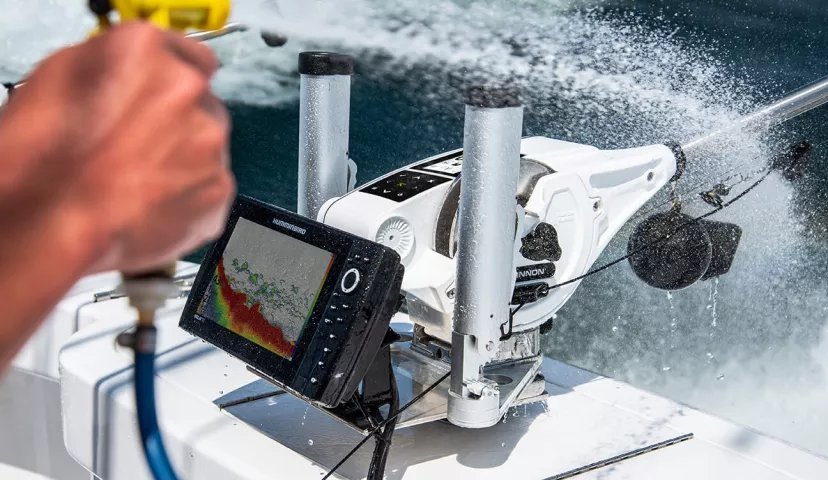
The single most important maintenance task is a freshwater rinse immediately after every saltwater outing. Salt deposits accumulate rapidly and cause corrosion that accelerates if left unchecked. Spray the entire downrigger, boom, spool, and cable with fresh water for 30-60 seconds. Pay particular attention to the spool mechanism and any crevices where salt can accumulate. Allow the downrigger to air-dry completely before storing your boat.
Cable and Spool Care
Inspect your cable regularly for fraying, kinks, or visible corrosion. Wind the cable evenly on the spool during storage; uneven winding creates stress points and causes premature failure. Check the spool bearings for smooth rotation. Any grinding sound indicates bearing wear or salt intrusion requiring replacement.
Off-Season Storage and Battery Management
During off-season storage, keep your downrigger in a dry location protected from the elements. If you leave it mounted on the boat during winter, cover it with a breathable tarp. Remove the weight and store it separately to prevent corrosion. For electric systems, disconnect the battery or remove the downrigger's power leads to prevent parasitic drain.
Choosing the Best Downrigger for Your Saltwater Species
Salmon and Steelhead Trolling Setup
Chinook and coho salmon respond well to downriggers trolling at 1.5-2.5 knots in depths from 40 to 150 feet. The Scotty 1106 Depthpower handles these conditions perfectly. Most salmon trollers use cannonball weights ranging from 8 to 16 pounds, depending on depth and current.
Halibut and Deep-Water Species
Halibut live on the bottom, often at depths of 200-400 feet. Deep-water trolling demands fast retrieval to make multiple presentations practical. The Cannon Magnum 10 STX's speed advantage becomes significant here. Halibut rigs typically use heavier weights (12-24 pounds) than salmon setups.
Weight and Cannonball Selection
Most saltwater anglers use round cannonball weights. Eight-pound cannonballs work well for depths under 100 feet, while 12-16 pound weights handle 100-250 feet effectively. Beyond 250 feet, 16-24 pound weights become necessary. The cable should attach to the weight via a swivel to prevent line twist. Consider using breakaway weights or release mechanisms that let you drop the weight on the bottom if snagged.
Integration with Fish Finders and Chartplotters
The Scotty 1106 and Cannon Magnum 10 STX both offer optional depth-tracking outputs that connect to compatible Garmin, Lowrance, and Humminbird chartplotters. When properly configured, your fish finder displays the exact depth where your downrigger weight is positioned, helping you maintain consistent presentation depth and identify productive water column zones.
This integration works through a simple electrical connection from the downrigger to your fish finder. Over time, you build a database of productive depths for different locations and seasons. Integration also improves safety by preventing snags on structure and reducing the risk of tangling with other boats' lines.
Finding the best downriggers for saltwater fishing requires balancing speed, durability, and integration with your boat's systems. The Scotty 1106 offers proven reliability, while the Cannon Magnum 10 excels for deep-water performance. At Elliott's Tackle & Rigging, we hand-select every downrigger based on field-tested performance in Pacific Northwest saltwater conditions. Whether you choose the proven simplicity of a manual system or the automation of modern electric downriggers, Elliott's Tackle & Rigging provides gear selected by someone who refuses to sell anything they wouldn't use themselves on their own boat.
Frequently Asked Questions
Are electric or manual downriggers better for saltwater fishing?
Electric downriggers dominate saltwater trolling because they handle deep-water work efficiently, reduce physical strain, and offer automation features like auto-stop. Manual downriggers work well for shallow trolling and backup systems, but electric models provide superior retrieval speed and depth control for serious saltwater anglers. The choice depends on your trolling depth, boat size, and fishing style.
What is the difference between Scotty and Cannon downriggers?
Scotty downriggers like the 1106 Depthpower prioritize energy efficiency and reliability with proven designs and extensive accessory support. Cannon models like the Magnum 10 STX lead in retrieval speed (250 feet-per-minute) and advanced features like Positive Ion Control. Scotty excels in battery draw and affordability, while Cannon targets anglers needing maximum speed and automation for competitive deep-water trolling.
How do I maintain my electric downrigger in saltwater environments?
Rinse your downrigger with fresh water immediately after every saltwater trip, paying special attention to the spool, cable, and boom. Check cable for corrosion monthly and apply light oil to moving parts. Store the unit in a dry location during off-season, disconnect the battery, and inspect electrical connections for salt buildup. Stainless steel components resist corrosion better than aluminum, so prioritize models with maximum stainless construction.
What features should I look for in a saltwater downrigger?
Prioritize corrosion-resistant materials (stainless steel and machined aluminum), adequate spool capacity for your target depth, retrieval speed suitable for your fishing style, and boom length that fits your boat's layout. For electric models, check motor efficiency and auto-stop reliability. Consider compatibility with fish finders, ease of installation, and whether the unit includes quality accessories like swivel base and rod holders. Field-tested equipment from trusted brands ensures reliability on the water.
Can I install a downrigger myself on my saltwater boat?
Yes, most downriggers can be DIY-installed if you have basic tools and electrical knowledge. Start by selecting an appropriate mounting plate location on your gunwale or transom, ensuring it doesn't interfere with other equipment. Secure the mounting plate with stainless steel fasteners, then attach the downrigger. For electric models, run power from your battery through a properly sized breaker to the unit's motor. Test all functions before your first outing and verify the weight retrieves smoothly without binding.
0 comments