

Table of Contents
- What Makes Durable Saltwater Fishing Rod Holders Different
- Quick Comparison: Top Rod Holders for Saltwater Use
- Marine-Grade Stainless Steel Rod Holders: The Gold Standard
- Flush Mount vs. Clamp-On Rod Holders: Installation & Performance
- How to Install Boat Rod Holders: Mounting Methods Explained
- Top Rod Holder Options for Saltwater Fishing
- Maintaining Saltwater Fishing Equipment: Long-Term Care Strategies
- DIY vs. Commercial Rod Holders: Cost-Benefit Analysis
Last Updated: July 10, 2026
What Makes Durable Saltwater Fishing Rod Holders Different
Durable saltwater fishing rod holders protect expensive tackle and keep your boat organized. The difference between a rod holder that lasts five years and one that corrodes within eighteen months comes down to material science and design that most anglers overlook.
Saltwater exposure presents unique challenges. Salt spray, UV radiation, moisture, and temperature swings create corrosion pressures that destroy inferior materials within months. A rod holder rated for "saltwater use" needs marine-grade construction that goes several levels deeper than standard stainless steel.
The real challenge is finding equipment that functions reliably after three seasons of hard use. This guide covers the materials, installation methods, and maintenance strategies that separate gear that fails from equipment that becomes permanent boat infrastructure.
Quick Comparison: Top Rod Holders for Saltwater Use
|
Rod Holder |
Material |
Best For |
Key Advantage |
|---|---|---|---|
|
Cisco Fishing Systems |
Aluminum with Miltiary grade anaodized finish |
Track Mount System |
Corrosion resistant, lifetime warranty, multiple mount options, various finishes |
|
Gemlux Bluewater Series |
316L stainless steel |
Offshore heavy-tackle fishing |
Exceptional corrosion resistance in extreme salt environments |
|
Scotty Powerlock |
Engineering-grade nylon |
Versatile boat and kayak mounting |
360-degree rotation with universal cradle design |
|
Taco Marine Deluxe Trident |
316L stainless steel |
Multi-rod storage on center consoles |
Space-saving design holds three rods securely |
|
Lee's Tackle Swivel Base |
316 stainless steel |
Professional trolling operations |
Swivel base prevents rod damage during heavy fights |
|
Oceansouth 316 Stainless Steel Rack |
Mirror-polished 316 stainless |
Boat and garage storage |
Full polypropylene liner protects rod handles |
Marine-Grade Stainless Steel Rod Holders: The Gold Standard
When shopping for durable saltwater fishing rod holders, 316L stainless steel represents the tier where performance truly separates from compromise. This material is engineered specifically for saltwater environments where chloride ions actively attack standard metals.
316L Stainless Steel vs. Other Metals
The distinction between 316L and 304 stainless steel matters significantly. Standard 304 stainless contains 18% chromium and 8% nickel. 316L adds 2-3% molybdenum, which creates a protective barrier against chloride pitting, the specific corrosion type saltwater causes.
A 304 stainless rod holder will develop small pits within 6-12 months. These aren't cosmetic; they're stress points where corrosion accelerates. By season two, structural failure occurs. A 316L holder in the same environment remains corrosion-free for 5+ years with minimal maintenance.
Aluminum alternatives corrode faster than 304 stainless. Powder-coated aluminum lasts 2-3 years before the coating fails. Plastic options like ABS or polypropylene avoid corrosion but lack the structural strength needed for heavy-duty offshore fishing.
Corrosion Resistance in High-Salt Environments
Molybdenum in 316L stainless steel creates a thicker, more stable oxide layer that resists chloride ion penetration. In high-salt environments where salt spray hits your boat daily, this difference translates directly into years of additional service life.
Research from ASTM International saltwater corrosion standards confirms that 316L stainless steel maintains structural integrity in high-chloride environments for 10+ years, while 304 stainless shows measurable pitting within 18-24 months. The mirror-polished finish on quality 316L rod holders isn't just aesthetic, polishing removes surface imperfections that could become corrosion initiation sites.
Flush Mount vs. Clamp-On Rod Holders: Installation & Performance
Your installation choice determines both space consumption and structural stress on your boat's hull or gunwale.
Flush-Mount Advantages for Permanent Installations
Flush-mount rod holders integrate directly into your boat's structure, requiring holes drilled through the gunwale or transom. This is the superior long-term choice for serious anglers planning to keep their boat set up the same way for years.
The structural advantage is significant. Instead of clamping to the outside of your gunwale, flush-mount distributes load across a backing plate mounted inside your boat. When fighting a large fish with 30+ pounds of pressure on your rod, that distributed load keeps your boat's structure intact. Flush-mount solutions are rigid; your rod sits exactly the same way every time.
Installation requires careful planning and involves backing plates and proper sealing to prevent water intrusion. Once installed, a flush-mount rod holder becomes invisible infrastructure that simply works.
Clamp-On Flexibility for Portable Solutions
Clamp-on rod holders mount to the outside of your gunwale using tension screws. They're popular because they require no drilling and can be moved if you change your boat configuration. For kayak anglers, boat renters, or anyone testing a setup before committing, clamp-on solutions make sense.
The Scotty Powerlock exemplifies good clamp-on design. The universal cradle accommodates most rod and reel styles, the 360-degree horizontal rotation lets you angle rods however you need, and the front locking ring prevents accidental rod loss. However, clamp-on solutions have limitations. The clamping force distributes stress at a single point on your gunwale, and repeated clamping can create permanent indentations.
How to Install Boat Rod Holders: Mounting Methods Explained
Installation method determines whether your rod holder becomes reliable boat infrastructure or a constant source of frustration. Proper installation requires backing plates, sealant, and understanding the forces your boat's structure experiences.
Gunwale and Transom Mounting
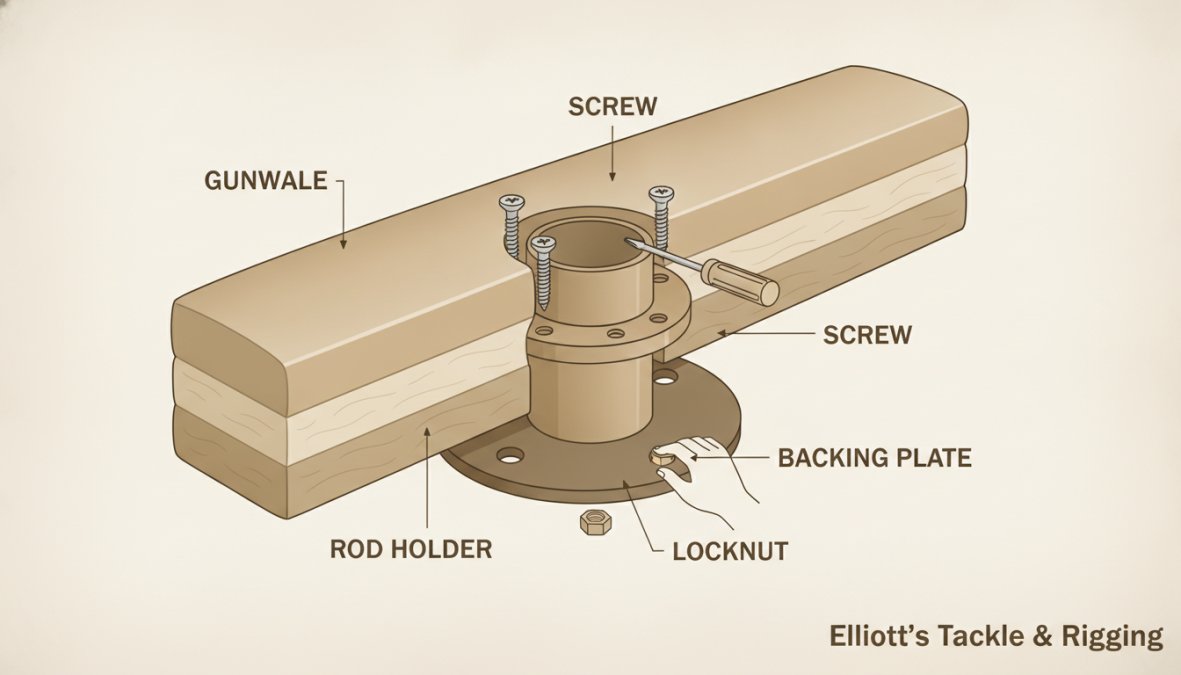
Gunwale mounting is the most common approach for boats under 35 feet. Proper gunwale installation requires a backing plate on the inside of your gunwale to distribute load across a larger surface area instead of concentrating it at the bolt hole.
Transom mounting (mounting on the boat's stern) is ideal for rod holders that will hold rods at specific angles during trolling. The transom is thicker and stronger than the gunwale, making it better suited for holding multiple rods or rods experiencing constant pressure.
The installation sequence matters: drill holes, install backing plates from inside the boat, apply marine-grade sealant (like 3M 5200 or Sikaflex) around bolt holes, then install the rod holder. The sealant prevents water from entering the boat through mounting holes.
Track System Integration
Modern boats increasingly use track systems (like Cisco Fishing Systems, Cannon or Scotty track mounts) that run along the gunwale or deck. These systems solve the installation problem by creating a continuous rail where rod holders can be positioned anywhere without additional drilling.
Track systems distribute load along the entire track length instead of concentrating it at single bolt points. You can also adjust rod holder position as your fishing needs change. The trade-off is cost and complexity, but for serious anglers wanting flexibility, track systems represent the best balance between performance and adaptability.
Top Rod Holder Options for Saltwater Fishing
Cisco Fishing Systems: Flexible Configurations, Track Mount and Lifetime Warranty
The Cisco Fishing Systems tube style rod holder and tarck combination is a favorite for saltwater anglers trolling for salmon, halibut and other saltwater fish. Cisco has a multitude of mounting and configuration options, some are designed to index 360° with 20 interlocking positions by simply lifting and turning our exclusively engineered spring loaded mechanism. When engaged, it is secured by machined teeth around the entire circumference for virtually no wear on the product ensuring long lasting sustainability.
In addition to the radial movement, the rod holder tube will adjust to any angle from 0-90° by actuating the padded lever. The lever can be rotated in any direction so it locks in the downward position.
Risers can be added to any rod holder to increase the height of the rods! This is great for staggering positions while pulling inline planer boards!. No tools are required for positioning of the rod holder. All aluminum components are anodized to military specs.
Gemlux Bluewater Series: Heavy-Duty Offshore Performance
The Gemlux Bluewater Series represents the pinnacle of offshore performance. Constructed from 316 stainless steel, these rod holders come in 0, 15, and 30-degree angles with optional integrated cupholders and backing plates.
What separates Gemlux from competitors is material consistency and manufacturing precision. Every component is stainless steel with no plastic liners or composite parts that could fail. The rod cradle is machined to exact tolerances, so your rod sits securely without movement. For offshore anglers targeting big game fish, this reliability is non-negotiable.
Scotty Powerlock: Versatile & Impact-Resistant
The Scotty Powerlock has become the industry standard for kayak anglers and small boat owners. The universal cradle accommodates everything from light spinning rods to heavy saltwater conventional reels, eliminating the need for multiple rod holders.
Engineering-grade nylon is impact-resistant in ways stainless steel isn't. The 360-degree horizontal rotation lets you angle rods to match your boat layout, and the front locking ring prevents rod loss in rough water. Setup is fast, clamp it to your gunwale, insert your rod, tighten the locking ring, and you're fishing. For kayak anglers or seasonal boaters, this durability profile makes sense.
Taco Marine Deluxe Trident: Multi-Rod Storage Solution
When you need to store three rods in minimal space, the Taco Marine Deluxe Trident solves the problem with elegant engineering. The polished 316L stainless steel construction resists corrosion, and the compact footprint fits on space-limited boats.
The Trident design holds three rods securely in a triangular arrangement, distributing weight across three contact points instead of concentrating it on a single rod. This reduces stress on individual rods and prevents them from clinking together during boat movement.
Lee's Tackle Swivel Base: Professional Trolling Standard
Lee's Tackle Swivel Base rod holders have become the industry standard for professional trolling operations. The swivel base allows the rod butt to rotate under pressure, distributing forces across the gimbal bar instead of concentrating them at a single point.
When fighting a 50-pound fish with your rod bending hard, that swivel action keeps the rod from snapping. The heavy-duty 316 stainless steel construction survives years of saltwater exposure.
Oceansouth 316 Stainless Steel Rack: Garage & Boat Storage
Oceansouth's mirror-polished 316 stainless steel racks represent the sweet spot between quality and practical application. These work equally well mounted on your boat or in your garage.
The full-length polypropylene liner protects rod handles from direct contact with stainless steel, preventing handle degradation. The gimbal pin rod stop keeps rods from sliding out during movement. Versatile mounting options mean you can deploy the same rack in multiple locations.
Maintaining Saltwater Fishing Equipment: Long-Term Care Strategies
The difference between a rod holder that lasts five years and one that lasts fifteen years comes down to maintenance protocols that most anglers ignore. Marine-grade material is only as good as the care you invest in it after installation.
Freshwater Rinse Protocols After Each Use
Every time you fish in saltwater, salt deposits accumulate on your rod holder. These deposits are hygroscopic, they absorb moisture from the air, creating a perpetually damp environment that accelerates corrosion even on stainless steel.
Rinse your rod holder with freshwater immediately after returning to the dock. Use a hose or spray bottle, focusing on crevices where salt deposits accumulate. This single step, done consistently, cuts corrosion rates by roughly 70% compared to rod holders that never get rinsed. Make it part of your end-of-day routine, like securing the boat or stowing tackle.
Protective Coatings & UV Inhibitor Benefits
Even 316L stainless steel benefits from protective coatings in extreme saltwater environments. A thin coat of marine-grade wax or specialized stainless steel protectant creates a barrier against salt spray and UV radiation.
UV inhibitors are particularly important for plastic rod holders. Sunlight degrades plastic polymers over time, causing brittleness and color fading. A UV-protective coating extends the lifespan of plastic rod holders by 3-5 years. Apply protective coatings 2-3 times per year, more frequently in extremely harsh conditions.
Seasonal Storage & Off-Season Preparation
Before storage, rinse your rod holders thoroughly and apply a protective coating. Use a small brush to ensure salt deposits are completely removed from crevices. Consider covering your boat with a breathable cover to reduce exposure to salt spray and UV radiation.
When bringing your boat out of storage, repeat the freshwater rinse and protective coating process before fishing.
DIY vs. Commercial Rod Holders: Cost-Benefit Analysis
The decision between building your own rod holder solution and purchasing commercial equipment involves more than upfront cost. It's about long-term durability, installation complexity, and whether you have the skills to execute a professional-quality installation.
DIY rod holders built from PVC pipe or wooden dowels might cost $20-40 in materials but typically last 1-2 years before requiring replacement. PVC degrades in saltwater UV exposure, and wood rots even with protective coatings. When you factor in your time, the actual cost per year of service is higher than purchasing a commercial rod holder.
Commercial rod holders from established manufacturers cost $60-300+ depending on material and design. A $100 rod holder lasting ten years costs $10 per year. A $40 DIY rod holder lasting two years costs $20 per year. The commercial solution is actually cheaper over time, plus it eliminates the hassle of rebuilding rod holders every couple of years.
Installation complexity also matters. Flush-mount installations require drilling through your boat's hull with precision and knowledge of your boat's internal structure. DIY installations often skip backing plates or use inadequate sealant, leading to water intrusion and structural damage that costs far more to repair than the rod holder itself.
For serious saltwater anglers, commercial rod holders represent the only sensible choice. The durability difference is so dramatic that DIY solutions become a false economy.
The key to maximizing your durable saltwater fishing rod holders is understanding that installation and maintenance matter as much as the equipment itself. A 316L stainless steel rod holder installed without backing plates and never rinsed will fail faster than a quality plastic rod holder that receives consistent freshwater rinses. At Elliott's Tackle & Rigging, we've seen this pattern repeat for decades. Anglers invest in premium equipment and then wonder why it corrodes. The answer is almost always in the care routine, not the equipment choice. Get started with Elliott's Tackle & Rigging's marine-grade rod holders and our maintenance guides, and you'll build a rod storage system that survives decades of hard saltwater use.
Frequently Asked Questions
What material is best for durable saltwater fishing rod holders?
316L stainless steel is the industry standard for saltwater rod holders due to superior corrosion resistance in salt-spray environments. Marine-grade composite materials with UV inhibitors also perform well and offer lighter weight. Avoid standard stainless steel (304 grade) in high-salt conditions, as it lacks the molybdenum content needed for long-term durability. Polished or anodized finishes add extra protection against rust and oxidation.
How do you prevent rust and corrosion on marine-grade stainless steel rod holders?
Rinse with fresh water after every saltwater use to remove salt residue that accelerates corrosion. Store in a dry location when not in use, and apply a light protective coating (like silicone spray or wax) during off-season storage. Inspect mounting hardware quarterly for early signs of rust, and replace any corroded fasteners immediately. Proper maintenance extends the life of even high-quality rod holders by years.
Are flush-mount rod holders better than clamp-on holders for saltwater boats?
Flush-mount holders offer superior durability and a cleaner aesthetic for permanent installations, as they're fully integrated into the boat structure. Clamp-on holders provide flexibility and portability, making them ideal for kayaks or boats with limited mounting options. For serious saltwater anglers planning long-term use, flush-mount 316 stainless steel holders resist corrosion better due to reduced crevice exposure. Choose based on your boat type and whether you need portability or permanent installation.
How often should I maintain my saltwater fishing rod holders?
Rinse with fresh water immediately after every saltwater trip—this is the most critical maintenance step. Inspect mounting hardware monthly for corrosion, and apply protective coatings every 3-6 months depending on usage frequency. Before seasonal storage, clean thoroughly and apply a thin protective layer. Regular maintenance prevents expensive rust damage and ensures your rod holders last 10+ years in harsh marine conditions.
Can you use freshwater rod holders in saltwater environments?
Freshwater rod holders are not recommended for saltwater use. Standard aluminum, mild steel, and lower-grade stainless steel (304) corrode rapidly in salt-spray conditions. Saltwater-rated holders use 316L stainless steel, anodized aluminum, or marine-grade composite materials specifically engineered to resist corrosion. Investing in proper saltwater-rated durable fishing rod holders prevents premature failure and protects your fishing investment.
0 comments