

Table of Contents
- 5 Best Marine Fish Finders for Small Boats 2026: Quick Comparison
- How We Selected the Best Marine Fish Finders for Small Boats
- Portable Fish Finders for Small Boats: Compact Power
- Fish Finder GPS Combo for Small Boats: Navigation and Sonar Combined
- Saltwater Fish Finder for Small Boats: Pacific Northwest Performance
- Fish Finder Installation for Small Boats: Setup and Mounting
- What to Look For When Choosing a Fish Finder for Small Boats
- Why Captain-Curated Gear Matters for Your Small Boat
5 Best Marine Fish Finders for Small Boats 2026
Last Updated: July 31, 2026
Finding the right fish finder for your small boat can mean the difference between a productive day on the water and coming home empty-handed. The 5 best marine fish finders for small boats 2026 all offer different strengths. Whether you're working shallow saltwater flats in the Pacific Northwest or trolling deeper channels for king salmon, the technology has never been better.
5 Best Marine Fish Finders for Small Boats 2026: Quick Comparison
Fish Finder |
Type |
Display |
Best For |
Starting Price |
|---|---|---|---|---|
Portable Unit |
3.5-inch |
Budget-conscious anglers, kayaks, small skiffs |
$149.99 |
|
GPS/Sonar Combo |
10-inch touchscreen |
Serious saltwater anglers needing detailed imaging |
$2,246.99 |
|
Garmin ECHOMAP Ultra 2 LiveScope Plus |
GPS/Sonar Combo |
Large sunlight-readable |
Live sonar technology, advanced navigation |
$2,664.99 |
GPS/Sonar Combo |
12-inch Full-HD |
Professional captains, larger vessels |
$2,799.99 |
|
Garmin GPSMAP 8610xsv |
GPS/Sonar Combo |
10-inch Full-HD |
Saltwater fishing with integrated mapping |
$2,102.99 |
How We Selected the Best Marine Fish Finders for Small Boats
We evaluated each unit based on sonar clarity, display readability in sunlight, GPS accuracy, ease of installation, and real-world performance in Pacific Northwest saltwater conditions. Every unit comes from Elliott's Tackle & Rigging's captain-curated selection.
Portable Fish Finders for Small Boats: Compact Power
Portable fish finders make sense if you rotate between multiple boats, fish from kayaks, or lack dedicated electronics space. These units deliver serious sonar performance in a compact footprint.
Garmin STRIKER 4 Fishfinder
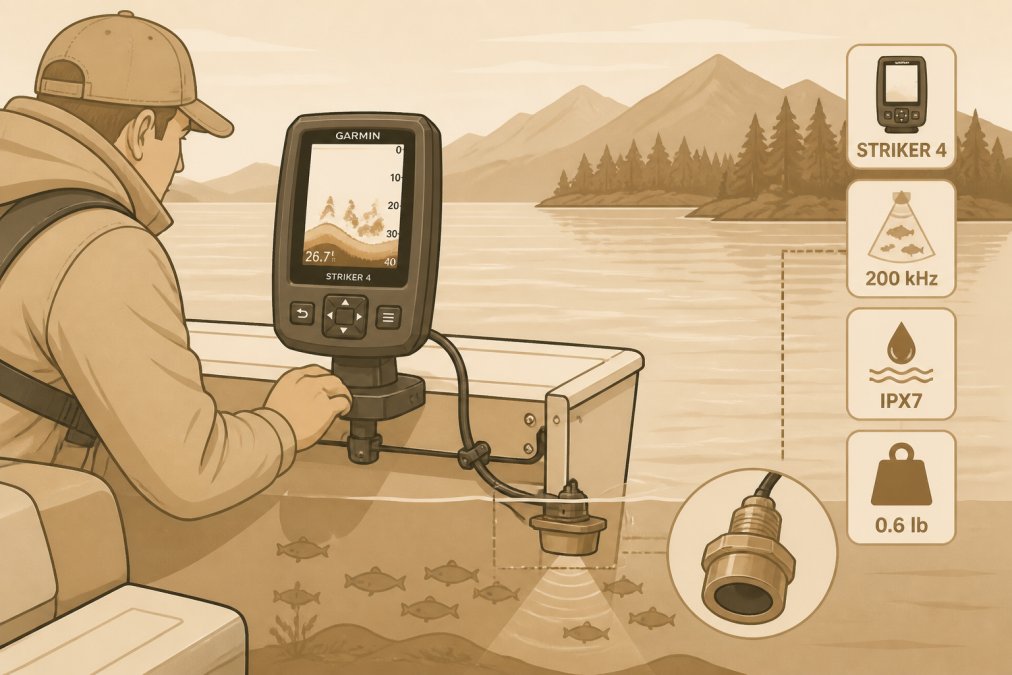
The Garmin STRIKER 4 is the entry point that doesn't feel like a compromise. Its 3.5-inch color display is surprisingly readable in daylight, and the built-in GPS lets you mark waypoints and track your position. The STRIKER 4 pairs a 77/200 kHz transducer with high-sensitivity GPS, delivering traditional CHIRP sonar that cuts through saltwater clutter effectively. The transducer mounts on your transom or trolling motor, and battery-powered operation means you can move this unit between boats.
What works: The price-to-performance ratio is unbeatable. For anglers fishing small bays, nearshore structure, or kelp beds, this delivers everything you need. Setup takes under 30 minutes.
What doesn't: The screen is small, limiting split-screen viewing. There's no networking capability, no mapping beyond the basemap, and no side imaging or down imaging features.
Available at Elliott's Tackle & Rigging, the STRIKER 4 represents the sweet spot for anglers who want reliable sonar without unnecessary complexity.
Fish Finder GPS Combo for Small Boats: Navigation and Sonar Combined
GPS/sonar combos integrate navigation and fish finding into one unit, eliminating the need for separate chartplotters. For small boats operating in saltwater, these combos offer detailed mapping, advanced sonar imaging, and the ability to overlay fish location data directly on your charts.
Humminbird XPLORE 10 CMSI+
The Humminbird XPLORE 10 CMSI+ combines a 10-inch Full-HD touchscreen with MEGA Side Imaging+, MEGA Down Imaging+, and Dual Spectrum CHIRP sonar. Side Imaging shows you a photorealistic view up to 125 feet on either side of the boat, identifying structure, kelp beds, and fish positioning with remarkable clarity. Down Imaging delivers the same detail directly below, revealing bottom composition and suspended fish.
The 10-inch touchscreen handles split-screen viewing without feeling cramped. Networking capabilities allow you to connect multiple units or add transducers as your setup evolves.
What works: The imaging quality is exceptional, showing individual rocks, logs, and fish positioning with clarity that changes how you approach structure fishing. The touchscreen is responsive and intuitive.
What doesn't: The price point is significant. The learning curve is steeper than basic units, requiring you to understand how to interpret MEGA imaging alongside traditional sonar.
Available at Elliott's Tackle & Rigging, this combo delivers imaging technology that was exclusive to much larger vessels just five years ago.

Garmin ECHOMAP Ultra 2 LiveScope Plus Bundle
The Garmin ECHOMAP Ultra 2 LiveScope Plus Bundle represents the cutting edge of real-time fish finding. LiveScope technology delivers live sonar, essentially a video feed of what's happening underwater in real time. You see fish moving, structure in real time, and your boat's position relative to both.
What works: LiveScope removes the guesswork from sonar interpretation. You see fish moving toward or away from your presentation. The learning curve is shorter because you're watching what's actually there.
What doesn't: LiveScope technology is expensive. Battery drain is higher than traditional sonar. In murky water, the advantage over traditional imaging diminishes.
Available at Elliott's Tackle & Rigging, this bundle is the choice for anglers who want to see exactly what's happening below the surface.

Saltwater Fish Finder for Small Boats: Pacific Northwest Performance
Saltwater fish finders face unique challenges: corrosion from salt spray, the need to see through denser water columns, and the requirement for detailed structure mapping in complex environments.
Humminbird XPLORE 12 CMSI+
The Humminbird XPLORE 12 CMSI+ is the professional choice for serious saltwater anglers. The 12-inch Full-HD touchscreen provides more screen real estate than smaller units, making it easier to run multiple sonar views simultaneously. This unit includes MEGA Side Imaging+, MEGA Down Imaging+, and Dual Spectrum CHIRP sonar.
For captains running charter operations or anglers who spend extended time on the water, that extra screen space translates to faster decision-making. Ethernet networking allows you to connect multiple displays or add specialized transducers.
What works: The imaging quality matches the 10-inch model, but the larger display makes that imaging more usable. The unit handles the full range of Pacific Northwest saltwater conditions, from shallow kelp beds to deep offshore structure.
What doesn't: Size matters for installation. On very small boats (under 16 feet), a 12-inch display can dominate the helm. Power consumption is higher than smaller units.
Available at Elliott's Tackle & Rigging, this is the choice for captains and serious anglers who want zero compromises.

Garmin GPSMAP 8610xsv Combo GPS/Fishfinder
The Garmin GPSMAP 8610xsv delivers a full-featured chartplotter and fishfinder experience built around a 10-inch full HD IPS touchscreen. The unit comes preloaded with Garmin Navionics+ mapping, giving you detailed bathymetry and coastal charts for the entire Pacific Northwest.
The sonar package includes high-wide CHIRP and ClearVü scanning sonar, delivering both traditional sonar arches and photorealistic down-imaging. The integration between mapping and sonar is seamless.
What works: The mapping is exceptional, with detailed contour lines, structure markers, and depth information that helps you locate fishing zones quickly. The sonar quality is solid, with ClearVü delivering clarity that rivals dedicated imaging units.
What doesn't: This unit doesn't include side imaging. You get down imaging and traditional sonar, but not the 125-foot side view that MEGA systems provide.
Available at Elliott's Tackle & Rigging, this combo is ideal for anglers who prioritize navigation and mapping alongside sonar.
Fish Finder Installation for Small Boats: Setup and Mounting
Installation determines whether your fish finder performs at its potential. Poor transducer placement or inadequate power supply will cripple even the best unit.
Transducer placement is everything. For through-hull transducers, the location must be below the waterline with clean flow, ideally on the centerline or slightly off-center to avoid prop wash turbulence. Transom-mount transducers work for boats without through-hull options, but they're more susceptible to aeration at high speeds.
Power supply matters more than anglers typically realize. Run dedicated 10-gauge wire from your main battery to the unit with proper fusing. Display mounting should position the screen where you can see it without taking your eyes off the water for extended periods. Route all cables through conduit or cable trays, and seal any openings where cables pass through the hull using marine-grade silicone sealant.
Most small-boat installations take 2-4 hours if you're comfortable with basic marine electrical work. Professional installation is worth the cost if you're not.
What to Look For When Choosing a Fish Finder for Small Boats
The right fish finder depends on your specific situation.
Display Size and Sunlight Readability
A 5-inch display is adequate for basic sonar, but anything beyond simple depth and fish arches becomes difficult to read. For split-screen viewing or detailed imaging, 7 inches should be your minimum. 10-12 inches gives you the flexibility to run multiple sonar views without cramping.
Sunlight readability depends on brightness (measured in nits), panel technology (IPS is superior to basic LED), and anti-glare coating.
Sonar Technology: CHIRP, Side Imaging, and Down Imaging
Traditional CHIRP sonar shows fish as arches and bottom composition as density patterns. Down Imaging delivers photorealistic views of what's directly below your boat. Side Imaging extends that view up to 125 feet on either side, showing structure and fish positioning with remarkable clarity.
For saltwater fishing, Down Imaging is more valuable than traditional sonar alone. For structure-heavy environments, Side Imaging becomes invaluable.
GPS and Mapping Capabilities
GPS serves two purposes: navigation and waypoint marking. Look for units with high-sensitivity receivers that maintain lock in challenging conditions. Mapping integration matters more than you might expect. Units preloaded with detailed bathymetry allow you to identify structure and depth changes from the helm without relying on sonar alone.
Transducer Compatibility and Mounting Options
Not all transducers work with all fish finders. Before you buy a unit, confirm that compatible transducers are available for your boat's configuration. Mounting options matter for small boats. If you fish from a kayak or very small skiff, a portable unit with a simple transducer is your only option. If you have a fixed helm, a through-hull or transom-mount transducer gives you better performance.
Why Captain-Curated Gear Matters for Your Small Boat
Every product featured here comes from Elliott's Tackle & Rigging's captain-curated selection. We only sell gear that has proven itself on the water in real fishing conditions with experienced anglers.
A fish finder that performs beautifully in a showroom might fail you when you need it most. The units featured here have all been tested in Pacific Northwest saltwater conditions.
When you buy from Elliott's Tackle & Rigging, you're getting gear that has been field-tested by an experienced captain with decades of saltwater fishing expertise.
Choosing the right fish finder for your small boat means balancing performance, budget, and your specific fishing style. The 5 best marine fish finders for small boats 2026 all deliver proven performance in saltwater conditions, but each excels in different situations. Whether you prioritize portability, advanced imaging, or professional-grade integration, Elliott's Tackle & Rigging has tested every option featured here. Start with your budget and your boat's physical constraints, then match those to the sonar technology that fits your fishing approach. The right fish finder transforms how you locate and catch fish, and the difference between a mediocre unit and a quality one becomes obvious the moment you hit the water.
Frequently Asked Questions
What features are most important in a marine fish finder for small boats?
For small boats, prioritize a portable or compact display (5–10 inches), reliable CHIRP sonar for structure detection, built-in GPS for waypoints and navigation, and a transducer with transom or trolling motor mounting options. Saltwater models should offer side imaging and down imaging for detailed underwater views. A sunlight-readable screen is essential for Pacific Northwest coastal conditions where glare can be intense.
What is the difference between a portable fish finder and a fish finder GPS combo for small boats?
Portable fish finders are standalone sonar units with minimal GPS, ideal for kayaks or tight spaces. Fish finder GPS combos integrate navigation charts, waypoint marking, and route planning alongside sonar—offering comprehensive chartplotter functionality. For serious anglers on small boats, a combo provides better navigation safety and the ability to mark productive fishing locations and navigate back to them reliably.
How do I install a fish finder on my small boat?
Most modern fish finders mount via quick-release brackets to the console or rail. The transducer—the critical component—mounts on the transom (stern) or trolling motor using supplied hardware. Ensure the transducer sits below the waterline and faces downward without obstruction. Route power and transducer cables along the boat's interior, securing them away from sharp edges. Many models include mounting hardware for both transom and trolling motor options, making installation straightforward without professional help.
Are saltwater fish finders different from freshwater models?
Yes. Saltwater fish finders use corrosion-resistant materials and often include advanced imaging (side and down imaging) to detect structure and pelagic species in deeper, clearer water. Freshwater models may prioritize shallow-water clarity and vegetation detection. For Pacific Northwest saltwater fishing, choose models specifically rated for saltwater environments. Elliott's Tackle & Rigging hand-selects saltwater-tested gear—every product is field-tested by an experienced captain to ensure it withstands marine conditions and delivers results on the water.
Can I use a fish finder designed for kayaks on a small boat?
Technically yes, but it's not ideal. Kayak fish finders are ultra-portable and affordable, but they lack the power, screen size, and advanced sonar of small-boat models. For a dedicated small boat—even 16–20 feet—invest in a unit designed for that platform. You'll gain better GPS accuracy, larger displays for split-screen viewing, and more robust sonar technology that justifies the investment for serious saltwater fishing.
0 comments