

Table of Contents
- Understanding Salmon Migration Patterns: A Guide for Anglers
- Salmon Run Timing: When to Be on the Water
- Salmon Migration by Species: Chinook, Coho, Sockeye, and More
- How to Find Salmon in Rivers: Reading the Water
- Salmon Fishing River Conditions: Flow, Temperature, and Clarity
- Matching Your Tactics to Migration Stage
- Frequently Asked Questions
Last Updated: October 4, 2026
Understanding Salmon Migration Patterns: A Guide for Anglers
Salmon migration is the seasonal movement of adult salmon from the ocean back into the rivers where they were born, and it is the single most useful thing an angler can learn to predict where fish will be and when.
Salmon migration is the directed movement of salmon between freshwater and saltwater habitats, driven by biology rather than chance. Every adult that enters a river is completing a life cycle that started in that same watershed years earlier, and that homing instinct is what makes runs predictable enough to plan around.
Salmon Run Timing: When to Be on the Water
Run timing is the calendar of when each species pushes into a given river system, and it varies more by watershed than by state. Two rivers a day's drive apart can peak three to five weeks apart in the same year, and the same river can shift its peak by two to four weeks year over year. That is why a generic chart fails and a region-aware window works. Treat every date below as a window, not a date, and confirm it against current reports before you burn a trip.
Why Timing Shifts: The Mechanism
Adult salmon stage offshore and enter rivers when a combination of cues lines up: lengthening or shortening photoperiod, water temperature crossing a species-specific threshold, and a rise in river flow that gives them a navigable path upstream. A dry fall delays Chinook entry; a warm summer pushes sockeye and pink through lower river sections fast. Because those cues are local, the run calendar is local too.
Regional Run Windows by Species
Use these as planning windows, then narrow them with local reports.
Pacific Northwest saltwater and coastal rivers
- Spring Chinook: April through June, with the largest fish often early
- Summer Chinook and sockeye: June through August
- Pink: odd-numbered years, August through September in many systems
- Coho: September through November, peaking after the first sustained rains
- Chum: October through December in coastal systems
Great Lakes tributaries
- Chinook: late August through October, driven by cooling water and rain events
- Coho: September through November, often behind the Chinook push
- Steelhead and brown trout overlap the same window in many tributaries
East Coast and Gulf of America
- Atlantic salmon runs are limited and heavily regulated; check state and federal rules before targeting them
- Landlocked salmon in New England lakes and their tributaries: spring and fall, tied to water temperature
- Gulf of America and southern coastal systems: focus on seasonal bait and temperature shifts rather than classic anadromous runs
Reading a Run Calendar Like a Local
A run calendar is only as good as the inputs behind it. Build yours from four sources:
Salmon Cannonball Weights 2lb Lead Downrigger Sinkers →
- State fish and wildlife run forecasts and escapement counts, published before and during the season
- Real-time counts at dams, weirs, and fish ladders where available
- Local tackle shop and charter reports from the last seven days
- Your own log: date, flow, water temperature, and whether you hooked up
NOAA Fisheries salmon species profiles
Salmon Migration by Species: Chinook, Coho, Sockeye, and More
Each species runs on its own schedule, and knowing which one is moving changes everything from your lure size to your trolling speed. Chinook and coho tend to overlap in fall, while sockeye, pink, and chum cluster in summer and early fall. Matching your target species to its actual run window is the difference between a full cooler and a long day of nothing.
Chinook and Coho: Fall and Spring Runs
Chinook, or king salmon, are the first to show in many spring fisheries and the last to leave in fall. Coho follow close behind in fall, often entering rivers on the same flows that push Chinook upstream. Both species stage in holding areas near river mouths before committing to the final upstream migration, which is exactly where trolling pays off.
Sockeye, Pink, and Chum: Summer and Fall Timing
Sockeye and pink salmon run hard and fast in summer, often in dense schools that move quickly through lower river sections. Chum round out the fall, hitting coastal systems later than coho and tolerating colder, dirtier water. These three species reward anglers who can read a run calendar and show up on the right week.
NOAA Fisheries salmon species profiles
How to Find Salmon in Rivers: Reading the Water
Finding salmon in rivers comes down to reading current seams, depth changes, and structure, because migrating fish follow the path of least resistance. Adult salmon on the upstream migration conserve energy by holding in slower water next to fast current, then darting forward when they're ready to move. Learn to spot those transitions and you'll find fish on almost any river.
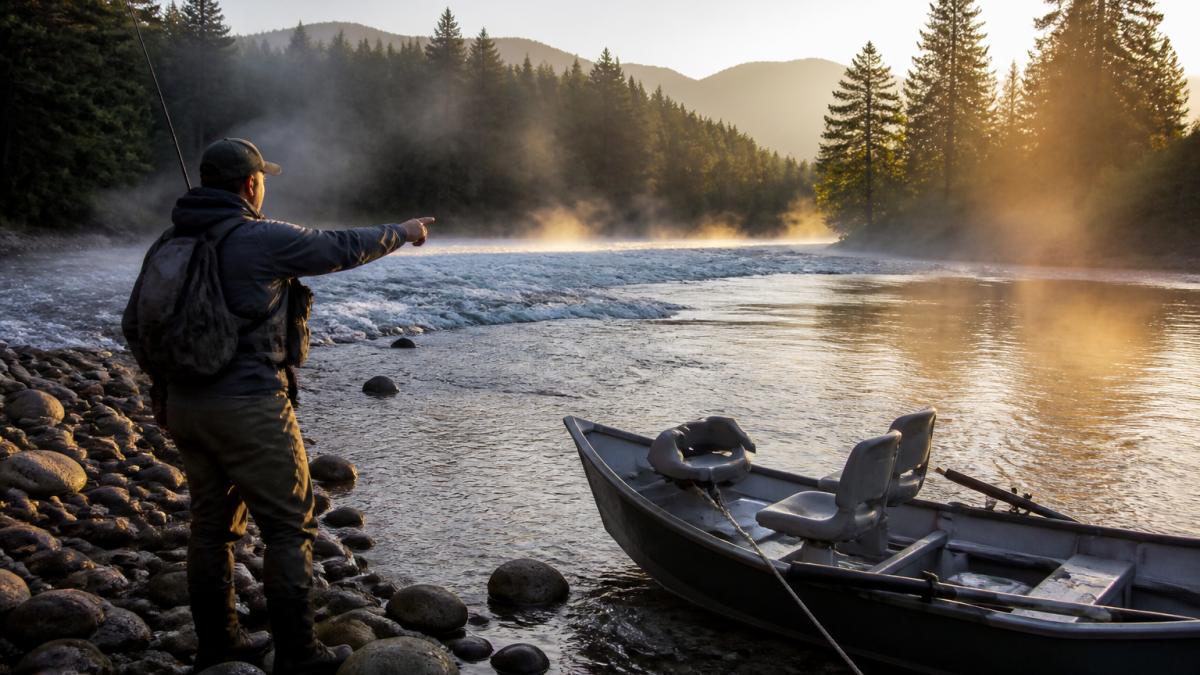
Holding Areas and Migration Routes
Holding areas are the deep, slow pockets where salmon rest before pushing farther upstream, and migration routes are the travel lanes they use to get there. Look for the seam where fast water meets slow, the tailout below a riffle, and the inside bend of a river where current softens. Fish these spots first, because that's where migrating salmon stack up.
Salmon Fishing River Conditions: Flow, Temperature, and Clarity
River conditions decide whether a run pushes upstream or stalls, and flow, water temperature, and clarity are the three variables that matter most. Salmon move best when flow is rising slightly after rain and water temperature sits in their comfort range. Cold, clear, low water slows everything down, while a muddy blowout can shut a run off entirely for days. The trick is not memorizing those rules, it is combining them into a single read before you rig up.
The Three Variables and What They Do
Flow. A rising hydrograph after rain gives salmon a navigable path and triggers upstream movement. A falling, clearing river concentrates fish in holding water. A blowout pushes them to the edges or stalls them entirely.
Water temperature. Each species has a comfort band. Chinook and coho tolerate cooler water than sockeye and pink. When temperature drops below the band, migration slows; when it climbs above it, fish move fast and shallow.
Salmon Cannonball Weights 2lb Lead Downrigger Sinkers →
Clarity. Salmon use sight and lateral line to navigate. Stained water can improve fishing by reducing spookiness; chocolate-milk water shuts down feeding and movement.
A Step-by-Step Method for Reading Current Conditions
Run this sequence before every trip:
- Check the hydrograph. Look at the last 72 hours of flow at the nearest gauge. Rising or stable-high is better than dropping and clearing.
- Check water temperature. Compare it to the comfort band for your target species. If it is below the band, expect slow fish and fish deeper.
- Check clarity. If you can see your boots in knee-deep water, it is clear; if you cannot see them at all, it is blown. Stained is the sweet spot.
- Check the weather. A coming rain event can trigger a push; a cold snap can stall it.
- Check recent reports. Local shops and charters know what the last three days looked like. Match your read to theirs.
- Pick your water. Rising flow: fish the lower river and move with the run. Falling and clear: slow down and target holding areas. Cold: fish deeper and slow your presentation. Warm: cover water and focus on travel lanes. Muddy: wait it out or move to a clearer tributary.
Matching Gear to the Read
Once you know the stage, match your presentation. Staging fish near river mouths respond to bright flashers and fast trolling; fish that have been in the river for weeks want slower presentations and smaller profiles. A flasher like the 11" Dual Fin Flasher Series at the right depth for the stage you're fishing is a proven way to trigger strikes from staging kings and coho. Pair it with the right downrigger weight, like our Salmon Cannonball Weights 2lb Lead Downrigger Sinkers, to hold your gear in the strike zone as fish move through.


| Condition | What It Means | What To Do |
|---|---|---|
| Rising flow | Fish push upstream | Fish the lower river, move with the run |
| Falling, clear flow | Fish hold in pools | Slow down, target holding areas |
| Cold water | Migration stalls | Fish deeper, slow your presentation |
| Warm water | Fish move fast | Cover water, focus on travel lanes |
| Muddy water | Run shuts down | Wait it out, fish clearer tribs |
Matching Your Tactics to Migration Stage
Tactics should change with the stage of the run, not stay fixed all season. Trolling a flasher like the 11" Dual Fin Flasher Series at the right depth for the stage you're fishing is a proven way to trigger strikes from staging kings and coho. Pair it with the right downrigger weight, like our Salmon Cannonball Weights 2lb Lead Downrigger Sinkers, to hold your gear in the strike zone as fish move through.
U.S. Fish and Wildlife Service salmon information
Every run is a moving target, and the anglers who catch consistently are the ones who plan around migration timing instead of hoping for luck. At Elliott's Tackle & Rigging, every piece of gear we sell is hand-selected by a captain with forty years on the water, so you're not guessing when it matters. From downrigger weights to flashers built for the spread, our catalog is built for serious salmon fishermen.
Frequently Asked Questions
When do salmon migrate?
Salmon migration timing varies by species and region. Spring Chinook often enter rivers from April through June, while fall Chinook and coho typically run from August through November. Sockeye and pink salmon usually migrate in summer. On the Great Lakes and East Coast, runs shift earlier or later depending on water temperature and river flow. Anglers should check local run calendars because peak migration can vary by two to three weeks from year to year.
What triggers salmon to migrate upstream?
Salmon migration upstream is triggered by a combination of changing daylight, water temperature, and river flow. When fall rains raise river levels and cool temperatures drop below about 55°F, adult salmon begin moving into spawning streams. Homing instinct guides them back to the watershed where they were born. Anglers watching for the first significant rain event after Labor Day often find the best early-season action.
How do water temperature and river flow affect salmon migration?
Water temperature and river flow are the two biggest factors in salmon fishing river conditions. Salmon avoid water warmer than 65°F and often hold in deeper pools until temperatures drop. A rising river after rain pulls fish upstream, while low, clear water makes them skittish and slow to move. Monitoring USGS stream gauges for flow and temperature helps anglers time trips when salmon are actively migrating rather than holding.
Where do salmon hold during their migration?
Salmon hold in areas with cover and cooler water: deep pools, undercut banks, behind boulders, and at the seams where fast current meets slow water. In tidal sections, they stack in deeper holes until the tide pushes them upstream. On the Great Lakes and East Coast rivers, look for similar holding areas below dams and around tributary mouths. Fishing these spots during low-light hours often produces the most strikes.
0 comments