

Table of Contents
- Why Downrigger Stacking Puts More Salmon in the Boat
- Gear You Need Before You Stack
- Downrigger Stacker Clip Setup: Choosing and Attaching Your Release
- Step-by-Step: Setting the Upper and Lower Lines
- Downrigger Line Spacing for Salmon: Depth, Speed, and Setback
- How to Prevent Downrigger Tangles
- Safety Around Cables, Weights, and Moving Gear
- Conclusion
- Frequently Asked Questions
Last Updated: October 21, 2026
Why Downrigger Stacking Puts More Salmon in the Boat
Downrigger stackers are the practice of running two or more fishing lines off a single downrigger cable.
Here is the reality on the water: kings and coho often hold in a narrow band of depth.
The stacked setup is a common technique for salmon trollers from the Pacific Northwest to the Gulf of America.
The payoff is simple. More baits in the strike zone means more shots at the fish you actually want to catch.
Gear You Need Before You Stack
Get the hardware right before you touch the water. A stacker setup fails for one of two reasons: the wrong release, or a cable that was never meant to carry two loads.
Here is what belongs on the boat:
- A stacker release with a leader, sized to your target species
- A primary release for your main (lower) line
- A downrigger weight heavy enough to track straight at trolling speed
The release is the piece most people skimp on, and it is the piece that decides whether stacking works. A cheap clip that grips too hard will drag a small salmon around without tripping.

Downrigger Stacker Clip Setup: Choosing and Attaching Your Release
A downrigger stacker clip is the release that holds your upper line and attaches to the downrigger cable above the weight.
We recommend the Scotty Power Grip Plus Stacker with 6" leader for most salmon trolling.

For fish that are running deeper or hitting light, the Scotty Power Grip Plus Stacker with 30" leader gives you more setback and a longer, more natural presentation.

If you want maximum tension range, the Cannon Universal Stacker Release covers 2 to 22 lb with two independent adjustment points.
And for the fastest setup, the Cannon Quick Stacker clips straight onto the cable with no twisting or looping, which cuts wear on your line.
Scotty Power Grip Plus Release - Stacker w/ 6" Leader →
Attaching the Stacker to the Cable
Attach the stacker above the weight, not at the weight. Clip the release onto the downrigger cable at the depth you want your upper line to run.
The key detail most anglers miss: the stacker should sit on the cable, but the line should sit in the release. Those are two separate connections. Get them confused and you will either lose the release or never trip it.
Setting Release Tension
Set tension by feel, then test it. Pull your line out of the clip by hand. It should release with a firm, steady pull, not a snap and not a struggle.
- Too tight: small fish drag without tripping, and you miss the hookset
- Too loose: the line pops on wave action or speed changes
- Just right: a solid pull frees the line, and a salmon strike trips it clean
On the Scotty models, slide the line deeper into the jaws for more hold, or shallower for less. The built-in tension adjuster can double holding power when you are running heavier gear or faster trolling speeds.
Step-by-Step: Setting the Upper and Lower Lines
Most stacking guides stop at "clip it on and let it out." That is not a salmon setup. The sequence below is built around how salmon often approach a trolled spread: they often follow the lower line first, then rise to the upper. That behavior dictates which line goes in the water first and how far back each one runs.
Before You Start
Confirm three things at the dock: both rods are rigged with the same line type and weight, both releases are set to trip under a firm pull, and the downrigger cable is free of frays. Mismatched rods are the quiet cause of most stacked-line tangles, because one rod loads deeper than the other and the lines cross on turns.
The Salmon-Specific Setup Sequence
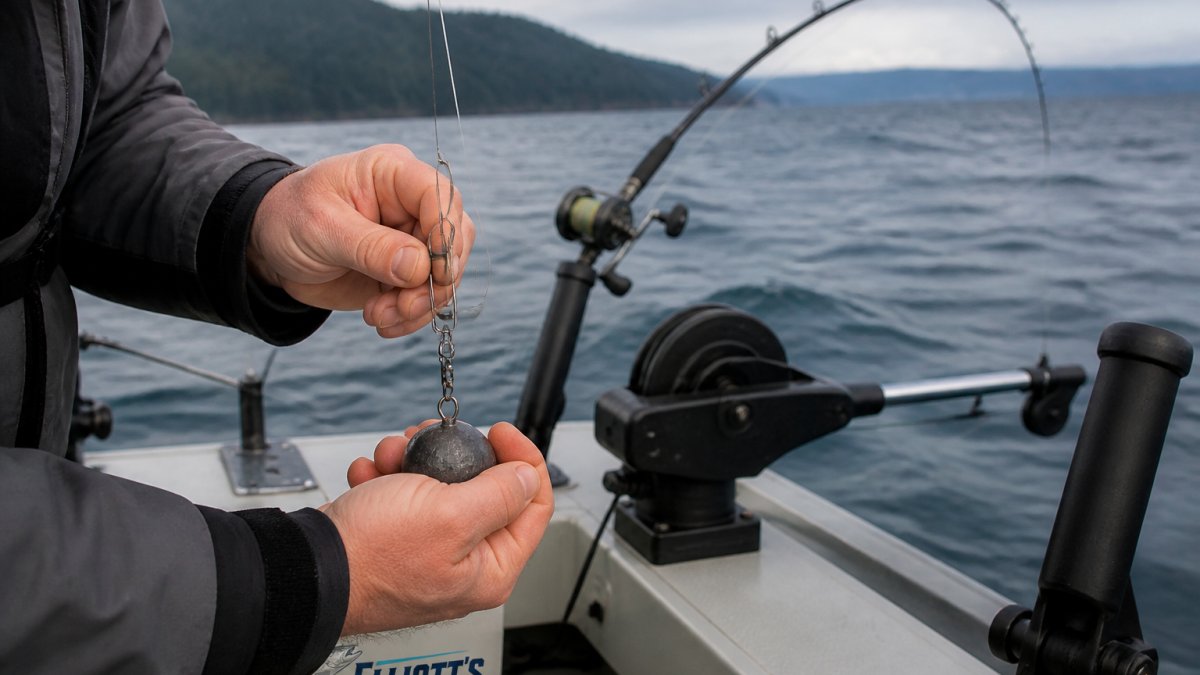
- Lower the weight to your target depth first. Send the cannonball down before anything is attached. This keeps the cable straight and gives you a stable reference for where the stacker will sit. On a manual downrigger, use the clutch to control descent; on an electric, watch the counter and stop at depth.
- Attach the stacker release to the cable above the weight. Clip it at the depth you want the upper line to run. The stacker sits on the cable; the fishing line sits in the release jaws. Keep those two connections separate.
- Set the lower line in the primary release at the weight. Let out your setback, then engage the reel and confirm the line sits cleanly in the clip.
- Set the upper line in the stacker release. Let out its setback, which should be shorter than the lower line's setback. This is the salmon-specific detail most guides skip: the upper line runs tighter to the cable so it does not cross the lower line when a fish strikes or the boat turns.
- Check both lines for twist and confirm each sits in its clip without slack.
- Start your troll slow and watch both rods for the first few minutes. A rod that pulses or dips without a fish is telling you the release is too loose or the setback is wrong.
Setting Depth and Setback for Salmon
A common pattern among salmon trollers is to run the lower line at the depth where the fish are marking and the upper line ten to fifteen feet above it.
When fish are suspended and spooky, lengthen both setbacks and widen the vertical gap. When fish are aggressive and deep, tighten the setbacks and run the upper line closer to the weight.
The salmon-specific rule that separates a working stack from a tangle: lower line long, upper line short, and always set the lower line first.
Downrigger Line Spacing for Salmon: Depth, Speed, and Setback
A fixed spacing rule is a starting point, not a setup. The gap between your stacker and your weight should change with depth, trolling speed, water clarity, and how the fish are behaving. The framework below outlines how spacing can be adjusted on the water.
The Three Variables That Set Spacing
- Vertical gap: the distance between the stacker release and the weight. Start at ten feet and adjust from there.
- Trolling speed: faster speeds pull both lines tighter and reduce swing, so you can run a closer gap. Slower speeds let baits wander, so open the gap.
- Setback: how far each line runs behind its release. The upper line should run a shorter setback than the lower line to prevent crossing on turns.
How to Adjust Spacing by Condition
- Deep, fast trolling: tighten the vertical gap toward ten feet and shorten setbacks. The lines track straighter and the risk of fouling drops.
- Slow trolling or live bait: open the gap to fifteen feet or more and lengthen setbacks so baits swing naturally.
- Clear water or pressured fish: widen both the vertical gap and setbacks. Salmon that have seen a spread before respond better to separation.
Leader Length and Setback
Setback is how far your line runs behind the release. Leader length is how far your bait sits from the clip. Both change how the presentation looks to a salmon.
- Short setback: tight to the cable, good for deep, fast trolling.
- Long setback: more natural action, better for pressured fish and clear water.
- Short leader: less fouling, better for stacked upper lines.
- Long leader: more swing, better for aggressive fish but riskier when stacked.
The upper line typically runs a shorter setback than the lower line. That stagger is what keeps the two presentations from crossing when the boat turns, and it is the detail most stacking guides leave out.
When in doubt, widen the vertical gap before you change anything else. Spacing is the cheapest fix for tangles, and it costs you nothing but a few feet of cable.
Scotty Power Grip Plus Release - Stacker w/ 6" Leader →
How to Prevent Downrigger Tangles
Most downrigger tangles trace back to one of four causes. Fix these and the problem mostly disappears.
- Spacing too tight. Keep a real gap between the stacker and the weight.
- Turning too sharp. Wide, gradual turns keep both lines tracking clean.
- Speed swings. Hold a steady trolling speed instead of surging.
- Mismatched setbacks. Upper line short, lower line long, every time.
The other culprit is a worn release. A clip that has lost its grip lets the line creep and swing into the cable. Check your releases before every trip, and swap any that feel loose.
The single biggest cause of tangles with downrigger stackers is turning too sharp with too little spacing. Widen the gap between the stacker and the weight before you change anything else.
Safety Around Cables, Weights, and Moving Gear
A downrigger under load is a machine, and it will hurt you if you forget that. The cable carries serious tension, and the weight swings when the boat rolls. Treat both with respect.
- Keep hands clear of the cable when the weight is moving up or down.
- Never grab the cable to slow a falling weight. Use the clutch or brake.
- Watch the weight on turns. A swinging cannonball can crack a hull or break a wrist.
- Secure loose line. A loop around a cleat or a finger is a real hazard.
Downrigger weights can cause injuries. Slow down, keep your hands where they belong, and rig with the weight in the water, not swinging over the deck.
Conclusion
Stacking your downriggers is one of the cheapest ways to put more salmon baits in the strike zone.
The hard part is discipline. Set your releases right, keep your spacing honest, and slow down on the turns.
If you want gear you can trust on the water, our team at Elliott's Tackle & Rigging hand-picks every release and downrigger accessory we sell.
Frequently Asked Questions
How far apart should stacked downrigger lines be?
Keep at least 10 to 15 feet between the upper and lower releases on the cable, and run more separation in shallower water or when salmon are aggressive. The upper line should sit well above the lower release so a fish on the bottom line does not cross the top leader during the fight. If you are fishing tight to the bottom in 30 feet or less, either shorten the setback or drop to a single line. Consistent spacing is the single biggest factor in avoiding tangles when you stack.
Where should you attach the stacker release clip?
Clip the stacker directly to the downrigger cable above the cannonball, not to the weight itself, unless the release is designed to attach at the ball. A cable-mounted stacker like the Cannon Quick Stacker clips on without twisting or looping the line, which reduces wear. Set the upper release 10 to 15 feet above the lower one, then let the line out until the rod loads slightly. The clip should hold firm at trolling speed but pop free on a strike.
How do you prevent stacked downrigger lines from tangling?
Three habits prevent most tangles: keep 10 to 15 feet between releases, match your setback to your trolling speed so the lines run at similar angles, and turn gradually instead of carving tight circles. Use a stacker release with adjustable tension so the upper line releases cleanly on a strike rather than dragging. Check the cable for fraying and the release pads for wear each trip. If you are trolling in rough water or crossing another boat's wake, pull the upper line and run a single stack.
Can you stack lines when salmon fishing in rough water?
It is possible but risky. In choppy conditions the boat surges, the cable angles change, and the upper line can swing into the lower one. Most experienced anglers drop to a single line per downrigger when seas build, or shorten the setback and increase spacing to 20 feet. If you do stack, use a release with firm tension and keep your trolling speed steady. Pulling the stack before you turn into a beam sea saves a lot of frustration and lost fish.
0 comments