

Table of Contents
- Understanding Salmon Trolling Setup for Beginners
- Essential Salmon Trolling Gear List
- Best Salmon Trolling Lures and Bait Presentation
- Downrigger Setup for Salmon: Depth and Water Column Control
- Core Salmon Trolling Techniques for Success
- Electronics, Safety, and Post-Catch Handling
- Common Mistakes and Troubleshooting Your Salmon Trolling Setup
- Conclusion
Salmon Trolling Setup for Beginners: A Complete Guide
Last Updated: July 16, 2026
Understanding Salmon Trolling Setup for Beginners
A salmon trolling setup for beginners doesn't need to be complicated or expensive to be effective. The key is understanding which components work together to put your lure in front of feeding salmon at the right depth and speed. Trolling works because it covers water efficiently, instead of casting and waiting, you're moving your lure through the water column where salmon actively hunt.
Research from Washington Department of Fish and Wildlife shows that trolling produces consistent catches across Puget Sound and the Pacific Northwest because it allows anglers to control depth, speed, and lure presentation simultaneously. The salmon trolling setup for beginners consists of five core components: a rod and reel rated for saltwater use, line appropriate for the species you're targeting, a downrigger or alternative depth control device, lures or bait, and leader material.
Why Trolling Works for Salmon
Salmon are migratory fish that cover significant distances during feeding periods. They move through specific water columns based on temperature, light penetration, and food availability. When you troll, you're searching the water column methodically rather than hoping salmon swim past your stationary position.
Trolling speed matters tremendously. Most Pacific Northwest anglers troll between 1.5 and 3 knots depending on the species and water conditions. Chinook salmon respond better to slower presentations (1.5-2 knots), while Coho and Pink salmon often prefer slightly faster speeds (2-2.5 knots). Your lure action changes at different speeds, which directly impacts your hook-up rate.
Trolling vs. Other Salmon Fishing Methods
Mooching, dropping bait straight down from a drifting boat, works well when you know salmon are holding at specific depths. But mooching requires you to be in the right location first. Trolling lets you search larger areas and adjust your depth quickly if fish aren't responding.
Casting from shore or a boat covers far less area than trolling. You're relying on salmon to come to your lure rather than bringing your lure to where salmon are feeding. The real advantage of trolling is control: you control speed, depth, lure action, and presentation timing.
Essential Salmon Trolling Gear List
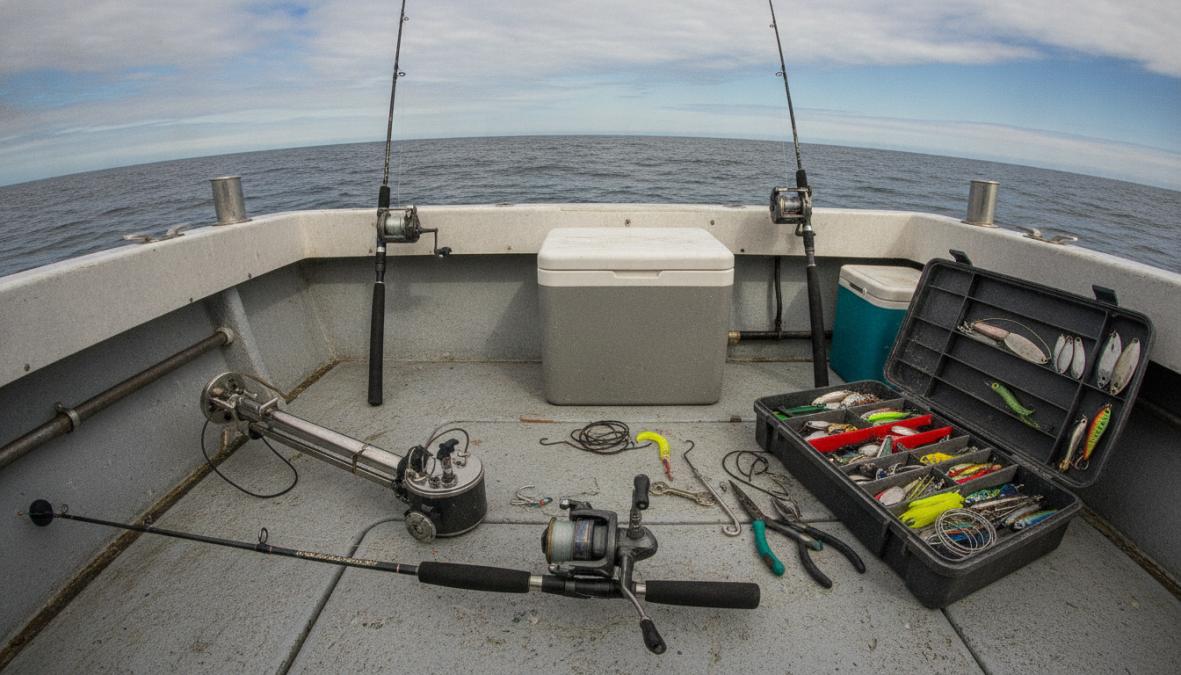
A functional salmon trolling setup for beginners requires seven key pieces of equipment. You don't need top-of-the-line versions of each, but you do need each component to work reliably on saltwater.
Rod and Reel Specifications
Your rod should be medium-heavy action, 6.5 to 7.5 feet long, rated specifically for saltwater use. The length gives you leverage to set the hook and fight larger fish. You need at least 200 yards of line capacity for trolling in most Pacific Northwest waters.
Conventional reels (baitcasting style) are preferred by most trollers because they give you precise speed control and better feel for what's happening below the boat. A quality saltwater reel with a smooth drag system prevents line breakage during the fight.
Line Selection: Braided vs. Fluorocarbon
Braided mainline is the standard choice for trolling. It has minimal stretch, which means you feel hits immediately and can set the hook faster. For a salmon trolling setup, 20-30 pound braided mainline works for most species.
Fluorocarbon is invisible underwater and should be used for your leader material. Salmon have excellent vision, and a visible monofilament leader spooks feeding fish. A 2-3 foot fluorocarbon leader (12-20 pound test depending on species) connects your braided mainline to your lure. This combination balances sensitivity with stealth and pays for itself in improved hook-up rates within your first few trips.
Depth Control Equipment
A downrigger is the most effective depth control tool for trolling. It's a mechanical device that holds your lure at a precise depth while you troll. A cable with a weighted ball (typically 8-15 pounds) descends to your target depth, and your line clips into a release mechanism. When a salmon hits, the line pops free from the release, and you fight the fish on your rod and reel without the weight of the downrigger ball.
Divers are an alternative to downriggers. These torpedo-shaped devices attach directly to your line and dive to depth based on their design and trolling speed. Divers are less expensive but require more experience to use effectively. For your first salmon trolling setup, a single downrigger is sufficient.
Best Salmon Trolling Lures and Bait Presentation
The lures you choose depend on the salmon species you're targeting and water conditions. A basic salmon trolling setup for beginners should include spoons, plugs, and spinners to cover different scenarios.
Spoons, Plugs, and Spinners Explained
Spoons are the workhorse lure for trolling. They're curved metal plates that flutter and flash as they move through the water, mimicking baitfish and triggering strikes. Spoons are durable, easy to use, and effective across all salmon species. Start with spoons in silver and chartreuse colors.
Plugs are hard plastic lures designed to dive to specific depths. They have a lip that creates a wobbling action when trolled and work well for targeting salmon at intermediate depths (15-40 feet), particularly Chinook salmon.
Spinners combine a spinning blade with a body and hook. The blade creates vibration and flash. They work best in areas with good visibility and are inexpensive, though less durable than spoons.
Flasher and Leader Length Setup
A flasher is a metal blade (usually 3-5 inches) that attaches above your lure. It creates additional flash and vibration that attracts salmon from a distance. The flasher does the "calling," and your lure does the "convincing."
Leader length between your flasher and lure matters. A 30-inch fluorocarbon leader is standard and gives your lure enough separation from the flasher that it can move independently. The connection between your mainline and flasher should be via a ball-bearing swivel to prevent line twist, which is critical because trolling creates constant rotational stress on your line.
Downrigger Setup for Salmon: Depth and Water Column Control
A downrigger is where precision enters your salmon trolling setup for beginners. Understanding how to use it transforms your fishing from random searching to methodical hunting.
Downriggers vs. Divers: When to Use Each
A downrigger holds your lure at a fixed depth while you troll. This is invaluable when you've located salmon on your fish finder or when you know from experience that salmon are holding at a specific depth. Downriggers also reduce the effort required to fight a fish because your rod isn't fighting the weight of a diver.
Divers are more affordable and don't require electricity or complex rigging. However, they require you to estimate how deep they're running based on line length and trolling speed. For a beginner's first season, a single downrigger is the better choice because it removes guesswork from depth control.
Setting Trolling Speed and Depth
Most salmon respond to trolling speeds between 1.5 and 3 knots. Chinook prefer slower speeds (1.5-2 knots), while Coho and Pink salmon often hit harder at 2-2.5 knots. Your boat's GPS or trolling speed indicator tells you exactly how fast you're moving.
Depth depends on water conditions and the time of year. In early spring, salmon often hold in shallower water (20-40 feet). As water warms in summer, they move deeper (40-80 feet). Start by setting your downrigger to 35 feet and adjusting based on where you're getting hits. Faster trolling creates more lure action and can push your lure shallower than your downrigger setting indicates, while slower trolling allows your lure to run deeper.
Core Salmon Trolling Techniques for Success
Successful trolling isn't just about equipment, it's about reading conditions and adapting your approach.
Species-Specific Tactics: Chinook, Coho, and Pink Salmon
Chinook salmon are the largest Pacific salmon and often the most aggressive. They respond well to larger lures (3-4 inch spoons) and slower trolling speeds. Chinook hold deeper than other species and prefer cooler water. Set your downrigger deeper (50-80 feet) and troll slower than you would for Coho.
Coho salmon are more active hunters. They chase faster-moving prey and respond well to higher trolling speeds (2-2.5 knots). Coho often hold at intermediate depths (30-50 feet) and are less sensitive to exact depth than Chinook. Smaller, more active lures (2-3 inch spoons) work well for Coho.
Pink salmon are smaller and less selective. They're excellent targets for beginners because they hit readily and don't require precise depth or speed control. Troll slightly faster for Pinks (2.5-3 knots) with smaller spoons in chartreuse or orange.
Reading Water Conditions and Tide Changes
Water temperature is the primary factor controlling salmon behavior. Most salmon feed actively in water between 48 and 55 degrees Fahrenheit. A simple temperature gauge on your downrigger cable tells you the water temperature at depth.
Tide changes affect salmon feeding patterns. Many anglers report better fishing during slack tide (the period between tidal changes) because salmon are less distracted by current. Structure, drop-offs, underwater ridges, and areas where different water masses meet concentrate salmon and increase your success rate significantly.
Electronics, Safety, and Post-Catch Handling
Modern marine electronics transform salmon trolling from guesswork to precision fishing.
Using Marine Electronics and Sonar Interpretation
A fish finder (sonar) shows you what's happening beneath your boat in real time. Salmon appear as arcs on the sonar screen. The larger the arc, the larger the fish. Learning to distinguish salmon from other species and structure takes practice, but it's worth the effort.
Water temperature displays on your electronics help you find the optimal feeding zone. Many anglers look for water between 48 and 55 degrees and troll along the boundary where this temperature band meets warmer or cooler water. This boundary, called a thermocline, concentrates salmon because it marks the edge of their preferred temperature range.
Safety Regulations and Best Practices
Check current regulations with Washington Department of Fish and Wildlife before each trip. Salmon seasons, daily limits, and size restrictions change annually.
Wear a Coast Guard-approved personal flotation device (PFD) whenever you're on the water. Tell someone on shore where you're fishing and when you expect to return. Carry a marine radio or cell phone for emergencies.
Proper Salmon Handling and Care
When you hook a salmon, fight it steadily without excessive jerking. Once the salmon is boated, handle it quickly and carefully. Wet your hands before touching the fish to protect its protective slime coat.
If you're keeping the salmon, kill it humanely with a sharp blow to the head. If you're releasing the fish, minimize air exposure and return it to the water as quickly as possible. Keep your salmon on ice immediately after landing to preserve meat quality.
Common Mistakes and Troubleshooting Your Salmon Trolling Setup
Most beginners make predictable mistakes that cost them fish. Understanding these errors and how to correct them accelerates your learning curve.
| Mistake | Cause | Fix | Result |
|---|---|---|---|
| No hits despite being in good area | Lure too deep or shallow | Adjust downrigger depth by 10 feet and observe | More strikes within 30 minutes |
| Frequent line breaks during fight | Drag set too tight | Set drag to slip at 25% of line test | Fish landed instead of broken line |
| Lure spinning/twisted line | No swivel between mainline and flasher | Add ball-bearing swivel above flasher | Cleaner casts and fewer breaks |
| Difficulty detecting hits | Braided line too thick or rod too stiff | Switch to 20-30 lb braided and medium-heavy rod | Immediate strike detection |
| Downrigger cable fraying | Improper cable storage or sharp edges | Store cable loosely and check for burrs | Extended equipment life |
Adjustments for Poor Conditions
When fishing is slow, make one adjustment at a time and fish for 30 minutes before evaluating results. If you're not getting hits, adjust depth first by moving your downrigger up or down by 10 feet. If that doesn't work, change lure color. Bright colors (chartreuse, orange) work better in low-light or murky water. Darker colors (black, purple) work better in clear water.
If you're getting hits but not hooking fish, your leader might be too light or your hook might be dull. Check your hook point with your fingernail, it should catch slightly. If it slides smoothly, sharpen it or replace the lure.
Conclusion
Building a salmon trolling setup for beginners requires understanding five core components and how they work together. Start with the fundamentals covered in this guide, invest in quality braided line and a downrigger, and spend your first season learning to read water and adjust depth. The fish are out there, a proper salmon trolling setup for beginners simply puts you in position to catch them.
Frequently Asked Questions
What is a basic salmon trolling setup for beginners?
A basic salmon trolling setup includes a medium-heavy rod and reel, braided or fluorocarbon line, a downrigger or diver for depth control, and lures like spoons or plugs. You'll also need a flasher to attract salmon and a leader to connect your main line to the lure. This foundation works across Puget Sound and the Pacific Northwest for Chinook, Coho, and Pink salmon.
What trolling speed should you use for salmon?
Most salmon trolling speeds range from 1.5 to 3.5 knots, depending on species and water conditions. Chinook typically respond well to 2-3 knots, while Coho prefer slightly faster speeds around 2.5-3.5 knots. Pink salmon often feed actively at 3-4 knots. Adjust speed based on lure action and feeding salmon behavior, slower speeds work better in cold water or when fish are less active.
Do you need a downrigger for salmon trolling?
A downrigger is highly recommended for salmon trolling setup, especially for reaching feeding salmon at specific depths in the water column. Downriggers allow precise depth control better than divers alone. However, beginners can start with divers or sinkers if budget is a concern. Downriggers improve your success rate significantly by placing lures in the exact zone where salmon migrate and feed.
What are the best lures for salmon trolling?
Effective salmon trolling lures include spoons (which mimic baitfish with flash and action), plugs (that dive and wiggle naturally), and spinners (with rotating blades for vibration). Pair your lure with a flasher to increase visibility and attraction. Leader length typically ranges from 18 to 36 inches depending on water clarity and species. Experiment with different colors and sizes based on water conditions and salmon species you're targeting.
How deep should you troll for salmon?
Salmon depth varies by species and season. Chinook often feed at 40-120 feet, while Coho typically stay at 20-60 feet. Pink salmon may be shallower, around 15-40 feet. Use marine electronics and sonar to locate the thermocline and feeding salmon in the water column. Adjust your downrigger depth based on tide changes and water conditions, drop-off areas often hold more feeding salmon.
What line should I use for salmon trolling?
Braided line offers superior strength and sensitivity for salmon trolling setup, allowing you to feel lure action and detect strikes. Fluorocarbon leaders provide invisibility near the lure and resist abrasion. Many anglers use 20-30 lb braided main line with 15-20 lb fluorocarbon leaders. This combination balances strength, casting distance, and bait presentation for successful salmon trolling in Puget Sound and Pacific Northwest waters.
How do you rig a flasher for salmon trolling?
Attach your flasher to your main line using a ball-bearing swivel to prevent line twist. Position it 18-36 inches above your lure or bait, the exact distance depends on water clarity and salmon species. The flasher creates flash and vibration that attracts feeding salmon. Use a quality leader to connect the flasher to your lure, ensuring the entire rig moves naturally through the water column without tangling.
This article was written using GrandRanker
0 comments