

Table of Contents
- Does Scent on Salmon Lures Actually Work?
- Best Salmon Fishing Scents and Attractant Types
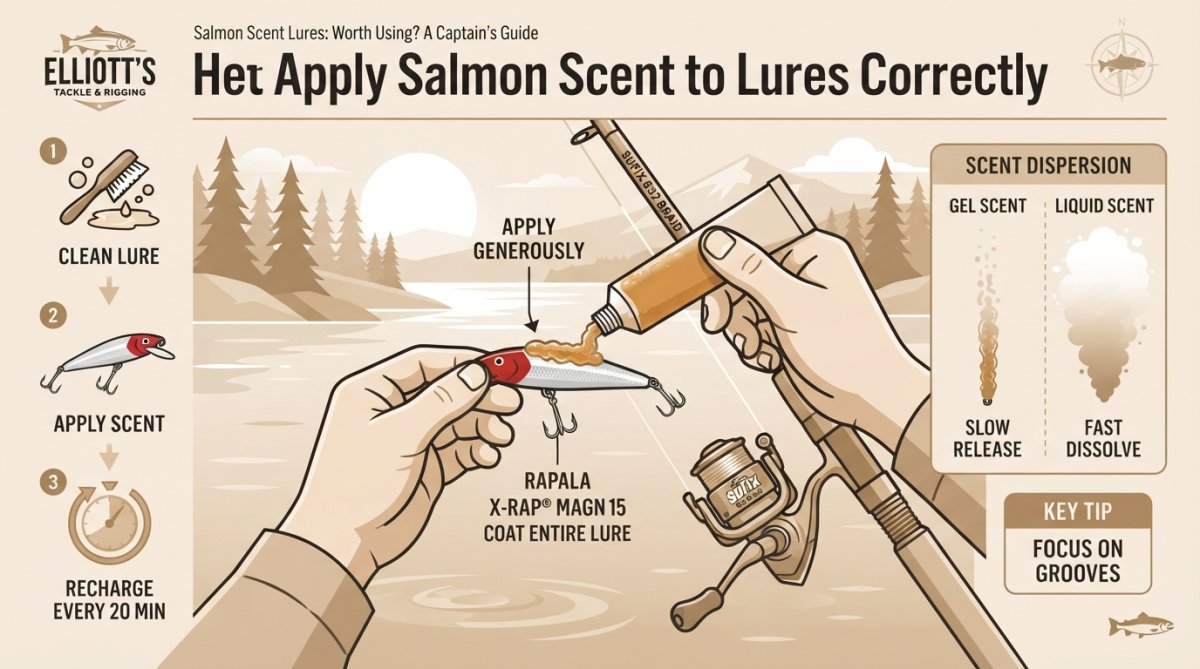
- How to Apply Salmon Scent to Lures Correctly
- Saltwater Salmon Lures and Scent Strategy in the Pacific Northwest
Salmon Scent Lures: Worth Using? A Captain's Guide
Last Updated: July 28, 2026
The question of whether is it worth using scent on salmon lures comes up constantly among Pacific Northwest anglers, and the answer depends on your specific conditions. At Elliott's Tackle & Rigging, we've tested scent applications across dozens of charter trips and found that scent works when you understand why it works and how to apply it correctly. Most anglers either overuse scent or apply it wrong, which explains why some swear by it and others dismiss it entirely.
Does Scent on Salmon Lures Actually Work?
Yes, salmon scent lures do work. Salmon possess an extraordinary olfactory system that can detect chemicals at concentrations measured in parts per billion, roughly equivalent to detecting a single drop of liquid in an Olympic swimming pool. When you apply scent to your lures, you're adding a supplementary signal that tips the decision in your favor, especially when fishing pressure is high or water conditions are marginal.
The goal is maintaining scent longevity throughout your presentation and ensuring the scent disperses properly in the water.
Best Salmon Fishing Scents and Attractant Types
Salmon scent attractants fall into three broad categories: gel-based, oil-based, and spray formulations.
Gel scents are the most popular choice because they adhere to your lure longer and release scent gradually as water friction breaks down the gel matrix. Gel formulations work best when you're trolling at consistent depths and speeds.
Oil-based scents disperse faster and create a pronounced scent cloud, ideal for areas with strong current or when covering water quickly. Anchovy oil, sardine oil, and herring-based formulations are common because they match natural prey species salmon hunt. The downside is that oil-based scents wash off faster, requiring reapplication every 15-20 minutes.
Spray scents offer convenience and even coverage, but work best as a supplementary boost rather than your primary application.
Scent Type |
Longevity |
Best For |
Application Frequency |
|---|---|---|---|
Gel |
20-40 minutes |
Deep trolling, steady presentations |
Every 30-40 minutes |
Oil-based |
10-20 minutes |
Fast trolling, high-current areas |
Every 15-20 minutes |
Spray |
5-10 minutes |
Quick coverage, supplementary boost |
Before each new drift |
The most effective approach combines gel and oil: apply a gel base for sustained release, then spray with oil-based scent when moving into a new zone or after a long period without strikes.
How to Apply Salmon Scent to Lures Correctly
Improper application ruins more scent applications than any other factor. Most anglers either glob scent onto their lures or apply it so sparingly that it washes off before the lure reaches productive depth.
Step 1: Clean your lure. Rinse your spoon, plug, or soft plastic with fresh water and dry it completely. Any algae, slime, or residue reduces scent adhesion.
Step 2: Apply gel scent in thin, even layers. A thin coating, roughly the thickness of a credit card, works better than a thick glob because it releases scent gradually. For a 3-inch spoon, use about a quarter-sized amount of gel.
Step 3: Work the gel into the lure's surface. Use your thumb to spread the gel across the body, paying special attention to the sides and belly where water turbulence is highest.
Step 4: Wait 20-30 seconds before fishing. Let the gel set slightly so it doesn't immediately wash off.
Step 5: Reapply every 30-40 minutes of active fishing. Refresh your application before you lose effectiveness entirely.
Saltwater Salmon Lures and Scent Strategy in the Pacific Northwest
The Pacific Northwest's saltwater salmon fishery presents unique conditions that demand a different scent strategy than freshwater applications. Saltwater disperses scent differently, and the presence of natural baitfish creates competing olfactory signals your lure must overcome.
In saltwater environments, scent degradation accelerates because salt water contains higher concentrations of enzymes and microorganisms that break down organic compounds. A gel scent that lasts 40 minutes in a river might only last 25-30 minutes in the ocean, which is why reapplication frequency matters even more in saltwater.
For chinook trolling at depths below 40 feet, gel scents outperform oils because they maintain concentration longer in the water column. For coho in shallower water (15-30 feet), a combination approach works best: gel base with occasional oil-based boosts. Steelhead in saltwater are less scent-dependent than chinook but more responsive to scent than many freshwater steelhead. Apply gel scent to your plugs and spoons, but don't expect scent alone to trigger strikes.
When fishing during periods of high fishing pressure, scent becomes your competitive advantage. Other anglers are running the same plugs and spoons you're using. Scent application separates the boats catching fish from the boats watching others catch fish.
The evidence is clear: scent works when you apply it correctly and match your strategy to water conditions, target species, and fishing depth. Elliott's Tackle & Rigging stocks captain-tested lures designed to hold scent effectively. Stop guessing about whether scent is worth it and start fishing with a proven system that delivers results on the water.
Frequently Asked Questions
Do salmon scent attractants on lures really improve catch rates?
Scent can improve your odds, especially in low-visibility conditions, cold water, or when fish are pressured. Salmon rely heavily on chemoreception to locate food—they can detect bait fish oils at parts per billion concentrations. However, scent alone won't overcome poor lure placement or trolling speed. The real value emerges when combined with proper technique and lure selection for your water conditions.
What are the best salmon fishing scents for Pacific Northwest saltwater?
Anchovy oil, sardine, and herring-based scents work well for Pacific Northwest salmon because they match natural forage. Gel scents like Smelly Jelly and oil-based options from Pro-Cure are popular because they disperse slowly and maintain longevity in saltwater. Choose scents that match the bait fish in your specific fishery—chinook, coho, and steelhead all respond to these natural attractants when applied to spoons and plugs.
How often should I reapply scent to my salmon lures?
Reapply scent every 15–20 minutes of active trolling or after each fish contact. Saltwater conditions, water temperature, and lure action all affect scent dispersal. Gel scents last longer than oils in colder water. If you're fishing high-pressure areas, more frequent application can help—the scent trail created by continuous dispersion attracts fish from greater distances.
Can removing human odor and gasoline residue from tackle actually help?
Yes. Salmon can detect human scent and fuel residues at very low concentrations, which may mask or interfere with attractant scents. Rinse your hands, lures, and tackle in fresh water before fishing, and avoid touching your lures directly. Store gear away from nicotine and fuel fumes. This simple step costs nothing and removes a barrier to scent effectiveness, especially when fishing pressure is high.
0 comments