

Table of Contents
- Understanding Minn Kota Trolling Motors: Core Features and Technology
- Minn Kota Riptide PowerDrive Series: Advanced Navigation and Control
- Trolling Motor Thrust Guide: Choosing the Right Power Level
- Trolling Motor Shaft Length Selection Guide
- Minn Kota Saltwater Trolling Motors: Corrosion Resistance and Durability
- Battery Life and Power Management for Extended Fishing Days
- Installation, Maintenance, and Long-Term Durability
- Minn Kota Accessories: Enhance Your Trolling Motor Setup
Last Updated: August 1, 2026
When outfitting a fishing boat for Pacific Northwest saltwater conditions, your trolling motor choice determines whether you'll have precise control or spend the day fighting current and wind. Minn Kota Trolling Motors deliver the reliability serious anglers depend on in rough conditions. At Elliott's Tackle & Rigging, we've spent forty years hand-selecting gear that actually works on the water, and Minn Kota sits at the core of our lineup because the engineering is superior.

Understanding Minn Kota Trolling Motors: Core Features and Technology
The motor you pick isn't just about thrust, it's about how that power translates to control, battery life, and whether you'll actually use all the features you're paying for. A 55-pound thrust motor on a 16-foot boat behaves completely differently than the same motor on a 20-footer.
Minn Kota's brushless motor technology eliminates carbon brush maintenance while delivering consistent power. Brushless motors run cooler, draw less amperage at the same thrust level, and last significantly longer than older designs. Variable speed control lets you dial in exactly the speed you need, crawling through shallow water at 0.5 mph or cruising at full throttle when covering ground quickly.

Thrust and Power Specifications Explained
Thrust is measured in pounds and represents the motor's ability to push your boat through water. Saltwater fishing often demands 55-80 pounds because you're fighting tidal current, heavier boats, and choppier conditions. The Pacific Northwest presents unique challenges, cold water, strong current, and significant tidal movement mean you need more power than you might think.
Voltage also matters significantly. Minn Kota offers 12V, 24V, and 36V systems. A 12V system is lighter and simpler but draws more amperage, draining your battery faster under sustained use. A 24V or 36V system delivers the same thrust with lower amperage draw, extending your fishing day considerably.
Brushless Motors and Variable Speed Control
Brushless motor technology eliminates carbon brushes that wear out in traditional designs. Electronic switching controls current flow instead, resulting in less heat generation, lower maintenance, and more consistent performance over the motor's lifetime.
Variable speed control lets you match your trolling speed to conditions and target species. King salmon might require a 1.5 mph presentation, while halibut fishing demands near-stationary positioning.
Minn Kota Riptide PowerDrive Series: Advanced Navigation and Control
The Riptide PowerDrive represents the upper end of Minn Kota's lineup, where GPS integration and advanced autopilot features enter the picture. These motors combine brushless power with integrated GPS, heading sensors, and digital maximizer technology that automatically adjusts power output based on current and wind conditions.

I-Pilot GPS and Spot-Lock Technology
I-Pilot GPS is Minn Kota's flagship autopilot system. The system integrates a GPS receiver and heading sensor that hold your boat on a precise course or lock onto a specific waypoint. Spot-Lock uses GPS to hold your exact position, accounting for current and wind drift automatically. You mark a waypoint over a productive reef or kelp bed, engage Spot-Lock, and the motor maintains your position while you fish. This is especially valuable in the Pacific Northwest where tidal current can swing 2-3 knots in either direction.
Remote Control and Foot Pedal Operation
Minn Kota Riptide PowerDrive motors offer both wireless remote control and traditional foot pedal operation. The Minn Kota Micro Remote-Bluetooth gives you wireless control from anywhere in the boat, which is useful when fighting a fish and needing to adjust position without reaching down to a pedal.
The foot pedal remains the primary control for most anglers because it's always available and doesn't require batteries. For precision work in tight water, many anglers prefer pedal control because the feedback is immediate and intuitive.
Trolling Motor Thrust Guide: Choosing the Right Power Level
Selecting the right thrust level prevents overspending or underperforming. Too much thrust wastes money and battery life. Too little creates frustration and limits your ability to fish effectively in challenging conditions.
Freshwater vs. Saltwater Thrust Requirements
Freshwater trolling motors typically run 30-55 pounds of thrust. Saltwater fishing demands more power because of tidal current, heavier boats, and the need to hold position in rougher water. Pacific Northwest saltwater anglers typically run 55-80 pounds of thrust minimum.
Weight-to-Thrust Ratio and Boat Size Considerations
A basic guideline: you want at least 1 pound of thrust for every 50-75 pounds of boat weight (including fuel, gear, and anglers). A 20-foot boat with full fuel and three anglers might weigh 6,000-7,000 pounds, suggesting 80-140 pounds of thrust for comfortable operation.
Boat Type |
Typical Weight |
Recommended Thrust |
Voltage |
|---|---|---|---|
14-foot aluminum skiff |
1,500-2,000 lbs |
30-40 lbs |
12V |
16-foot center console |
2,500-3,500 lbs |
55 lbs |
12V or 24V |
18-foot saltwater boat |
3,500-4,500 lbs |
70-80 lbs |
24V or 36V |
20-foot saltwater boat |
4,500-6,000 lbs |
80-100 lbs |
36V |
Trolling Motor Shaft Length Selection Guide
Shaft length determines how the motor sits relative to your boat's transom or bow. The motor's propeller needs to be fully submerged but not so deep that it creates unnecessary drag or inefficiency.
Transom Mount vs. Bow Mount Configurations
Transom mounts attach to the rear of the boat and are the traditional configuration. Bow mounts attach to the front of the boat and offer superior steering control and positioning precision. Most serious saltwater anglers prefer bow mounts because they allow tighter turns and better boat control in current.
Shaft length for transom mounts typically ranges from 24 to 36 inches. Shaft length for bow mounts ranges from 54 to 72 inches. The correct length depends on your boat's freeboard and how the motor will be positioned relative to the water surface.
Deployment Systems and Quick Release Brackets
Quick release brackets allow rapid removal of the entire motor assembly, useful for storage, maintenance, or switching between boats. The [Minn Kota MKR-30 Remote Power Switch(/products/minn-kota-mkr-30-remote-power-switch-1865130) | elliottstackleandrigging.com/products/minn-kota-mkr-30-remote-power-switch-1865130] provides convenient remote on/off control for compatible motors, eliminating the need to reach the pedal or remote to shut down the system.
Minn Kota Saltwater Trolling Motors: Corrosion Resistance and Durability
Saltwater fishing is brutal on equipment, and a trolling motor that works fine in freshwater will corrode and fail quickly in the ocean. Minn Kota's saltwater-rated models address this with specific materials and coatings designed to resist corrosion in high-salt environments.
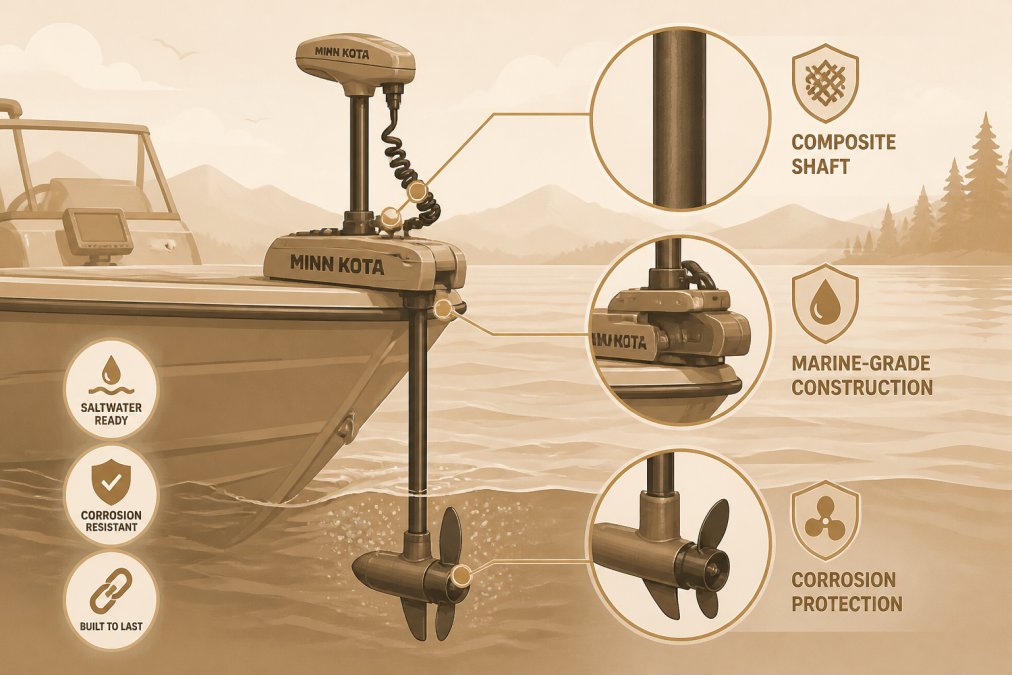
Composite Shaft and Saltwater-Rated Components
Saltwater Minn Kota trolling motors use composite shafts instead of aluminum or steel. Composite materials don't corrode, don't require protective coatings, and maintain structural integrity indefinitely in saltwater. The motor head uses saltwater-rated stainless steel and corrosion-resistant coatings on all exposed fasteners and connections.
Internal components are sealed against saltwater intrusion, and all electrical connections use marine-grade connectors with proper drainage. In the Pacific Northwest, where you're regularly exposed to salt spray and immersion, saltwater-rated components aren't optional.
Shallow Water Anchoring Systems for Coastal Fishing
Shallow water anchor systems on Minn Kota motors deploy a specialized mechanism that locks the propeller in place when engaged, effectively anchoring your boat in shallow water without dropping an anchor. This is invaluable when fishing flats or shallow reefs where traditional anchoring is impractical or risks snagging bottom structure.
Battery Life and Power Management for Extended Fishing Days
Battery selection and management determine how long you'll actually fish before returning to the dock. Understanding amperage draw, voltage systems, and battery chemistry helps you make an informed choice that matches your fishing style.
Battery Chemistry: Lithium vs. AGM Compatibility
Traditional AGM (Absorbent Glass Mat) batteries have been the standard for trolling motors for decades. They're affordable, reliable, and compatible with all Minn Kota systems. Lithium batteries offer significantly longer cycle life, lighter weight, and better performance in cold water. They maintain consistent voltage throughout the discharge cycle, meaning your motor performs the same at full battery as it does at half charge.
Amperage Draw and Voltage Specifications
Amperage draw is the current your motor consumes at a given thrust level and speed. A 55-pound 12V motor at full speed might draw 80-100 amps, while a 55-pound 24V motor draws roughly 40-50 amps at the same thrust. Lower amperage draw means longer battery life on the same capacity battery.
System Voltage |
Typical Amperage Draw (at full thrust) |
Battery Runtime (200 Ah AGM) |
|---|---|---|
12V |
80-120 amps |
1.5-2.5 hours |
24V |
40-60 amps |
3.5-5 hours |
36V |
25-40 amps |
5-8 hours |
Installation, Maintenance, and Long-Term Durability
Installing a Minn Kota trolling motor correctly determines whether it performs reliably for years or develops problems within months. Most installation issues stem from improper mounting, inadequate wiring, or poor battery connections.
DIY Installation Troubleshooting and Setup Tips
Start with a solid mounting bracket properly secured to your boat's structure. Transom mounts need solid backing plates to distribute the load, and bow mounts need reinforced mounting points that can handle lateral stress.
Wiring is where most DIY installations go wrong. Use marine-grade wire sized appropriately for the amperage draw. A 55-pound 12V motor drawing 100 amps needs 2/0 gauge wire or larger. Run the wire in a loom or conduit, keep it away from engine heat and sharp edges, and use proper marine connectors throughout.
Battery connections must be clean and tight. Corrosion at the battery terminals creates resistance, limiting power delivery and causing the motor to underperform. Test the motor in shallow water before your first serious fishing trip.
Repairability and Replacement Parts Availability
Minn Kota's greatest strength is parts availability. Virtually every component is available as a replacement, and the company has supported their motors for decades. Common wear items include propellers, foot pedals, and battery cables. Elliott's Tackle & Rigging carries replacement propellers including the Minn Kota MKP-37 Power Prop for heavy vegetation and the Minn Kota MKP-2 Power Prop as standard replacements.
The motor head itself rarely fails if maintained properly. This repairability is why Minn Kota motors hold value, a 10-year-old motor can still be serviced and used reliably if it's been maintained.
Minn Kota Accessories: Enhance Your Trolling Motor Setup
The accessories you choose determine how effectively you'll use your trolling motor. Remote controls, power switches, and replacement propellers are the core accessories. The Minn Kota Micro Remote-Bluetooth at Elliott's Tackle & Rigging gives you wireless control without the hassle of running wired remotes through your boat. The MKR-30 Remote Power Switch provides convenient on/off control from anywhere on the boat, useful when repositioning frequently.
Propeller selection matters more than most anglers realize. Standard propellers work well in open water, but the MKP-37 Power Prop is specifically designed for heavy vegetation and weed beds, cutting through growth without bogging down. The MKP-2 is a solid general-purpose replacement for standard applications.
Choosing the right Minn Kota Trolling Motor for Pacific Northwest saltwater fishing requires understanding thrust, voltage, shaft length, and the specific demands of your fishing style. Underpowering costs you fishing time and frustration, while overpowering wastes money and battery life. Elliott's Tackle & Rigging has spent four decades hand-selecting gear that actually performs on the water, and our Minn Kota lineup reflects that commitment to reliability and performance. Browse our complete trolling motor collection and find the motor that matches your boat and fishing ambitions.
Frequently Asked Questions
What is the best Minn Kota trolling motor for saltwater fishing in the Pacific Northwest?
Minn Kota saltwater trolling motors with composite shafts and corrosion-resistant components are essential for Pacific Northwest conditions. Look for models with shallow water anchor systems and GPS-enabled navigation like the Riptide PowerDrive series. Elliott's Tackle & Rigging hand-selects saltwater-rated Minn Kota motors tested by experienced captains who understand coastal fishing demands. Check Elliott's trolling motor collection for saltwater-specific options curated for reliability in harsh marine environments.
How do I choose between transom and bow mount Minn Kota trolling motors?
Transom mounts work best for smaller boats and backup thrust, while bow mounts provide primary steering control and better precision for spot-lock anchoring. Bow mounts are standard for serious anglers who need GPS-guided navigation and heading sensor integration. Your boat size, fishing style, and whether you're fishing freshwater lakes or saltwater determine the right choice. Consider shaft length carefully: longer shafts suit deeper keels, while shorter ones work for shallow hulls. Elliott's experienced team can help match the configuration to your specific boat setup.
What battery chemistry works best with Minn Kota trolling motors?
Minn Kota trolling motors are compatible with both lithium and AGM (absorbed glass mat) batteries, but they perform differently. Lithium batteries offer longer runtime and faster charging but cost more upfront. AGM batteries are affordable and reliable for casual fishing but require more frequent charging. Check your motor's voltage and amperage draw specifications to ensure compatibility. Many experienced anglers in the Pacific Northwest use AGM for daily fishing and lithium for extended trips. Elliott's Tackle & Rigging carries accessories like the Minn Kota MKR-30 Remote Power Switch to optimize battery management.
How does Spot-Lock work on Minn Kota Riptide PowerDrive motors?
Spot-Lock uses GPS and a heading sensor to hold your boat in one position without anchoring, automatically correcting for wind and current. The system engages through the i-Pilot remote control and maintains your location with precision. This technology is invaluable for trolling specific structure or holding position over deep-water fish in saltwater environments. Riptide PowerDrive models integrate sonar and marine electronics for real-time water mapping. Elliott's carries Minn Kota Micro Remote-Bluetooth accessories to enhance your control options and make Spot-Lock operation more convenient on the water.
0 comments