

Table of Contents
- Minn Kota Riptide Trolling Motor Overview
- Comparing Minn Kota Riptide Models
- Choosing the Right Trolling Motor Thrust
- Saltwater Corrosion Resistance and Build Quality
- GPS Navigation, Spot-Lock, and Fish Finder Integration
- Saltwater Trolling Motor Maintenance Tips
- Installation, Mounting, and Compatibility
- Which Minn Kota Riptide Model Should You Choose?
- Frequently Asked Questions
Last Updated: August 4, 2026
Minn Kota Riptide Trolling Motor Overview
The Minn Kota Riptide trolling motor has become the standard for saltwater anglers across the Pacific Northwest who demand precision boat control and durability in harsh marine environments. Whether you're working shallow bays, rocky outcrops, or open water, the Riptide line delivers the GPS accuracy and corrosion resistance that separates a productive day from a frustrating one. At Elliott's Tackle & Rigging, we've hand-selected the Riptide lineup because every model is built around the same core principle: reliability where it matters most.

Why Saltwater Anglers Choose Riptide
The Riptide platform stands apart because Minn Kota engineered it specifically for saltwater conditions from the ground up. The anodized aluminum construction, sacrificial anode protection, and sealed bearing design mean your motor will perform after seasons of exposure to salt spray and corrosive conditions. The deploy-assist lever and auto stow functionality on higher-end models save your back and keep your hands free to manage your fishing line.
GPS integration through Spot-Lock and AutoPilot features lets you anchor precisely without dropping an anchor or burning fuel. For anglers working tight structure or windy conditions, this is the difference between staying on fish and drifting off. The heading sensor on GPS-equipped models works independently of your boat's compass, performing reliably even in areas with magnetic interference from rock formations or metal structures common in Pacific Northwest fishing grounds.
Key Specifications: Thrust, Voltage, and Shaft Length
Thrust ratings for Riptide motors range from 55 to 112 pounds. The thrust you need depends directly on your boat weight and water conditions. A 20-foot center console in calm bay water might run fine with 80 pounds of thrust, while the same boat in open water with wind and current demands 112 pounds minimum.
Voltage options include 12V, 24V, and 36V configurations. The 36V systems deliver the most power and efficiency but require three batteries instead of one or two. Many serious saltwater anglers run 36V because the extended runtime and reduced amp draw justify the battery investment over a full season.
Shaft length matters for bow-mount installation. Common lengths run 45, 54, and 60 inches. Measure from your bow eye down to the waterline at rest, that's your starting point. Too short and the motor won't push water efficiently. Too long and you risk cavitation and prop walk.
Comparing Minn Kota Riptide Models
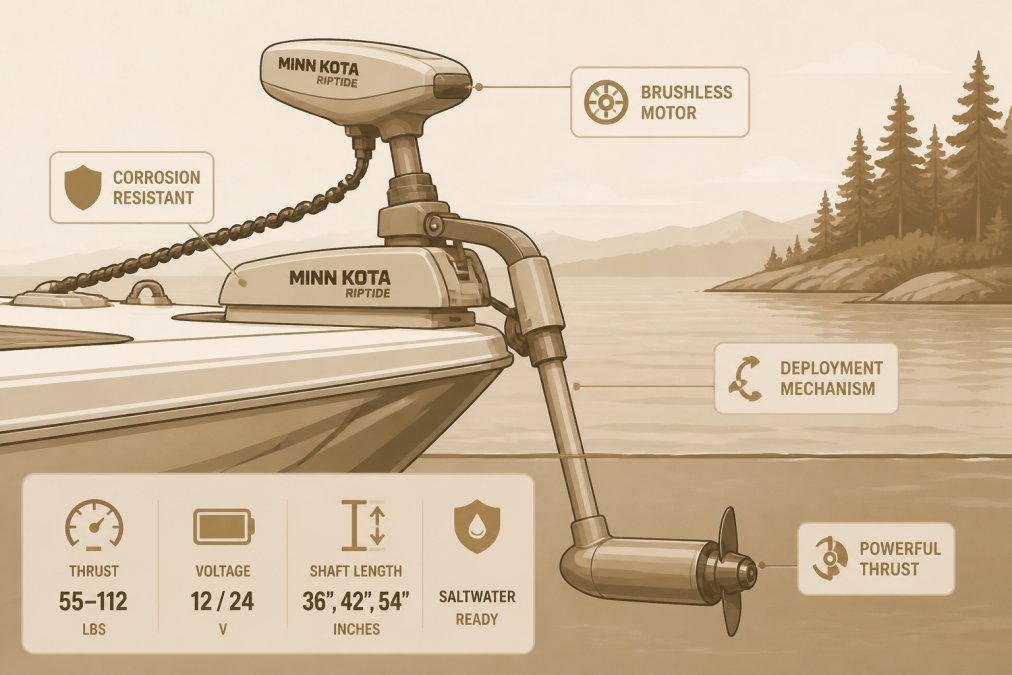
Elliott's Tackle & Rigging carries three core Riptide models that cover 90% of saltwater angler needs. Each fills a specific role, and the choice comes down to your budget and what features matter for your fishing style.
Terrova 80 and Terrova 112: GPS-Driven Precision
The Minn Kota Riptide Terrova 80 and Terrova 112 represent the sweet spot for most saltwater anglers. Both feature the advanced GPS Trolling System with Spot-Lock and AutoPilot, letting you lock onto a specific spot and hold it against wind and current without touching the remote. The wireless remote control works reliably up to 150 feet, and Digital Maximizer technology extends battery runtime by reducing unnecessary power draw.

The 80-pound thrust model suits boats in the 16-20 foot range in calm to moderate conditions. The 112-pound version handles larger boats and rougher water. Both come with a wireless remote and integrated battery meter. The Spot-Lock feature holds your position with GPS accuracy within a few feet, even in wind, worth the investment alone for precision work over structure.
Instinct QUEST 90/115: Brushless Power for Serious Anglers
The Minn Kota Riptide Instinct QUEST 90/115 is the flagship. This motor brings brushless motor technology, dual 24V/36V auto-detect voltage, and automatic stow/deploy functionality. The QUEST brushless motor generates more torque than brush motors and extends runtime significantly, users report 30-40% longer battery life compared to traditional designs.

Auto stow and deploy means the motor retracts fully with a button press, a game-changer for boats with limited bow space or for anglers who launch and retrieve frequently. Power trim lets you adjust depth on the fly without tilting the entire motor. One-Boat Network integration connects your trolling motor to compatible Minn Kota fish finders and sonar units, creating a unified system where your GPS and sonar talk to each other.
Edge, Fortrex, and Transom Options
The Minn Kota Riptide Edge is the entry-level saltwater bow-mount, skipping GPS entirely and relying on cable-steer control and variable speed. The Digital Maximizer extends battery life, and the Weedless Wedge 2 propeller handles shallow water. The Fortrex is a cable-steer bow-mount built for anglers who prefer mechanical control over electronic steering, with exceptional ruggedness and a Counter Tension Stabilizer that reduces steering effort. For smaller boats, kayaks, or secondary trolling motors, the Minn Kota Riptide Transom offers hand-tiller control and transom mounting, ideal for backup systems or boats where bow-mounting isn't practical.
Choosing the Right Trolling Motor Thrust
Thrust Ratings and Boat Size Matching
Thrust requirements scale with boat weight and water conditions. As a baseline, you need roughly 5 pounds of thrust per 200 pounds of boat weight in calm conditions. A 4,000-pound boat needs about 100 pounds of thrust minimum. Add wind, current, and chop, and you'll want 10-15% more thrust than the baseline.
The Terrova 80 works for boats up to roughly 20 feet in protected bays and calm conditions. The Terrova 112 handles boats to 24 feet and rougher water. The QUEST 90 and 115 are designed for larger boats (24-35 feet) and demanding offshore conditions.
Real-World Battery Runtime Calculations
Battery runtime depends on motor thrust setting, battery capacity, and amp draw. A Terrova 80 running at half speed on a 24V battery system draws roughly 30-40 amps. A full 24V lithium battery bank (typically 100 amp-hours) provides 2.5-3 hours at half speed. The brushless QUEST motors draw 15-20% less current at equivalent thrust levels compared to brush motors, extending runtime accordingly.
Most serious saltwater anglers run 36V lithium battery systems to maximize runtime and minimize weight. A 300 amp-hour 36V lithium bank provides 8-10 hours of fishing time at moderate speed.
Saltwater Corrosion Resistance and Build Quality
Anodized Aluminum and Sacrificial Anode Protection
Every Riptide motor features an anodized aluminum lower unit and shaft. Anodizing creates a protective oxide layer that resists salt water corrosion far better than bare aluminum. Sacrificial anodes are small metal pieces bolted to the lower unit that corrode preferentially to the aluminum, protecting the motor itself. Inspect your anode at the start of each season and replace it if it's more than half gone. A fresh anode takes 10 minutes to swap and prevents hundreds in motor repairs.
The propeller is typically stainless steel or composite material. Stainless props resist corrosion well but are more expensive. Composite props cost less and perform adequately in saltwater if you rinse them regularly.
Auto Stow and Deploy Functionality
Auto stow and deploy on QUEST-series motors uses an electric motor and hydraulic system to raise and lower the trolling motor shaft. This eliminates manual tilting and reduces wear on your shoulder and back. The deploy-assist lever on Terrova models provides a mechanical advantage without full automation, reducing the force required by roughly 70%.
GPS Navigation, Spot-Lock, and Fish Finder Integration
Spot-Lock and AutoPilot Features
Spot-Lock uses GPS to hold your boat in a fixed position relative to the water bottom, not the surface. If you're drifting over a reef or structure, Spot-Lock will maintain your exact position even as wind and current push your boat, holding position within a few feet. AutoPilot navigates your boat along a preset course or waypoint path, invaluable for running parallel to structure or covering ground methodically while you focus on fishing.
Both features require a compatible Minn Kota fish finder or the wireless remote with integrated GPS. Your fish finder displays waypoints, routes, and your current Spot-Lock position on the same screen.
Integration with Third-Party Sonar and Fish Finders
The One-Boat Network on QUEST-series motors connects to compatible Minn Kota sonar units and allows basic integration with third-party systems like Humminbird and Garmin. Integration works best when you use a Minn Kota fish finder paired with a QUEST motor, though third-party integration exists but may not support all advanced features.
Saltwater Trolling Motor Maintenance Tips
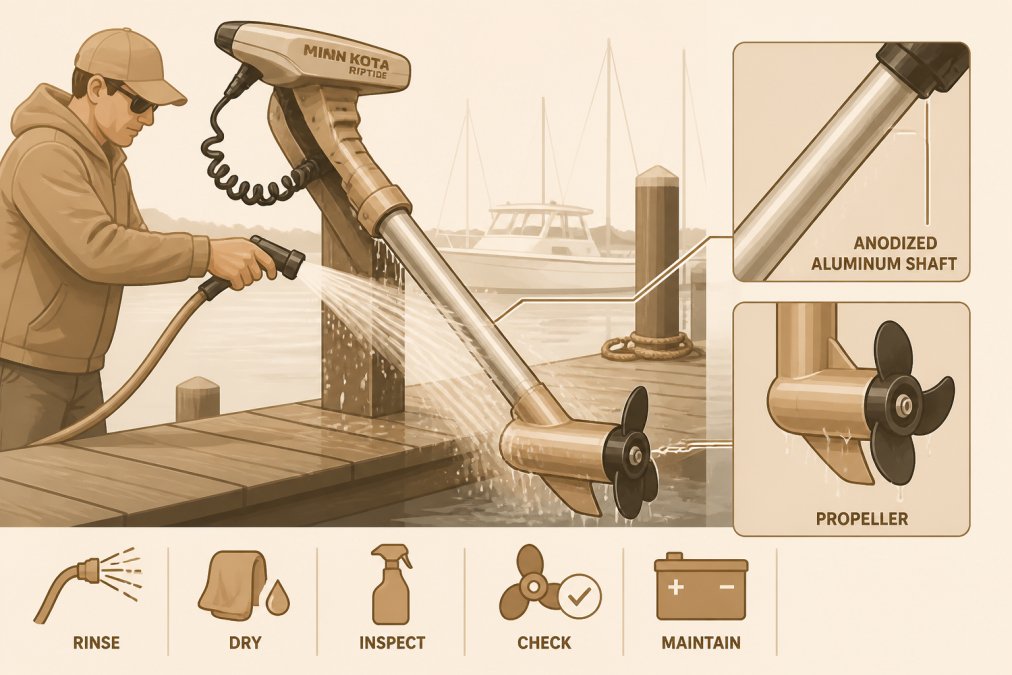
Saltwater trolling motor maintenance is straightforward but non-negotiable. Skip it and you'll face expensive repairs or premature motor failure.
Freshwater Rinse and Storage Protocols
Rinse your entire trolling motor with fresh water immediately after every saltwater outing. Use a spray nozzle on low pressure and flush the lower unit, shaft, and mount thoroughly. Pay special attention to the prop, anode, and cable connectors. Store your motor in a cool, dry location during the off-season. For motors with deploy-assist or auto stow/deploy mechanisms, operate them monthly even during off-season storage to flush any salt residue from internal passages.
Troubleshooting Common Saltwater-Specific Issues
Corrosion on battery terminals: Clean with a wire brush and apply a thin coat of dielectric grease. If corrosion is severe, replace the terminal connector.
Reduced thrust despite full battery charge: Check your propeller for bent blades or salt deposits. A damaged or fouled prop reduces efficiency by 20-30%. If the prop is clean, the motor may have internal corrosion in the lower unit requiring professional service.
GPS signal loss or Spot-Lock drift: Verify your antenna is mounted above the cabin and has clear sky view. Clean the antenna connector with a dry cloth and apply dielectric grease. If signal remains poor, the antenna may need replacement.
Sluggish deployment or stowing: On auto stow/deploy models, this indicates hydraulic fluid degradation or air in the lines. Have the system inspected and flushed by an authorized dealer.
Installation, Mounting, and Compatibility
Bow-Mount vs. Transom-Mount Selection
Bow-mount trolling motors are standard for saltwater fishing because they provide better boat control, especially in wind and current. The bow position gives you superior steering and holding ability. Most Riptide models are bow-mount systems designed for 20-35 foot boats. Transom-mount motors are compact and affordable but provide less directional control, best for smaller boats (under 18 feet), kayaks, or as backup systems on larger boats.
The mounting bracket must match your boat's bow configuration. Most modern boats use standard 2-inch or 3-inch eye bolts that accept Minn Kota's universal brackets. Professional installation is recommended if you're uncertain about bracket compatibility or if your boat has an unusual bow design. DIY installation is feasible if you're comfortable with basic electrical work and drilling mounting holes.
Which Minn Kota Riptide Model Should You Choose?
Decision Framework by Fishing Style and Boat Size
Fishing Style |
Boat Size |
Recommended Model |
Key Reason |
|---|---|---|---|
Inshore bays, shallow structure |
16-20 ft |
Terrova 80 |
Adequate thrust for calm water, GPS Spot-Lock for precision |
Coastal, moderate wind/current |
20-26 ft |
Terrova 112 |
Extra thrust handles rougher conditions, proven reliability |
Larger boats, open water, frequent launching |
26-35 ft |
QUEST 90/115 |
Brushless efficiency, auto stow/deploy, advanced GPS integration |
Budget-conscious, calm water only |
16-20 ft |
Edge 55 |
Basic corrosion protection, no GPS, lower cost |
Cable-steer preference, rugged use |
18-24 ft |
Fortrex |
Mechanical control, exceptional durability, no electronics |
For most Pacific Northwest saltwater anglers, the Terrova 80 or 112 hits the sweet spot between capability and cost. You get GPS precision, wireless remote control, and corrosion-resistant construction without paying for automation features you may not need.
Choose the QUEST if you launch multiple times daily, run larger boats, or fish in consistently rough water. The brushless motor and auto stow/deploy justify the premium for serious, full-time anglers.
Choose the Edge or Fortrex if you fish calm bays infrequently and want to minimize complexity. Both are reliable, durable motors that will serve you well in protected water.
Saltwater trolling motor selection comes down to matching thrust, features, and budget to your specific boat and fishing style. The Minn Kota Riptide platform delivers proven GPS accuracy, corrosion resistance, and reliability across multiple price points. Whether you choose a Terrova for precision inshore work or a QUEST for maximum power and automation, you're investing in equipment that will perform for years with proper maintenance. Start with a freshwater rinse after every saltwater outing, replace your sacrificial anode annually, and inspect your electrical connectors regularly. Those simple steps will keep your motor running reliably and protect your investment long-term.
Frequently Asked Questions
Is the Minn Kota Riptide series specifically designed for saltwater?
Yes, the Minn Kota Riptide series is engineered from the ground up for saltwater environments. Every model features advanced corrosion resistance through anodized aluminum construction and sacrificial anode protection. The brushless motors in higher-end models like the Instinct QUEST deliver superior durability against salt spray and oxidation. Freshwater rinsing after each use is still recommended to extend the motor's lifespan, but Riptide motors are built to handle aggressive saltwater conditions.
Does the Minn Kota Riptide feature GPS Spot-Lock technology?
GPS Spot-Lock is available on most Riptide models except the entry-level Edge and cable-steer options like the Fortrex and Maxxum. The Terrova 80, Terrova 112, PowerDrive, and Instinct QUEST all feature Spot-Lock with AutoPilot, allowing you to hold position over structure or hold a heading automatically. This technology is invaluable for saltwater anglers targeting specific areas during tidal changes or when fishing deep structure.
How do I choose the right shaft length for my saltwater boat?
Shaft length depends on your boat's freeboard (distance from waterline to gunwale). Measure from the mounting surface to the waterline when the boat is loaded. Most saltwater boats use 54-inch to 72-inch shafts. Inshore skiffs and small boats typically need 54-60 inches, while center console and larger offshore boats require 60-72 inches. An undersized shaft reduces thrust efficiency and can cause cavitation, while an oversized shaft may hit bottom in shallow water. Elliott's Tackle & Rigging staff can help you verify the correct length for your specific setup.
What thrust rating do I need for my boat size?
A general rule is 5 pounds of thrust per 100 pounds of boat weight, though saltwater boats often benefit from extra thrust for wind and current. Small inshore boats (16-20 feet) typically use 55-80 lb thrust; mid-size boats (20-28 feet) use 80-112 lb thrust; larger boats (28+ feet) often require 112+ lb thrust or dual motors. The Riptide Terrova 80 and 112 suit most saltwater center consoles, while the Instinct QUEST 90/115 handles bigger boats and challenging conditions. Consider water conditions, wind exposure, and whether you'll fish alone or with a crew.
Can I integrate a Minn Kota Riptide with my existing fish finder?
Yes, most Riptide models support integration with third-party fish finders through NMEA 0183 networking. The Instinct QUEST and higher-end Terrova models allow you to view Spot-Lock, heading, and depth data on compatible Garmin, Humminbird, and Lowrance units. This integration streamlines your electronics setup and lets you anchor over marked structure with precision. Older or basic fish finders may not support this networking, so verify compatibility with your specific sonar unit before purchasing.
0 comments