

Last Updated: October 27, 2026
Quick Summary
A Lake Michigan King Salmon gear checklist starts with a medium-heavy to heavy 8 to 9 foot trolling rod, a line-counter reel with enough capacity for a 200-foot run, and 12 to 20 pound test line with braid backing and a fluorocarbon leader. Build the spread around downriggers, divers, copper, and planer boards, then pair flashers with meat rigs, flies, or spoons.
- Run high lines on planer boards with 8 to 12 feet of fluorocarbon leader to target the top 15 feet.
- Set the flasher 10 to 15 feet behind the downrigger ball and the bait 3 to 5 feet behind the flasher.
- Copper line sinks about 1 foot per 10 feet of line out, so 300 feet of copper reaches roughly 30 feet.
- Start trolling at 2.0 to 2.5 mph at the ball and adjust throttle to keep a consistent presentation.
- Set the spread from deep to shallow and inside to outside to prevent tangles when a fish runs.
Table of Contents
- Rod, Reel, and Line: The Foundation of a King Salmon Gear Checklist
- Building a King Salmon Trolling Setup That Covers Water
- Salmon Fishing Downrigger Setup: Manual vs. Heavy-Duty
- Lake Michigan Salmon Lures: Flashers, Meat Rigs, and Flies
- Salmon Fishing Boat Safety Gear and On-Water Essentials
- Tackle Storage and Spares for a Full Day on the Water
- Stocking Your Boat at Elliott's Tackle & Rigging
- Frequently Asked Questions
Rod, Reel, and Line: The Foundation of a King Salmon Gear Checklist
A Lake Michigan King Salmon gear checklist starts with three decisions that dictate everything else: rod action, reel capacity, and line type. Get those wrong and the best lures on the boat won't save the trip.
Here's the good news: the king salmon gear foundation is simple once you understand what each piece does. Below, we break down the rods, reels, and line that hold up to big-water Chinook, plus the trolling, downrigger, and lure setups that cover water efficiently.
Rods Built for Big Water
A king salmon rod needs backbone to set hooks in a fish with a hard, bony mouth, plus enough give to absorb violent head shakes. Look for a medium-heavy to heavy-action rod in the 8 to 9 foot range for trolling. Longer rods spread lines wider and give you more control when a fish runs toward the prop.
For jigging or casting to staging fish, a shorter heavy-action rod gives you better use. What most guides miss is that rod length and action should match your presentation, not your personal preference. A noodle-soft rod feels fun until you lose fish at the net.
Reels and Line Capacity
Line capacity matters more than drag specs for most Lake Michigan trolling. A king can strip 200 feet in a single run, and you need enough spool left to keep pressure on. Line-counter reels take the guesswork out of repeating a hot depth, which is why they dominate Great Lakes trolling spreads.
Size your reel so it holds your full presentation with a comfortable reserve.
Line Types, Strength, and Length
Braided main line cuts water resistance and transmits depth changes clearly. Monofilament gives stretch that forgives aggressive hooksets. Fluorocarbon leaders disappear in clear water.
A Lake Michigan salmon-season guide recommends line in the 12 to 20 pound test range for typical setups, per Net Dreams Fishing's 2026 season guide. We'd run heavier braid as backing and step down at the leader, so you get capacity plus a stealthy terminal end.
Building a King Salmon Trolling Setup That Covers Water
A king salmon trolling setup is a spread, not a single rod. The goal is to present different depths and actions at once, then let the fish tell you which one they want. Michigan's fishing regulations are in effect through March 31, 2027, so check the current Michigan DNR fishing regulations before you set lines.
A workable spread covers four zones, and each zone demands a different rod, reel, and line configuration:
- High lines off planer boards for spooky fish, run medium-light rods with monofilament main line and a fluorocarbon leader, typically 8 to 12 feet of leader behind the board. These lines target the top 15 feet where kings cruise early and late.
- Mid-depth divers running Dipsy-style presentations, use medium-heavy rods with braided main line for better depth repeatability. A common pattern is a 6- to 8-foot leader from diver to flasher, with the diver set to run 30 to 50 feet down depending on speed.
- Downrigger lines for precise depth control, pair heavy-action rods with line-counter reels spooled with braid. Set the flasher 10 to 15 feet behind the ball and the bait another 3 to 5 feet behind the flasher. This is the zone where you can repeat a hot depth exactly.
- Copper or lead-core for a deep, sweeping presentation, use heavy rods with high-capacity reels. Copper line sinks predictably at roughly 1 foot per 10 feet of line out at typical trolling speeds, so a 300-foot copper setup reaches about 30 feet down without a diver.
Rotate until you find the zone holding bait. Then duplicate it. Most practitioners find that trolling speed dictates the spread more than any other variable: 2.0 to 2.5 mph at the ball is a common starting range for kings, but speed at the lure matters more than speed over ground. Current, wind, and turns all change lure action, so check your downrigger cable angle and adjust throttle to keep a consistent presentation.
For a method-specific gear split, keep two rod setups ready: one heavy trolling rod with a line-counter reel for downriggers and divers, and one medium rod with a planer-board release for high lines. The Scotty 1050 Depthmaster and Scotty 1085 Strongarm cover manual downrigger needs.
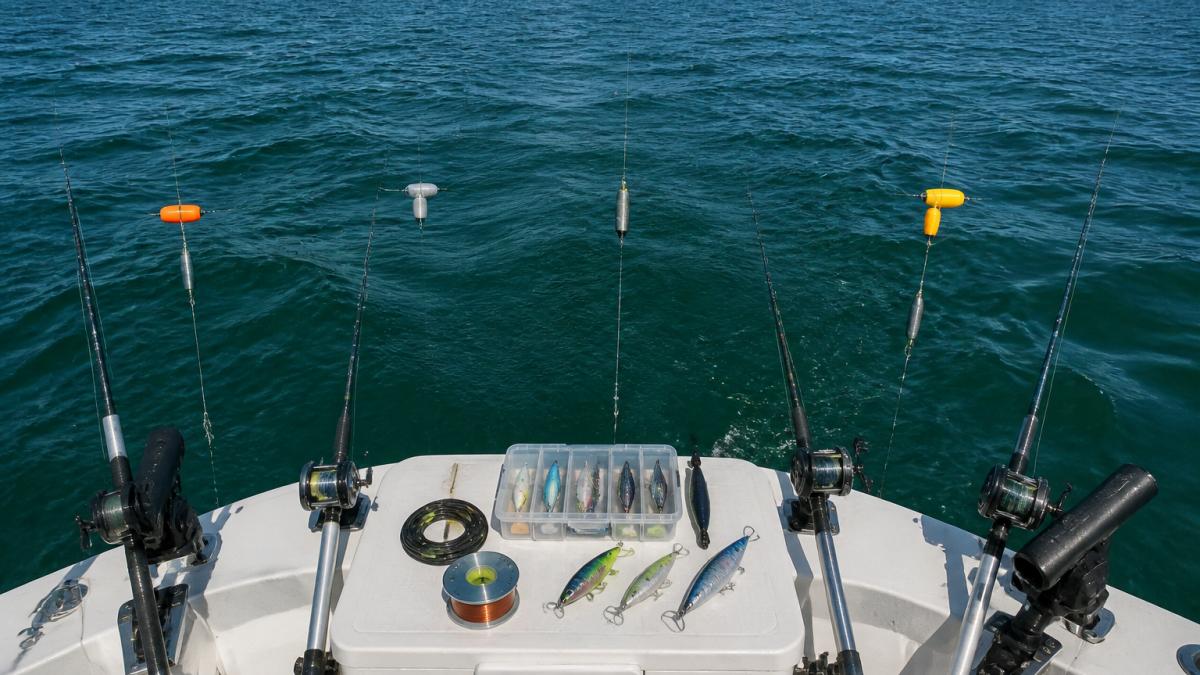
Salmon Fishing Downrigger Setup: Manual vs. Heavy-Duty
A salmon fishing downrigger setup comes down to how much boat you're rigging and how deep you fish. Manual downriggers are simple, reliable, and cost less. Electric units save your arms on long days.
Manual units suit smaller boats and anglers who fish a few rods. The Scotty 1050 Depthmaster runs a 23-inch stainless boom with 200 feet of cable and a clutch brake that pays out on bottom hang-ups. Step up to the Scotty 1085 Strongarm for a 30-inch boom and a high-speed spool that retrieves 2 feet per turn on intermediate-size boats.
Ice Strong Outdoors - Krunch Meat Rigs →
If you're pricing a full electric spread, the Cannon Optimum 10 BT two-pack with covers is worth a look. Downriggers are widely treated as essential for precise trolling presentation in Lake Michigan salmon fishing, per Great Lakes Fish Co.'s Lake Michigan salmon guide.
Lake Michigan Salmon Lures: Flashers, Meat Rigs, and Flies
Lake Michigan salmon lures fall into two jobs: attractors that create flash and vibration, and the baits trailing behind them. Flashers do the attracting. Meat rigs, flies, and spoons do the closing. The key is matching attractor size and bait action to your trolling speed and the baitfish present, then organizing lures by method so you can swap presentations fast.
Flasher-and-fly combos and flasher-meat rig pairs are standard gear options for targeting Lake Michigan king salmon, according to a Lake Michigan king salmon gear guide. Match attractor size to your trolling speed and the baitfish present. A common pattern is an 8- to 10-inch flasher for kings, with flies running 25 to 30 inches behind the attractor and meat rigs running 36 to 48 inches back.
Our pick for a durable attractor is the Ice Strong 8.5" Dual Fin Flasher, built to pair with Krunch Meat Rigs and Too Strong Flies. Trail it with the Krunch Meat Rig, which runs a 48-inch, 50-pound fluorocarbon leader and 1/0 VMC hooks, or the Too Strong Premium Trolling Fly, designed to run 25 to 30 inches behind an attractor.


Spoons, Jigs, and Terminal Tackle
The Plano EDGE 3700 Stowaway uses a Dri-Loc seal and Rustrictor to block moisture and rust. For flat rigs and jigs, the Daiwa D-Box Feeder Case runs a 360-degree gasket and four-point clasp.
Salmon Fishing Boat Safety Gear and On-Water Essentials
Salmon fishing boat safety gear belongs on the checklist before any lure does. Big water changes fast, and a king salmon trip often means early starts, cold air, and rough afternoon chop. A heavy-duty coiled safety tether secures rods and gear in rough water.
Pack these every trip:
- Warm, waterproof layers and a spare set
- Sunglasses and sunscreen for glare off open water
- A heavy-duty safety tether to secure rods and gear in rough water
- A charged marine radio and a float plan left with someone ashore
- First-aid kit and a throwable flotation device
Tackle Storage and Spares for a Full Day on the Water
Tackle storage keeps a full day organized and dry. A waterproof-base tackle bag keeps spoons, flashers, and terminal tackle dry on deck. Spoons, flashers, and terminal tackle tangle fast when they're loose in a bucket, and wet gear rusts overnight.
For flat rigs and jigs, the Daiwa D-Box Feeder Case runs a 360-degree gasket and four-point clasp.
| Category | Must-Have | Optional Upgrade | Why It Matters |
|---|---|---|---|
| Rods and reels | Medium-heavy trolling rod, line-counter reel | Spare rod setup | Backup saves a trip |
| Line | Braid main line, fluorocarbon leader | Copper or lead-core | Depth coverage |
| Attractors | One flasher per rod | Extra color patterns | Match baitfish |
| Baits | Meat rigs, flies, spoons | Jigs for vertical work | Versatility |
| Downrigger | Manual unit with cable | Electric two-pack | Precise depth |
| Safety | Layers, tether, radio | Spare tether | Rough-water security |
| Storage | Watertight tray, deck bag | Stackable cases | Dry, organized gear |
Stocking Your Boat at Elliott's Tackle & Rigging
A complete Lake Michigan King Salmon gear checklist is a system: rods and reels sized for big fish, line matched to depth, attractors paired with the right baits, and safety gear that never gets left in the truck. Build it once, then refine it as the season teaches you which zones produce.
At Elliott's Tackle & Rigging, every product is hand-selected by a captain with forty years of fishing experience, and we won't sell gear we wouldn't run on our own boat. Our selection includes downriggers, flashers, meat rigs, and storage, with free shipping and 30-day returns.
Frequently Asked Questions
What gear do you need to fish for king salmon on Lake Michigan?
Add flashers paired with meat rigs or trolling flies. The Krunch Meat Rig has a 48-inch, 50-pound fluorocarbon leader and size 1/0 VMC Vanadium hooks. A waterproof tackle box keeps hooks and swivels organized and dry.
What rods and reels are best for trolling for king salmon?
The Scotty 1050 Depthmaster is a compact manual downrigger with a 23-inch stainless steel boom and a depth counter. The Scotty 1085 Strongarm has a 30-inch stainless steel boom and retrieves 2 feet of line per turn.
What lures catch king salmon in Lake Michigan?
The 8.5-inch Dual Fin Flasher is designed to pair with Krunch Meat Rigs or Too Strong Premium Trolling Flies. The Krunch Meat Rig has a 48-inch, 50-pound fluorocarbon leader and size 1/0 VMC Vanadium hooks. Too Strong Premium Trolling Flies are listed with a recommended distance of 25 to 30 inches behind an attractor.
Do you need downriggers to troll for Lake Michigan salmon?
The Scotty 1050 Depthmaster is a compact manual downrigger with a 23-inch stainless steel boom and a depth counter. The Scotty 1085 Strongarm has a 30-inch stainless steel boom and retrieves 2 feet of line per turn.
What safety equipment should you bring on a salmon fishing boat?
Pack warm layers, waterproof clothing, sunglasses, and sunscreen. Add a throwable flotation device and a first-aid kit.
The hardest part of a king salmon trip isn't finding fish. It's trusting the gear when a big one hits. We built our catalog around that moment: captain-curated tackle, downriggers and rod holders that survive big water, and storage that keeps everything dry and ready. Get started with Elliott's Tackle & Rigging and fish with gear chosen by someone who refuses to sell anything he wouldn't run himself.

0 comments