

Last Updated: October 28, 2026
Quick Summary
To troll multiple rods for Lake Michigan salmon, spread several lines at different depths and distances, using downriggers, diver rods, copper or lead-core line, and planer boards. Deploy the deepest and shortest lines first, then work outward, so each new line runs behind the ones already set.
- Each rod presents a different bait at a different depth and distance, covering more water per pass.
- Deploy downriggers first, then diver rods, then copper and lead-core lines last.
- Keep the upper stacked line shorter than the lower one so fish do not swim through it.
- Stagger rod distances and keep planer boards in separate lanes to prevent tangles.
- Turn wide and slow, and reset the whole spread to its marked positions after every fish.
Table of Contents
- Why a Multi-Rod Spread Catches More Lake Michigan Salmon
- Gear You Need Before You Start Trolling Multiple Rods
- Lake Michigan Fishing Rod Limits and Crew Rules to Know First
- How to Use Downriggers for Salmon in a Multi-Rod Spread
- Planer Boards for Salmon Trolling and Widening Your Spread
- How to Prevent Trolling Line Tangles and Handle Fish on Multiple Rods
- Setting Your Lines Today: Your Next Step on the Water
- Frequently Asked Questions
Why a Multi-Rod Spread Catches More Lake Michigan Salmon
Learning to troll multiple rods at once lets you present baits at different depths and distances. Each rod presents a different bait at a different depth and distance, so you cover more water in every pass. Game & Fish describes planer boards as a way to widen a spread when fish are holding near the surface.
A spread lets anglers test depths and baits, then adjust where they place their lines.
Gear You Need Before You Start Trolling Multiple Rods
A six-rod spread used to troll multiple rods can combine downriggers, diver rods, a lead-core or copper line, and a back rod.
Start with the basics:
- Downriggers: Get baits down to the depth where salmon are holding. The Cannon Easi Troll St Manual Downrigger is a solid manual option.
- Downrigger line: Braided line gives you the reach to get deep. The Scotty Premium Power Braid Downrigger Line, 200 ft of 200 lb test is built for long drops.
- Rod holders: Keep rods secure and spaced. The Triple Deck Mount with Multi-Lok Rod Holders gives you six angle positions and full 360° rotation.
- Reels and rods: Pick trolling gear sized for Lake Michigan salmon. For help choosing, see Best Trolling Reels for Lake Michigan Salmon & Trout.
Start with a spread that suits your boat and crew.

Lake Michigan Fishing Rod Limits and Crew Rules to Know First
Before you set a spread, check the current official fishing regulations for the waters you plan to fish. Rules can change, so consult the relevant official source.
Triple Deck Mount w/ Multi-Lok Rod Holders →
How to Use Downriggers for Salmon in a Multi-Rod Spread
Downriggers can hold baits at a selected depth. Adjust your presentation as conditions change.
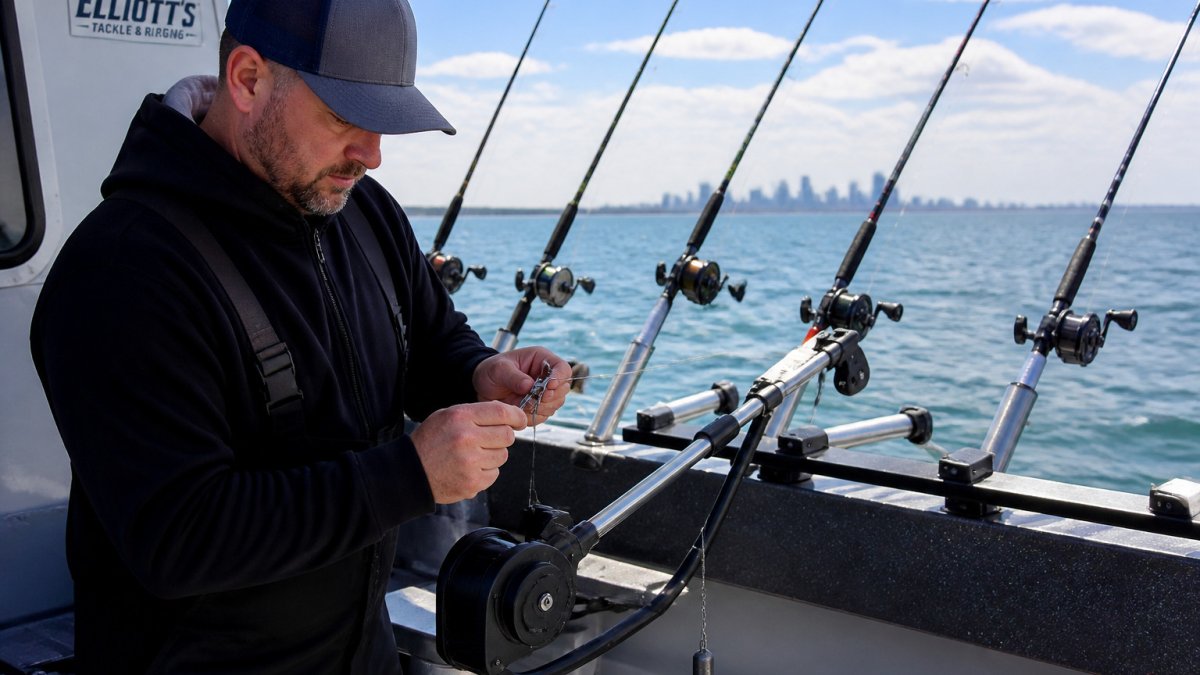
Deploy the spread in this order
- Downriggers first. Send the deepest presentations down before anything else is in the water. The Scotty Power Grip Plus Release Stacker with 30" Leader is a stacker release with a 30" leader.
- Diver rods next. Diving planers run behind and above the downrigger lines, so set them after the balls are down and keep them on the outside of the spread.
- Copper and lead-core last. Long-line presentations go out farthest and widest, so they go in after the short lines are set and tracking clean.
- Planer boards on the outside. Boards can widen the spread.
Why the order matters
Every line you add has to pass behind lines already in the water. Deploying deepest and shortest first, then working outward and longer, means each new line goes out behind the ones already set instead of across them. Reverse that order and you will drag a fresh line through your downrigger spread on the first turn.

Stacking and spacing on the ball
When you stack two lines on one downrigger, keep the upper line shorter than the lower one so a fish on the top release does not swim down through the bottom line. Most practitioners run the stacker 10 to 15 feet above the main release and set the upper rod slightly higher in the holder. Check both releases after every turn, because a stacked line that trips silently will trail slack and tangle the ball.
Deploy the spread in this order so each new line goes out behind the ones already set.
| Step | What to Do | Note |
|---|---|---|
| 1. Downriggers first | Send the deepest presentations down before anything else | Stacker release with 30" leader |
| 2. Diver rods next | Set them after the balls are down | Keep them on the outside of the spread |
| 3. Copper and lead-core last | Set long-line presentations after short lines track clean | Go farthest and widest |
| 4. Planer boards | Place on the outside of the spread | Widen the spread |
| Stacking on the ball | Keep upper line shorter than the lower one | Run stacker 10 to 15 feet above main release |
Planer Boards for Salmon Trolling and Widening Your Spread
Planer boards can push lines out to the side. Game & Fish describes planer boards as a way to widen a spread.
Pair your boards with the Scotty Mini Powergrip Plus Planer Board Release, 4 Pack.
How to Prevent Trolling Line Tangles and Handle Fish on Multiple Rods
Lines can cross, and boards can collide. Keep a consistent spacing pattern and check each line after a turn.
Prevent tangles before they start
- Stagger your distances. Never run two rods at the same setback on the same side. A common pattern is to step each rod back in even increments so no two lines sit at the same distance.
- Keep boards apart. Boards that cross are the fastest route to a tangle. Give each board its own lane and bring the outside board in first on a turn.
- Turn wide and slow. Sharp turns swing the outside lines through the inside lines. A gentle turn keeps the spread tracking clean.
- Reset after every fish. A landed fish leaves slack and shifted lines. Reset the whole spread to its marked positions before you resume trolling.
When a fish hits one rod
- Call the line. Announce which rod is fighting so the crew knows where to look and where not to step.
- Clear the nearest lines first. The Triple Deck Mount with Multi-Lok Rod Holders includes three Multi-Lok Rod Holders with six angle positions and full 360° rotation.
- Keep the boat straight. Do not turn toward the fish while lines are still out. Straighten out, clear, then maneuver.
- Bring the fish to the net on the cleared side. Land fish on the side of the boat you have already cleared.
When two rods go at once
A double is common on a hot bite, and the crew has to decide fast. If you have the people, assign one angler per rod and a third person on the net and boat control. If you do not, fight the fish on the outside line first while the inside angler holds pressure, then clear the remaining lines before either fish reaches the boat. A fish fighting near a tangled line can break off, so clear the other rods before you bring either fish to the net.
Triple Deck Mount w/ Multi-Lok Rod Holders →
Recovering a tangle
If lines do cross, stop the boat or slow to idle and bring the tangle to the surface rather than pulling hard against it. Free the lightest line first, untangle by hand with the drags backed off, and check every line for abrasion before you redeploy. A line that rubbed through braid or copper will fail on the next fish, so retie anything that looks scuffed.
Adapt the spread to your boat and crew
Match rod count to your boat and crew, and check the current official regulations for the waters you plan to fish.
Setting Your Lines Today: Your Next Step on the Water
Check the current regulations and adjust your setup as conditions change. Explore gear from Elliott's Tackle & Rigging.
Frequently Asked Questions
How many rods can you use while fishing on Lake Michigan?
Check the current official fishing regulations for the waters you plan to fish before you launch.
How do you set up multiple rods for salmon trolling?
The Triple Deck Mount w/ Multi-Lok Rod Holders from Elliott's includes three holders with six angle positions and full 360° rotation.
How do you keep multiple trolling rods from tangling?
The Scotty Power Grip Plus Release Stacker with a 30" leader from Elliott's is a stacker release with a tension-adjustable clip.
How do downriggers and planer boards work together?
Planer boards can widen a spread. The Triple Deck Mount w/ Multi-Lok Rod Holders from Elliott's is described as ideal for planer board setups and multi-line trolling.

0 comments