

Table of Contents
- Understanding When Chinook Salmon Go Deep
- Best Lures for Deep Water Chinook Salmon
- Downriggers for Chinook Salmon Deep Water Fishing
- Chinook Salmon Deep Water Fishing Techniques
- Using Sonar and Fishfinder Interpretation
- How to Target Chinook Salmon in Deep Water: Common Mistakes to Avoid
- Essential Gear Checklist for Deep Water Chinook
- Conclusion
How to Target Chinook Salmon in Deep Water
Last Updated: July 26, 2026
Chinook salmon, also called King salmon, are the largest Pacific salmon species and don't stay shallow. When targeting chinook in deep water, you need to understand that these fish move vertically based on season, light, and food availability. At Elliott's Tackle & Rigging, we've spent decades helping anglers master deep-water tactics, the difference between an empty cooler and a full one often comes down to depth management and presentation.
Understanding When Chinook Salmon Go Deep
Chinook follow food, and seasonal behavior is predictable once you understand what drives them. In spring and early summer, when water temperatures are cool and baitfish distribute throughout the water column, chinook may feed anywhere from 20 to 80 feet. By mid-summer, surface water temperatures climb past 60 degrees Fahrenheit, and chinook retreat to cooler, deeper water where oxygen levels remain stable. The thermocline, that sharp temperature boundary between warm surface water and cold deep water, acts like a magnet for chinook. They position themselves just above or within it, where temperature and oxygen create ideal conditions.
Barometric Pressure and Light Conditions
When atmospheric pressure drops before a storm, chinook become more aggressive and feed closer to the surface. Rising pressure after a storm typically pushes them deeper as they become more cautious. Low-light conditions matter tremendously: overcast days, early morning, and late evening push chinook shallower because reduced light penetration makes surface feeding safer. Bright midday sun drives them deeper. On a clear, sunny day, expect to work depths of 80-120 feet. On an overcast morning, you might find active fish at 40-60 feet.
Best Lures for Deep Water Chinook Salmon
The right lure selection makes deep-water fishing dramatically more effective. Chinook in deep water respond to presentations that mimic herring, anchovy, and sand eels.
Flashers and Spoon Selection
Flashers are your primary tool for deep-water chinook. These metallic attractors create flash and vibration that draws fish from distance. A quality flasher like the Rapala X-Rap Magnum series runs true without tuning and maintains action even at deep depths. The Rapala X-Rap Magnum 30 in HD Flying Fish reaches 30 feet unassisted and costs $24.99.
Larger flashers (3-4 inches) work best for deep water because they create more vibration and are easier for chinook to locate in low-visibility conditions. Silver and blue patterns typically outperform other colors in saltwater, though chartreuse and hot pink UV finishes have proven effective on overcast days. Match flasher size to your trolling speed: faster speeds require larger flashers to maintain proper action.
Spoons deliver the final strike trigger through their wobbling action, which mimics an injured baitfish. The Rapala X-Rap Magnum 20 in Hot Pink UV ($21.99) dives to 20 feet on its own, making it ideal for mid-depth trolling when combined with a downrigger. For shallower deep-water work, the Rapala X-Rap Magnum 15 in Silver ($20.99) provides excellent action at 15-foot depths. Match your lure weight to trolling speed: at 2-3 knots, use lighter spoons (1-2 ounces); at 4-5 knots, use heavier options (3-4 ounces).
Cured Salmon Eggs and Natural Baits
Cured salmon eggs remain highly effective for deep-water chinook. Use 3-5 eggs on a single hook rather than a small cluster, and change your bait every 15 minutes of trolling to maintain scent dispersal.
Herring is the gold standard for deep-water chinook. A 3-4 inch herring fillet or whole herring produces consistent results, especially when rigged on a slider system that allows it to move independently from your weight. Fresh bait always outperforms frozen. When trolling with natural bait in deep water, use a leader of 3-4 feet between your main line and bait. Adjust leader length based on water clarity: murky water tolerates shorter leaders, while clear water requires longer ones.
Downriggers for Chinook Salmon Deep Water Fishing
A downrigger is non-negotiable for serious deep-water chinook fishing. This device allows you to present lures at precise depths while maintaining the ability to feel strikes and set hooks.
Setting Depth and Using Sinker Releases
Your fishing line attaches to a sinker release, a mechanical clip that holds your line until a fish strikes. When a chinook hits your lure, it pulls hard enough to pop the line free from the release, and you fight the fish on your main line without the weight of the downrigger cable.
Use your fishfinder to identify the thermocline, then position your lure 5-10 feet above it. If the thermocline sits at 70 feet, set your downrigger ball to 60-65 feet. Chinook position themselves just above the thermocline where water temperature is optimal but food is abundant.
Mechanical releases are simpler and more reliable in deep water than electrical releases. Set the release tension so it pops free at 5-8 pounds of drag. Too tight, and you'll lose your lure when it hits bottom; too loose, and weeds or debris trigger false releases.
Rod and Reel Setup for Deep Trolling
Your rod and reel must handle the demands of deep-water trolling. A fast-action rod (7-8 feet) with medium-heavy power provides the backbone needed for 100+ foot depths while maintaining sensitivity for strike detection.
A conventional baitcasting reel with 300+ yards of 20-30 pound braided line gives you the capacity and sensitivity needed for deep work. Braided line stretches less than monofilament, meaning you feel strikes more clearly and maintain better contact with your lure at depth. Tie a 4-6 foot fluorocarbon leader to your braided main line using an Albright knot.
Set your reel drag to slip at 25-30% of your line's breaking strength. For 20-pound braided line, this means approximately 5-6 pounds of drag pressure. This setting allows chinook to take line on the initial strike without breaking off, while still providing enough pressure to set the hook.
Chinook Salmon Deep Water Fishing Techniques
Trolling Speed and Presentation
Maintain a consistent trolling speed of 2.5-4 knots when working deep water. Slower speeds (2-2.5 knots) work best when using natural bait or smaller spoons. Faster speeds (3.5-4 knots) suit larger flashers and spoons, which need water flow to maintain proper action.
Trolling speed should match water temperature. In cold water (below 50 degrees), chinook are less aggressive and respond better to slower presentations. In warmer water (55-62 degrees), increase speed slightly to trigger more strikes.
The pop-and-drop technique works exceptionally well in deep water. Periodically drop your downrigger ball 5-10 feet, then reel it back to your original depth. This creates an erratic lure action that mimics an injured baitfish and triggers strikes from neutral or inactive fish. Execute this technique every 30-45 seconds during your troll.
Reading Water Structure and Thermoclines
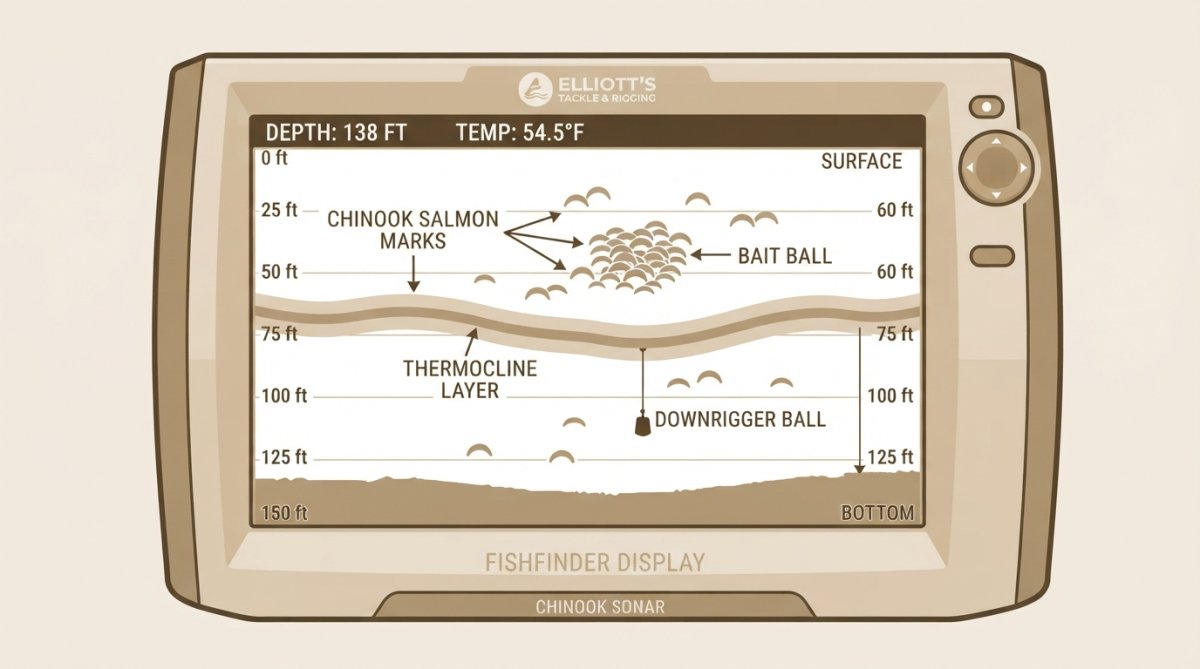
Your fishfinder is your most important tool. The thermocline appears as a distinct arc or band on your display, typically showing a sharp temperature change. Position your lure just above this band where chinook congregate.
Structure matters even in deep water. Underwater ridges, drop-offs, and rocky areas concentrate chinook because they funnel baitfish and create current breaks. When your fishfinder shows structure at depth, slow your trolling speed and work the area thoroughly.
Sand flats at depth (40-80 feet) are prime chinook habitat. These areas provide good visibility for hunting while offering escape cover nearby. Plan your trolling pattern to cross sand flats at least twice during each pass.
Using Sonar and Fishfinder Interpretation
Modern fishfinders with CHIRP sonar technology give you unprecedented ability to locate deep-water chinook. Understanding how to interpret what you're seeing separates consistent catchers from occasional ones.
Identifying Chinook on Your Display
Chinook appear as distinct arcs on your fishfinder display, typically larger and more defined than smaller baitfish marks. They often hold near the thermocline, appearing as concentrated clusters rather than scattered marks. Large individual arcs representing fish 20+ pounds indicate mature chinook worth pursuing.
Temperature readouts are critical. Chinook prefer water between 48-58 degrees Fahrenheit. When your sounder shows water colder than 48 degrees, fish are usually inactive. Above 58 degrees, chinook move deeper to find cooler water. Position your lures in the zone where temperature matches this preference.
Chinook don't always appear as obvious marks on the display. Sometimes they appear as subtle changes in the water column, slight density shifts or faint marks near structure. Learn to recognize these subtle signals by comparing what you see on screen with where you actually catch fish.
Locating Structure and Bait Schools
Baitfish schools appear as dense clouds of small marks on your display. When you see a baitfish school, position your trolling pattern to pass through it. Chinook hunt these schools aggressively, especially in deep water where food is less abundant.
Structure shows as harder returns (brighter colors) on your display. Deep-water structure concentrates chinook because it provides hunting advantages and current breaks. When your sounder shows structure at your target depth, adjust your trolling pattern to work it thoroughly.
Temperature breaks, visible as distinct color changes or boundaries on your display, mark thermoclines. Position your lure 5-10 feet above the thermocline boundary and troll parallel to it rather than perpendicular. This keeps your presentation in the strike zone longer.
How to Target Chinook Salmon in Deep Water: Common Mistakes to Avoid
Depth Miscalculation and Rig Failure
The most common error is fishing too shallow when conditions call for deep water. Mid-summer chinook frequently suspend at 80-120 feet. Start deeper than you think necessary, then adjust upward if you're not getting strikes.
Rig failure in deep water is usually caused by inadequate equipment. Your downrigger cable should be at least 150-pound test. Your sinker release must be properly adjusted: too tight causes lost lures when hitting bottom, too loose causes false releases on weeds.
In murky water (visibility under 10 feet), use larger, brighter lures that create more vibration. In clear water (visibility over 20 feet), downsize your presentation and use more natural colors.
Ignoring Current and Tidal Influence
Current dramatically affects deep-water chinook behavior. When tidal current runs strong (over 1 knot), chinook position themselves on the down-current side of structure, using rocks or reefs to break the flow. Trolling against current in these zones produces more strikes than trolling with current.
Slack tide (when current transitions from ebb to flood) often produces excellent fishing because chinook move away from structure and feed more aggressively. During peak flood or ebb, they hold tighter to structure. Adjust your trolling pattern based on tidal stage.
Strong current pushes your downrigger ball sideways, changing the actual depth of your lure compared to your cable readout. In current over 1 knot, add 10-15 feet to your target depth to compensate for this drift.
Essential Gear Checklist for Deep Water Chinook
| Item | Purpose | Why It Matters |
|---|---|---|
| Downrigger (electric) | Precise depth control | Electric units maintain consistent depth while trolling |
| Fast-action rod (7-8 ft) | Strike detection and hook set | Fast action provides sensitivity at depth while maintaining backbone for fighting fish |
| Conventional reel (300+ yards capacity) | Line capacity and sensitivity | Braided line on conventional reels feels strikes clearly in deep water |
| Fishfinder with CHIRP sonar | Locating fish and structure | CHIRP technology shows thermoclines and baitfish better than traditional sonar |
| Sinker release (mechanical) | Connecting line to downrigger | Mechanical releases are more reliable than electrical in deep water |
| Fluorocarbon leader (4-6 ft) | Reduced visibility in clear water | Nearly invisible to chinook compared to monofilament |
| Quality flashers and spoons | Attracting and triggering strikes | Proven deep-water lures that maintain action at 100+ foot depths |
| Depth sounder | Monitoring water temperature | Temperature readouts guide depth adjustments throughout the day |
Elliott's Tackle & Rigging carries all these items, hand-selected by an experienced captain with forty years of Pacific Northwest fishing expertise. Every product in our inventory is field-tested and proven to perform in real deep-water conditions. When you're investing in equipment for serious chinook fishing, you need gear that works harder and lasts longer, exactly what we provide.
Deep-water chinook fishing demands precision, patience, and the right equipment. The techniques covered here, understanding seasonal depth patterns, reading your fishfinder, managing your downrigger, and adjusting to current and light conditions, work consistently when executed properly. Elliott's Tackle & Rigging solves the equipment challenge by offering captain-curated gear tested on the water, FREE shipping, and 30-day returns. Get started with Elliott's Tackle & Rigging and transform your deep-water chinook fishing from occasional success into consistent results.
Frequently Asked Questions
What is the best lure for deep water Chinook salmon?
Flashers paired with spoons or plugs work exceptionally well for deep water Chinook salmon. The Rapala X-Rap Magnum series, available in 15, 20, and 30-foot diving depths, delivers excellent action without added weight. Cured salmon eggs also produce consistent results. The key is matching lure size to water depth and current: larger lures (3-4 inches) in deeper water, smaller profiles in moderate depths. Color selection matters too, silver, blue mackerel, and hot pink UV patterns excel in varying light conditions.
When do Chinook salmon go deep, and what depth should I fish?
Chinook salmon (King salmon) typically move deeper during summer months when surface water warms, and during low-light conditions like overcast days or early morning. They often position near thermoclines, the temperature boundary layer where water density changes. In saltwater environments, target depths of 80-150 feet depending on season and location. In freshwater lakes, fish 40-80 feet. Use a fishfinder to locate thermoclines and adjust your downrigger accordingly. Barometric pressure also influences depth: dropping pressure often triggers deeper feeding behavior.
How do downriggers help when targeting Chinook salmon in deep water?
Downriggers allow precise depth control while maintaining natural lure action. A weight ball attached to a cable descends to your target depth, carrying your line via a sinker release mechanism. When a Chinook strikes, the line releases from the ball, letting you fight the fish on your rod without the weight. This setup is essential for deep water trolling because it keeps your lure in the strike zone consistently. Fast-action rods paired with sinker releases ensure solid hooksets. Downriggers also let you cover multiple depth zones simultaneously by staggering weights on different lines.
What does sonar tell me about Chinook salmon location in deep water?
A quality fishfinder reveals critical information: thermocline depth (shown as a distinct arch), baitfish schools (which Chinook follow), and individual fish marks. Chinook typically appear as medium-sized marks near structure or suspended in the water column. Sonar helps you identify sand flats, shelves, and drop-offs where Chinook congregate. Look for areas where thermoclines intersect with underwater structure, these are high-probability zones. Interpreting sonar takes practice, but focusing on baitfish concentrations and temperature layers significantly increases your success rate when targeting deep water Chinook.
0 comments