

Table of Contents
- Why Salmon Rods Need Different Storage Than Other Gear
- How to Store Salmon Fishing Rods at Home and in the Offseason
- Boat Rod Storage and Transport: Racks That Hold Up at Trolling Speed
- How to Transport Fishing Rods in a Truck Without Breaking Tips
- Fishing Rod Cases for Travel: Soft, Hard, and Airline-Ready
- How to Clean Fishing Rods After Saltwater Fishing
- Common Storage and Transport Mistakes That Cost You Rods
- Frequently Asked Questions
Last Updated: October 16, 2026
Why Salmon Rods Need Different Storage Than Other Gear
Salmon rods take more abuse than almost any other stick in the boat. Long trolling blanks, big reels, and constant salt spray add up fast. Learning how to store and transport salmon fishing rods properly is what keeps guides and serious anglers from replacing gear every season.
At Elliott's Tackle & Rigging, we've watched rods fail for one reason more than any other: poor storage between trips. A rod that fishes hard for ten years can crack in a garage corner over one winter.
Salmon rods differ from bass or panfish gear in three ways:
- They run longer, often 8 to 10 feet, so they flex more in storage
- They carry heavier reels that stress the handle and seat
- They see saltwater, which attacks guides, reel seats, and finishes
That combination means the usual "lean it in the corner" approach costs you real money.
How to Store Salmon Fishing Rods at Home and in the Offseason
Store salmon fishing rods horizontally, under light tension, in a dry space away from sun and heat. That single habit prevents most of the damage we see. Rod blanks take a "set" when left bent for months, and UV light breaks down finishes and line.
Here's how we'd set up a home rack:
- Mount the rack at chest height, not near a window
- Support the rod at three points along the blank
- Back off the drag before hanging any reel
- Loosen the line so it isn't pulling the tip over
For the offseason, pull the reels off entirely and store them separately. Wipe rods down first, then hang them. A rod sock adds a cheap layer of protection against dust and accidental knocks.
Horizontal vs Vertical Storage: Which Protects Rod Blanks Better
Horizontal storage wins for long salmon rods. Gravity pulls evenly along the blank instead of concentrating stress at one point.
Vertical storage works fine for short rods and in tight spaces. But a 9-foot trolling rod standing upright in a corner is an accident waiting to happen. One bump and the tip snaps.
If you must go vertical, use a rack that grips the butt end and holds the blank straight. Lee's Single Rod Rack Set, available in bright gold and satin silver, mounts horizontally, vertically, or overhead. The closed end has a vinyl insert that cushions the butt, and the locking end uses a rotating nylon ring to hold the tip.

| Storage Method | Best For | Main Risk |
|---|---|---|
| Horizontal rack | Long salmon trolling rods | Takes up wall space |
| Vertical rack | Short rods, tight spaces | Tip damage from bumps |
| Overhead mount | Boats with cabin space | Head clearance |
Boat Rod Storage and Transport: Racks That Hold Up at Trolling Speed
A boat rod rack has to survive more than a garage shelf. It has to hold rods steady at trolling speed, in chop, with downriggers running.
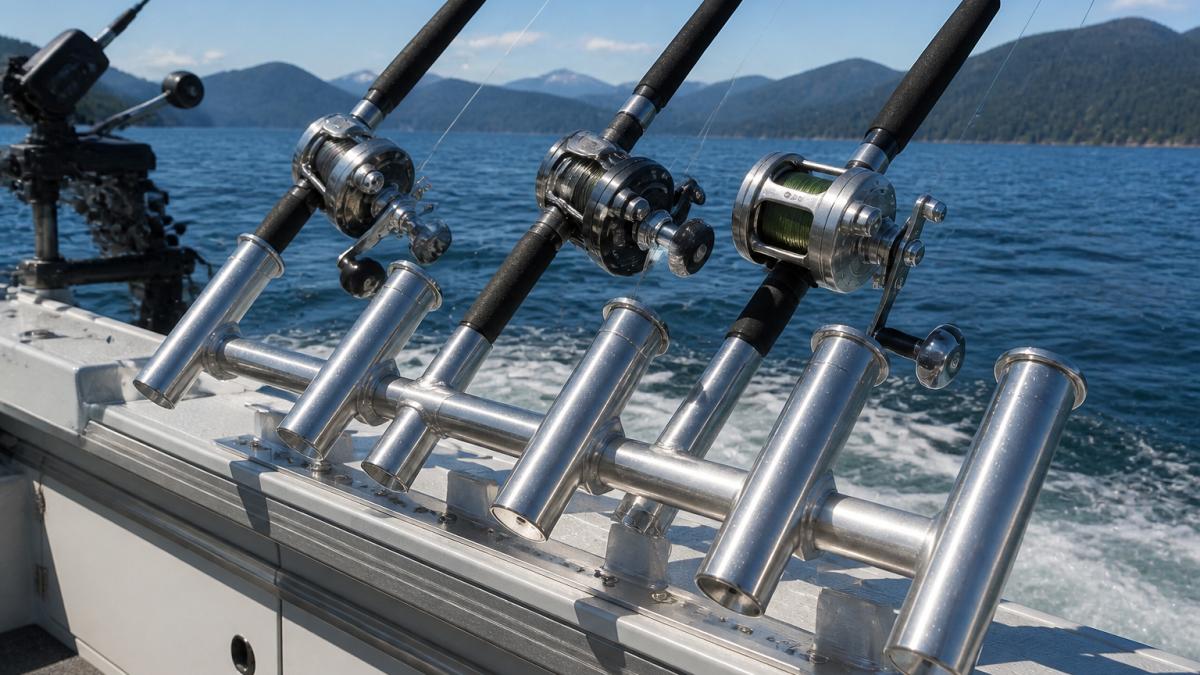
The Cisco Fishing Systems Stationary Rod Storage Rack is built for exactly this. Threaded aluminum tubes on 6.75-inch centers lock rods in place without rattling or shifting underway. You pick the capacity, anywhere from 2 to 12 rods, and choose an 18° angled base or a 90° vertical base to match your gunwale or console face.
Cisco Fishing Systems Stationary Rod Storage Rack →

Every rack is machined from solid aluminum and hand-assembled to order in Brunswick, Ohio. Lead times run 8 to 14 business days, and the rod holders carry a lifetime warranty.
Track-Mounted and Rail-End Options for Cockpit Space
Deck space disappears fast on a salmon boat. Between downriggers, rod holders, and nets, the cockpit fills up before you even start fishing.
The Cisco Fishing Systems 6-Pack Rod Storage Mount solves that with a 19-inch offset plate that overhangs the end of your Cisco track rail. Six rods tuck alongside the windshield instead of eating deck space. It comes in silver, black, blue, and gold, and carries the same lifetime warranty on rod holders.
How to Transport Fishing Rods in a Truck Without Breaking Tips
Transport fishing rods in a truck by securing them so they cannot slide, bounce, or flex against a hard surface. Most broken tips happen in the truck bed, not on the water.
A few rules we follow:
- Lay rods flat, never leaning against the tailgate
- Use a rod rack or strap system to stop movement
- Keep tips pointed toward the cab, butts at the tailgate
- Never let a rod rest on a hard edge
If you run a crew cab, lay rods across the back seat with the tips forward. If you use the bed, a simple PVC tube or a padded rack keeps them off the metal.
For long drives, a rod sock or two costs almost nothing and prevents guide damage from vibration.
Fishing Rod Cases for Travel: Soft, Hard, and Airline-Ready
Fishing rod cases for travel come in three basic types, and the right pick depends on how you're moving the rods.
Soft cases are light and cheap. They work for truck beds and short trips. They will not survive an airline baggage handler.
Hard cases protect against crushing and impact. They're heavier and cost more, but they're the only real option for checked baggage.
Airline-ready cases combine a hard shell with internal straps and tip tubes. If you fly to fish, this is the category to shop.
What most guides miss is the tip tube. A hard case without internal tip protection still lets the last six inches of a rod flex and crack. Look for a case with a dedicated tip channel, or add one yourself.
Cisco Fishing Systems Stationary Rod Storage Rack →
How to Clean Fishing Rods After Saltwater Fishing
Rinse salmon rods with fresh water after every saltwater trip, then dry them completely before storage. Salt left on guides and reel seats causes corrosion that ruins a rod over a season.
Our routine after a day on the salt:
- Rinse the whole rod with low-pressure fresh water
- Wipe the blank down with a soft cloth
- Check each guide for salt buildup and green corrosion
- Dry the rod fully before it goes in the rack
- Back off the drag and store the reel separately
Pay attention to the reel seat and the guide feet. Those are where corrosion starts. A light coat of reel oil on the seat threads keeps them working smoothly.
Don't use a pressure washer. High pressure forces water past guide wraps and into the blank.
Common Storage and Transport Mistakes That Cost You Rods
Most rod damage traces back to a short list of avoidable mistakes. Here's what we see most often, and how to fix each one.
| Mistake | What It Costs You | The Fix |
|---|---|---|
| Leaning rods in a corner | Bent blanks, cracked tips | Use a horizontal rack |
| Storing with drags tight | Compressed reel drag washers | Back off drag before storage |
| Leaving salt on guides | Corrosion, rough line flow | Rinse and dry after every trip |
| Rods loose in a truck bed | Broken tips from sliding | Strap down or use a rack |
| Soft case for air travel | Crushed blanks | Use a hard, tip-protected case |
The pattern is simple. Rods fail when they're left free to move or left dirty. Fix both and your gear lasts years longer.
If you want a rack that holds up to trolling speed and salt air, the Cisco Stationary Rod Storage Rack and the 6-Pack Rod Storage Mount are both built to order in the USA with a lifetime warranty on rod holders. Every product we carry is hand-picked by a captain with forty years on the water, and we won't sell gear we wouldn't run on our own boat.

Salmon rods are expensive, and the difference between a rod that lasts five seasons and one that lasts fifteen comes down to how you store and move it. If you're tired of replacing cracked tips and corroded guides, it's time to set up proper storage. Elliott's Tackle & Rigging carries captain-curated rod storage built for serious saltwater anglers, including solid aluminum racks with a lifetime warranty, free shipping, and 30-day returns. Search our rod storage collection and get your gear off the deck and out of harm's way.
Frequently Asked Questions
Should salmon fishing rods be stored vertically or horizontally?
Both work if the rod is supported along its length. Vertical storage saves floor space and keeps rods off the deck, but the rod tip must be secured so it cannot whip or knock against a wall. Horizontal storage spreads weight more evenly and is easier on older fiberglass blanks. Whichever you choose, avoid leaning a rod unsupported in a corner, since that puts constant pressure on one spot of the blank and can set a permanent curve. A dedicated rack solves both problems because it holds each rod at fixed spacing.
How do you transport fishing rods safely in a truck?
Keep rods inside the cab when you can, laid flat with the tips forward and the reels up so they are not resting on their handles. If they ride in the bed, use a locking horizontal rod holder or a hard case strapped down so nothing shifts. Never let a rod tip hang past the tailgate where it can catch wind or clip a trailer. Break two-piece rods down and sleeve the sections together with the guides aligned, then bundle them so they cannot rub against each other on rough roads.
How do you secure salmon rods on a boat while underway?
Rods need to be locked at both ends, not just dropped into a tube. A rack with threaded aluminum tubes on 6.75-inch centers holds rods firmly without rattling or shifting at trolling speed, and it can be built from 2 to 12 rods depending on your spread. For track systems, an offset mount that overhangs the rail end tucks rods beside the windshield and keeps the deck clear. Check that the butt is seated and the tip is captured before you throttle up.
How do you clean salmon rods after saltwater fishing?
Rinse the entire rod with fresh water after every saltwater trip, paying attention to the guides, reel seat, and any exposed metal. Salt sits in the guide frames and foot wraps and starts corrosion there first. Wipe the blank dry with a soft cloth, then check the guide rings for nicks that can shred line. Let the rod dry fully before it goes back in a closed case or rack, since trapping moisture against the finish is what causes cloudy spots and lifting thread epoxy over time.
0 comments