

Table of Contents
- What You'll Need to Spool Fishing Reels
- How to Spool a Spinning Reel: The Complete Process
- How to Spool a Baitcaster Without Common Mistakes
- Understanding Fishing Line Types for Proper Spooling
- Preventing Line Twist and Managing Line Memory
- Common Mistakes to Avoid When Spooling
- Maintenance and Care After Spooling
- Conclusion
How to Spool Fishing Reels: Step-by-Step Guide
Last Updated: July 21, 2026
Learning how to spool fishing reels properly is one of the most overlooked fundamentals in angling. Most anglers grab their rod, tie some line to the spool, and start cranking, then wonder why they experience line twist, premature failures, and frustrating casts. Proper spooling technique affects everything: casting distance, bite detection sensitivity, line longevity, and whether you'll spend the day fighting line twist or actually fishing.
What You'll Need to Spool Fishing Reels
Essential Tools and Materials
A spooling station keeps your line spool level and rotating freely. A pencil through the line spool's arbor, held by a vice or two people, works fine. Many anglers use specialized spooling tools that clamp to a table and hold tension steady.
You'll need quality fishing line appropriate for your target species. Monofilament is forgiving for beginners. Braided line casts farther and feels more sensitive but requires different handling. Fluorocarbon sinks faster and is nearly invisible underwater but has more memory.
Backing line (typically cheaper monofilament or braided line) fills the spool before your main line, saving money and preventing your expensive line from slipping. Most reels need 50-150 yards of backing depending on capacity.
An arbor knot is the only knot you absolutely need for this process. It's simple, reliable, and won't slip under load.
Reel and Rod Setup
Start with a clean reel. If respooling, remove old line completely and check the spool for cracks, corrosion, or rough spots that could damage new line.
Attach your rod to a stable holder. The rod should be positioned so guides align naturally, not twisted or at an awkward angle.
Open the bail arm completely on spinning reels. For baitcasters, disengage the spool lock. You want zero resistance as line feeds onto the spool.
How to Spool a Spinning Reel: The Complete Process
Step 1: Prepare Your Reel and Bail Arm
Open the bail arm fully and position it so the line roller sits directly above the spool. Check that the spool rotates freely by spinning it by hand. Set your drag system to the lightest setting initially.
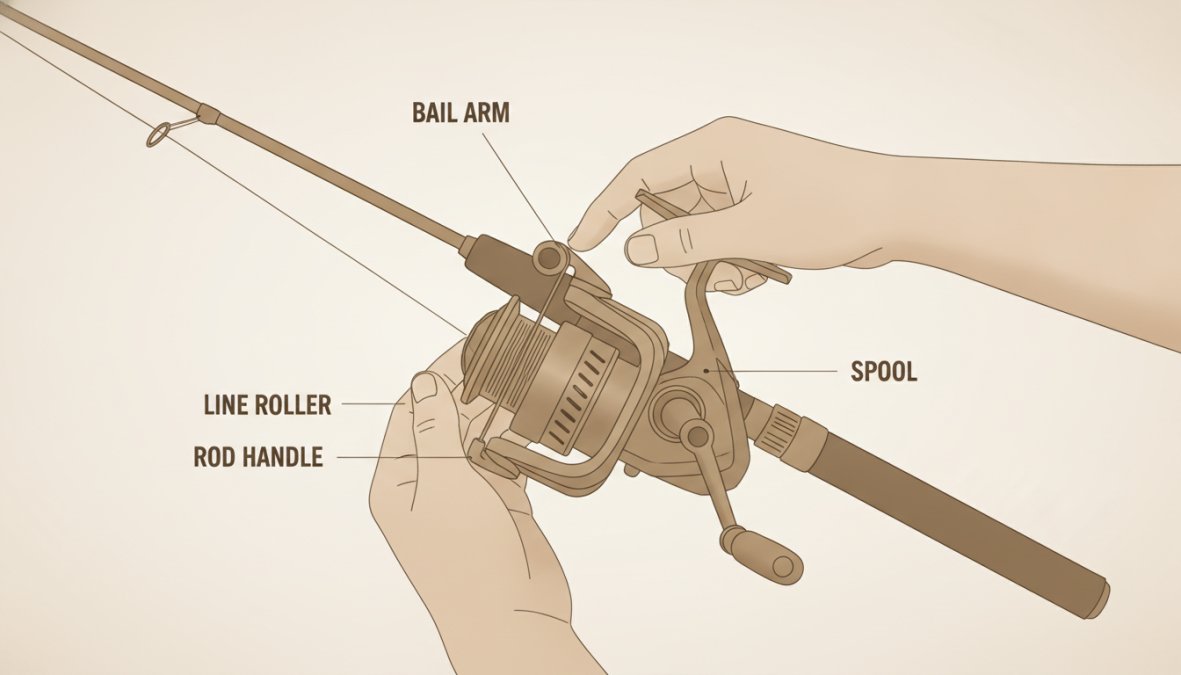
Step 2: Tie the Arbor Knot
The arbor knot holds your line to the spool without slipping under heavy load.
- Pass your line around the spool arbor (the center post)
- Tie an overhand knot around the standing line, but don't tighten it yet
- Tie a second overhand knot in the tag end of the line
- Slide the first knot down toward the spool, then pull tight
- The second knot acts as a stopper
Trim the tag end close to the knot. Test it by pulling hard; if it slips, retie it immediately.
Step 3: Run Line Through Rod Guides
Feed your line through every guide, starting with the guide closest to the reel. Check that line passes cleanly through each guide without twisting around it. Pay special attention to the line guide on your reel, if line doesn't feed straight through, everything downstream gets compromised.
Run line all the way through the rod tip, leaving about 12-18 inches extending past it.
Step 4: Maintain Proper Tension While Spooling
Pinch the line between your thumb and forefinger, about 12 inches above the reel. Apply steady, moderate pressure, firm enough that it won't slip, loose enough that you're not crushing it. As you crank the reel handle, maintain this pinch consistently, keeping your hand about the same distance from the reel throughout.
Watch the line as it layers onto the spool. It should lay evenly in neat rows, not bunching up or creating gaps. If you see bunching, stop immediately and adjust your tension.
Step 5: Monitor Spool Fill and Close the Bail
Fill the spool to within 1/8 inch of the rim. Too empty reduces casting distance; too full and line can slip off during casts or fights. Check your reel's manual for capacity specifications.
Once you've reached proper fill, close the bail arm. The line should sit in the line roller without slack. Trim any excess line.
How to Spool a Baitcaster Without Common Mistakes
Baitcasters demand more precision than spinning reels but reward you with better accuracy and sensitivity.
Baitcaster-Specific Setup and Spooling Direction
Check your reel's manual for the correct spooling direction. Spool in the wrong direction and you're introducing twist with every yard. Open the spool lock and ensure the spool rotates freely.
Tie your arbor knot so it sits directly in line with the spool's rotation axis. Maintain tension using the same pinch technique, but watch more carefully. Baitcaster spools fill faster, so line lay problems become obvious quickly.
Setting Drag and Tension on Baitcasters
After spooling, set your drag system properly. Set drag to the point where you can pull line out with steady pressure but it doesn't slip under normal casting loads.
Adjust your spool tension knob so the spool doesn't free-spool when you open the spool lock, but it rotates smoothly during the cast. Test cast in an open area before fishing.
Understanding Fishing Line Types for Proper Spooling
Monofilament: The Beginner-Friendly Choice
Monofilament is forgiving and doesn't require special handling during spooling. Use standard tension control with the pinch technique. Monofilament develops memory if spooled too tight or left unused for months. Combat this by spooling with moderate tension and occasionally soaking your spooled reel in warm water to relax the line.
Braided Line: Power and Sensitivity
Braid is stronger, thinner, and casts farther than monofilament but is more demanding to spool. Use slightly lighter tension when spooling braid. The line is tough, but aggressive pinching can flatten it. Maintain steady, moderate pressure and watch line lay carefully.
Fluorocarbon: Invisibility and Durability
Fluorocarbon is stiff and dense, ideal for clear-water fishing. It has the worst memory of all line types. Use the lightest tension you can maintain while keeping line from bunching. Spool fluorocarbon slowly and watch for bunching.
After spooling, soak your reel in warm water for 15-20 minutes. This relaxes the line and reduces memory significantly.
Backing Requirements and Line Capacity
Calculate backing needs by checking your reel's total capacity, then subtracting your main line yardage. Tie backing to the spool first using the arbor knot. Once backing is on, tie your main line to the backing using a Palomar knot or Alberto knot.
Preventing Line Twist and Managing Line Memory
Why Line Twist Happens During Spooling
Line twist occurs when your line spool rotates in the wrong direction relative to your reel spool. Check your line spool's rotation direction and ensure it matches your reel's requirements. For spinning reels, your line spool should rotate so line comes off the top. For baitcasters, check your manual.
Use a spooling station that keeps your line spool level and rotating freely.
Tension Control and Spooling Direction Techniques
Consistent tension eliminates most line twist problems. Maintain your pinch pressure throughout the entire spooling process. Watch your line as it layers onto the spool, it should lay in neat, parallel rows. If you see line crossing over itself or bunching, stop immediately and adjust your tension.
For baitcasters especially, watch spooling direction religiously.
Addressing Line Memory Before It Starts
Prevent line memory by spooling with moderate tension, not too tight. After spooling monofilament or fluorocarbon, soak your reel in warm water for 15-20 minutes. This relaxes the line and dramatically reduces memory.
Common Mistakes to Avoid When Spooling
Tension and Knot Mistakes
The most common mistake is inconsistent tension. Stay focused and pinch your line consistently throughout the entire process. If your hand gets tired, take a break rather than finishing with weak tension.
Arbor knot failures are the second most common problem. Always double-check your arbor knot before spooling by pulling hard on it.
Line Lay and Wind Knot Issues
Wind knots usually start during spooling when line bunches or crosses itself. Watch your line as it spools and stop immediately if you see bunching. Uneven line lay causes casting problems immediately.
Drag System and Maintenance Oversights
Set drag to about 25% of your line's breaking strength for most freshwater fishing, 30-35% for saltwater. Test your drag before fishing by holding the rod and pulling line steadily.
Maintenance and Care After Spooling
Rinse your reel with fresh water after each saltwater outing. Salt corrodes components and degrades line.
Store your reel in a cool, dry place away from direct sunlight. Periodically check your line for fraying or damage by running your fingers along it.
Getting how to spool fishing reels right transforms your entire fishing experience. Proper spooling eliminates frustration, extends line life, and ensures your reel performs consistently. Apply these techniques consistently and your reels will reward you with years of dependable performance on the water.
Frequently Asked Questions
What is the easiest way to spool a fishing reel for beginners?
The easiest method is to use a spooling station or have a helper hold the line spool steady while you maintain even tension. Start by tying a secure arbor knot to the spool, run your line through all rod guides, and wind slowly while applying light finger pressure to the line. This prevents line twist and wind knots. For spinning reels, keep the bail arm open and maintain steady tension, this is simpler than baitcasters for most beginners.
How do you keep fishing line from twisting when spooling?
Line twist occurs when spooling direction doesn't match the line's natural lay. Ensure your line spool rotates in the same direction as your reel handle turns. Maintain consistent, moderate tension on the line as it goes onto the reel, too loose causes slack and twists, too tight causes line memory. Use a tensioner or apply finger pressure to the line. For monofilament and fluorocarbon, this is critical; braided line is less prone to twist but still benefits from proper technique.
How much backing and line should I put on my fishing reel?
Fill your reel to within 1/8 inch of the spool rim for optimal casting distance and drag performance. Backing (typically cheaper monofilament) fills the spool first, then your main line goes on top. Check your reel's line capacity specifications, this tells you total capacity. For most spinning reels, backing takes up 50-70% of capacity, leaving room for your premium line (braided, fluorocarbon, or monofilament). Slightly underfilled reels perform better than overfilled ones.
What's the difference between spooling a spinning reel and a baitcaster?
Spinning reels have an open bail arm you flip closed after spooling; line lays in smooth, even wraps. Baitcasters require the spool to rotate freely and have a different line lay pattern. With baitcasters, spooling direction is critical, the spool must rotate the same way as your reel handle or line twist becomes severe. Baitcasters also require careful drag and tension adjustment to prevent backlashes. Spinning reels are more forgiving for beginners, while baitcasters demand precision but offer better control for experienced anglers.
This article was written using GrandRanker
0 comments