

Table of Contents
- What You'll Need for a Deep Drop Halibut Rig
- Understanding Halibut Fishing Rigs and Components
- Selecting the Right Halibut Hook Size and Bait Presentation
- Configuring Your Halibut Leader Setup
- Choosing Halibut Sinker Weight for Depth Control
- Step-by-Step: Assembling Your Deep Drop Halibut Rig
- Deployment, Line Control, and Common Mistakes to Avoid
- Frequently Asked Questions
Last Updated: October 8, 2026
What You'll Need for a Deep Drop Halibut Rig
Learning how to rig a deep drop halibut setup requires specific components working together. At Elliott's Tackle & Rigging, we've helped serious anglers assemble rigs that hold up in heavy current and extreme depths.

Here's what goes into a functional deep drop halibut setup:
- Main line (60-100 lb braided)
- Three-way swivel (rated for your line weight)
- Leader material (50-80 lb monofilament or fluorocarbon)
- Dropper loop or secondary connection point
- Sinker weight (cannonball or bank sinker, 2-16 oz depending on depth)
- Hooks (6/0 to 8/0 circle or J-hooks)
- Bait (squid, mackerel, or live herring)
- Swivels (ball bearing, to prevent line twist)
- Knot-tying tools (clippers, crimpers if using sleeves)
Deep drop fishing demands precision. Every component must handle pressure at depth without failing. The rig itself is simple, but the details matter.
Understanding Halibut Fishing Rigs and Components
A halibut fishing rig is a terminal tackle assembly designed to present bait near the bottom in deep water.
Most halibut fishing rigs use one of three core setups:
Three-Way Swivel Rig, This is the standard for deep drop halibut fishing. The three-way swivel connects your main line, a dropper line with weight, and your leader with the hook. The weight hangs below while the baited hook stays at mid-depth or bottom.
Dropper Loop Rig, A loop knot tied into your main line holds a sinker, while the leader extends below it.
Spreader Bar Rig, Used when vertical jigging or when you want multiple hooks in the water.
The three-way swivel rig dominates because it separates weight from bait presentation. Your weight touches bottom and holds position.
Selecting the Right Halibut Hook Size and Bait Presentation
Hook size for halibut depends on bait size and water depth. Most deep drop halibut anglers use 6/0 to 8/0 hooks.
Hook size guidelines:
- 6/0 hooks, Best for small bait (squid strips, small mackerel pieces)
- 7/0 hooks, Versatile mid-range size for most baits
- 8/0 hooks, Large baits, big halibut, heavy current
Bait presentation matters more than most anglers realize. Fresh bait works better than frozen, but frozen squid and mackerel are reliable standbys.
Thread your bait carefully. For squid, pierce the head once so the body dangles freely. For fish chunks, hook through the thickest part so the bait hangs straight.
Configuring Your Halibut Leader Setup
Your halibut leader setup connects your hook to your main line through the three-way swivel.
Leader configuration:
- Shorter leaders (24-30 inches), Bait stays closer to weight, better in strong current
- Longer leaders (36-48 inches), Bait has more freedom, better for light current and slower presentations
Leader material should be 50-80 lb test monofilament or fluorocarbon. Fluorocarbon is less visible to fish but costs more.
Depth Charge Auto Jigger Bent Deep Drop Rods →
Tie your leader directly to the three-way swivel using a Palomar knot or improved clinch knot.
The leader absorbs most abrasion from rocks and rough bottom. Replace it every few trips or when you see fraying. A weak leader costs you fish.
Choosing Halibut Sinker Weight for Depth Control
Sinker weight is the single variable that decides whether your deep drop halibut rig fishes or floats. Too light and the rig never reaches bottom in current.
The right weight is a function of three things working together: depth, current speed, and how much scope (line angle) you can tolerate.
Depth and weight starting points:
- 200-400 feet, 4-8 oz
- 400-600 feet, 8-12 oz
- 600-1000 feet, 12-16 oz
- 1000+ feet, 16-24 oz
Treat those as starting points, not rules. Add weight when:
- Your line angle exceeds roughly 20-30 degrees off vertical
- You feel the sinker ticking bottom, then losing contact as the boat drifts
- The rig swings behind the boat instead of hanging under it
Subtract weight when:
- You snag on every drop
- You cannot feel a distinct bottom tap
- Your rod tip loads up constantly from dragging, not from bites
Reading bottom contact. On braided main line, a sinker that has landed feels like a sharp tap followed by a slackening of tension.
Sinker styles for deep drop halibut:
- Cannonball sinkers roll over rock and cobble and stay compact in current, which is why they are the default for deep drop halibut.
- Bank sinkers are cheaper but flat-sided and prone to tumbling and tangling in strong current.
- Bullet or torpedo shapes cut current well but snag more in structure.
For deep drop halibut work, Elliott's Tackle & Rigging stocks cannonball and bank sinkers in the sizes that match these depth bands, along with the swivels and sleeves that hold up to repeated bouncing on hard bottom. Match your sinker weight to your rod's rating as well; a rod that is too light for a 16 oz sinker will not load properly on the hookset.
Step-by-Step: Assembling Your Deep Drop Halibut Rig
Understanding how to rig a deep drop halibut setup takes about 10 minutes once you know the sequence. Here is the full walkthrough, from parts list to finished rig.
Parts list for one rig:
- 60-100 lb braided main line
- One heavy-duty three-way swivel rated to your main line
- 50-80 lb monofilament or fluorocarbon leader material
- One 6/0 to 8/0 circle hook
- One cannonball or bank sinker, 4-24 oz depending on depth and current
- Two ball-bearing swivels (one above the three-way, one at the hook if you prefer)
- Optional: crimping sleeves and crimper for heavy leader
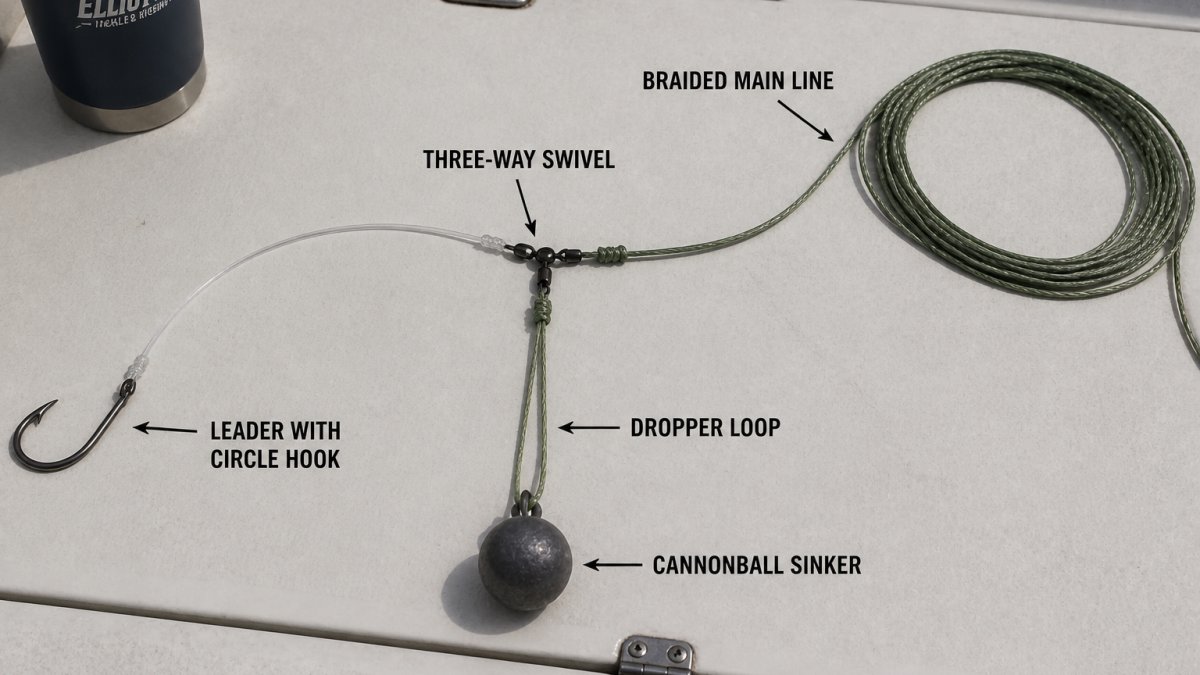
Attaching the Main Line to the Three-Way Swivel
Start with your main line. Cut about 12 inches of tag end. Tie the main line to the upper eye of the three-way swivel using an improved clinch knot or a Palomar knot.
Improved clinch steps:
- Thread the main line through the swivel eye
- Wrap the line around itself 5-7 times
- Pass the tag end back through the first loop near the swivel
- Pass it through the larger loop you just created
- Pull tight and trim excess
Test this knot by pulling hard. It should not slip. Braided line can slip on smooth swivel eyes, so make sure your wraps are tight and seated before you trim.
Rigging the Dropper Loop and Weight
The dropper loop holds your sinker and prevents it from sliding up the main line. Tie a dropper loop about 18-24 inches below the three-way swivel.
How to tie a dropper loop:
Depth Charge Auto Jigger Bent Deep Drop Rods →
- Make a small loop in your main line
- Twist the loop 5-10 times, creating a coil
- Pass the end of the loop through the center of the coil
- Tighten slowly by pulling on both sides of the main line
- The loop should be 2-3 inches long
Attach your sinker to the dropper loop by threading the loop through the sinker eye and back through itself, or with a surgeon's knot for heavy sinkers. The connection should be secure but allow the sinker to hang straight down.
Connecting the Leader and Hook
The leader connects to the remaining eye of the three-way swivel. Cut your leader material to 24-48 inches depending on current conditions.
Then tie your hook:
- Thread the leader through the hook eye
- Wrap around itself 5-7 times
- Pass the tag end back through the first loop
- Pass through the larger loop
- Pull tight and trim
Check that your hook hangs straight down from the leader. If it angles sideways, retie it. A straight hook presentation catches more fish.
Rig your bait onto the hook last, just before fishing. Fresh bait stays on better than bait rigged hours in advance.
Once assembled, inspect every connection one more time. Run your fingers along the leader for nicks, check that the swivels spin freely, and confirm the sinker hangs below the hook without tangling. A two-minute inspection prevents most lost fish.
Deployment, Line Control, and Common Mistakes to Avoid
Deploying your rig correctly makes the difference between solid catches and wasted time. Drop your rig straight down until you feel weight touch bottom. Then raise the rod tip about 2 feet to keep the bait just above the seafloor.
Proper deployment:
- Lower the rig at a steady pace (don't free-spool)
- Watch your line for the feel of bottom contact
- Once on bottom, raise the rod tip slightly to lift the bait
- Maintain light tension on the line
- Feel for taps and pulls
Common mistakes to avoid:
- Fishing too tight, Constant tension on the line prevents you from feeling bites. Keep slight tension only.
- Overweighting, Leads to constant snagging and lost rigs. Start light and add weight gradually.
- Weak knots, Rushing through knot-tying costs fish. Take time and test every connection.
- Tangled leaders, Leaders that loop or twist catch less and break easier. Keep them straight.
- Stale bait, Frozen bait works, but fresh bait catches more halibut. Use the freshest bait you can source.
Line twist is a silent killer in deep drop fishing. Use ball-bearing swivels, not cheap barrel swivels. Replace swivels if they don't spin freely. Twisted line breaks under load.
Deep drop halibut fishing rewards precision. Your rig is simple, but every component must work flawlessly. The three-way swivel rig described here has caught thousands of halibut because it's reliable, easy to modify for different conditions, and forgiving of small mistakes.
Deep drop halibut fishing demands gear that performs under pressure. The Depth Charge Auto Jigger Bent Deep Drop Rods deliver the sensitivity and power you need to feel bottom contact and set the hook at extreme depths. Pair it with the Daiwa Tanacom S500J Electric Reel for handheld control and consistent retrieve speeds.

Frequently Asked Questions
What weight should you use for a deep drop halibut rig?
Halibut sinker weight depends on depth and current. Start with 1-2 pounds for 200-400 feet, 2-4 pounds for 400-800 feet, and 4-6 pounds for depths beyond 800 feet. Use cannonball sinkers or torpedo weights; they maintain bottom contact without rolling. Adjust upward if current pushes your rig sideways. Most anglers working the Gulf and Eastern Seaboard use 2-3 pounds as a baseline for moderate depths. Always test your rig in calm water first to confirm it reaches bottom without excessive weight that reduces sensitivity.
How long should a halibut leader setup be?
A halibut leader setup typically runs 3-5 feet in length. Longer leaders (4-5 feet) give halibut more room to strike without feeling the main line; shorter leaders (3-4 feet) improve hook-up rates and reduce tangling on the drop. Use 60-100 pound fluorocarbon or monofilament for the leader, it resists abrasion and halibut's rough mouth. The leader connects to your three-way swivel above and your hook below, creating the terminal tackle section that directly contacts bait or jig.
What hooks to use for halibut?
Halibut hook size ranges from 4/0 to 8/0 depending on bait type and target size. Use 4/0 to 6/0 for smaller baits like herring or squid; 6/0 to 8/0 for larger mackerel or bonito. Circle hooks (3/0 to 5/0) work well for live or fresh bait because they hook the corner of the mouth and rarely require setting. J-hooks demand a firm hook set. Match your hook to your leader strength, a 100 pound leader can handle 8/0 J-hooks without risk of straightening. Modern stainless or chemically sharpened hooks penetrate better than older designs.
How do you rig bait for deep-drop halibut?
Thread your bait (herring, mackerel, or squid) onto the hook by piercing the head or shoulders, keeping the bait straight and centered. Avoid threading through the tail, it reduces natural movement and bait scent dispersal. For squid, insert the hook through the head and out the body; the tentacles trail naturally. Secure the bait with a small piece of elastic if needed. When using jigs instead of bait, drop straight down with a jigging motion to trigger strikes. The bait should hang naturally from the hook without twisting or bunching, allowing maximum scent release and visibility in deep water.
0 comments