

Table of Contents
- What You'll Need to Read River Currents
- How to Identify Current Seams and Breaks
- Where Salmon Hold in Rivers
- How to Fish a River With a Strong Current
- How Water Levels Affect Salmon Fishing
- Using Flow Rate and CFS to Plan Your Drift
- A Bank-Side Water-Reading Checklist
- Safety and Access While Reading Rivers
- Frequently Asked Questions
Last Updated: October 8, 2026
What You'll Need to Read River Currents
Learning how to read river currents for salmon fishing starts with your eyes, not your gear. At Elliott's Tackle & Rigging, we've spent forty years watching anglers miss obvious holding water because they never slowed down to look.
Salmon stack into specific lanes where the current gives them rest. Find those lanes and you find fish.
Here's what to bring to the bank:
- Polarized sunglasses to cut surface glare
- A notebook for tracking flows and results
- A flow gauge app for real-time CFS data
No gadget replaces time on the water.
How to Identify Current Seams and Breaks
A current seam is the visible line where fast water meets slow water, and where salmon sit. Current breaks are anything that interrupts flow: boulders, log jams, gravel bars, bridge pilings.
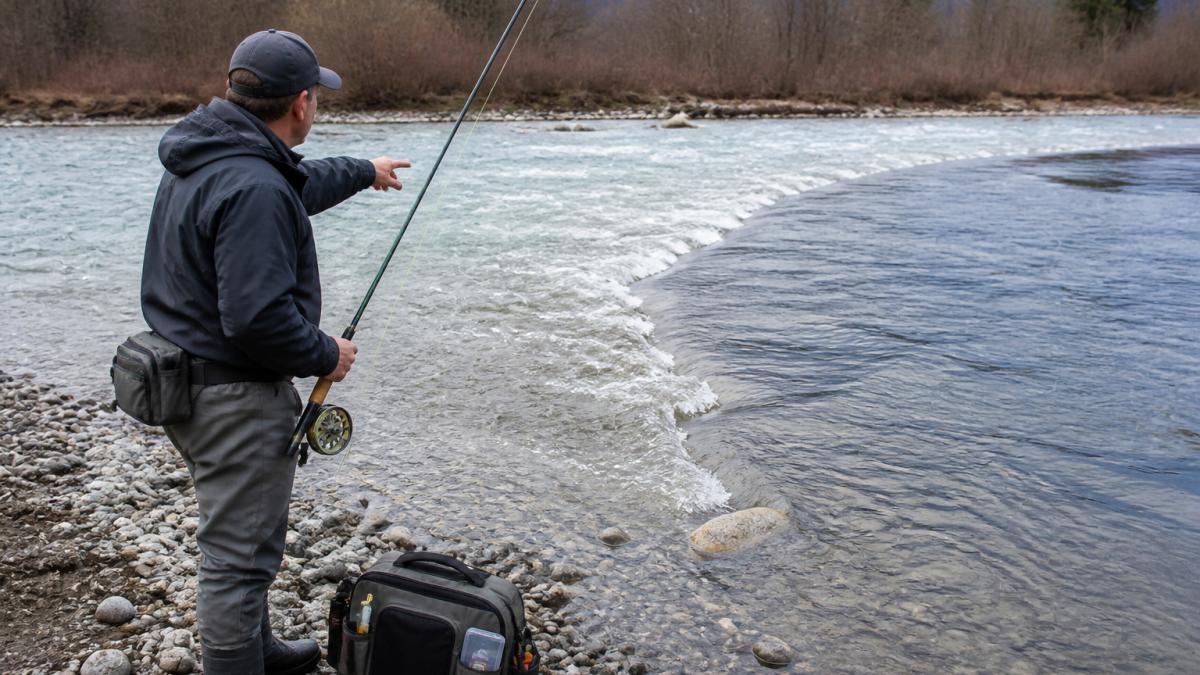
Reading Surface Signals: Boils, Slicks, and Choppy Lanes
Surface texture tells you what's happening below. A boil is upwelling water from a submerged rock or drop-off. Slicks are smooth patches where current slows. Choppy lanes show fast, shallow flow.
Fish the edges of boils. Salmon tuck right behind the structure causing them. Slicks often mark resting water. Choppy lanes usually mean move on.
Where Salmon Hold in Rivers
Salmon hold where they can rest without fighting the full push of the river, current breaks, depth changes, and seams between fast and slow water. The best holding water has three things:
- Slower current than the main flow
- Depth for cover, usually waist-deep or more
- A nearby lane of faster water carrying scent and food
Miss any one and the spot rarely produces, but the specifics shift with species and run stage.
Holding Lies by Species and Run Stage
Fresh-run kings sit in the deepest, coolest slots, tight to structure and slow to move.
Coho hold higher in the column, in softer seams that kings ignore. Pink and chum push into shallower, faster water than either.
Fresh fish want a slow, deep presentation. Colored-up fish in the upper river will move farther for a lure.
A practical way to think about it is a three-stage model that applies across species:
- Moving fish (fresh from tidewater). On a mission, they use the fastest water they can tolerate and rarely hold in soft water. Target the inside edges of fast lanes where the current softens just enough to give them a breather.
- Staging fish (holding before the final push). Where most catchable fish live: the seam, the tailout of a pool, the soft pocket behind a mid-river boulder. Resting but still responsive, build your checklist around this water.
- Spawning fish (on redds or paired up). Not feeding, though they may strike from aggression. If you see fish paired over clean gravel in shallow riffles, they're spawners. Many fisheries restrict targeting them, so check local regulations.
Species differences stack on top of that model:
- Chinook. The deepest, coolest, most structured water. Fresh kings tuck under cutbanks, behind large boulders, and in the deepest slot of a pool. Least likely to move for a lure, so precision beats coverage.
- Coho. Higher in the column, willing to sit in softer seams that look too shallow or slow to a king angler. Respond well to a swung or drifted presentation in the upper third of the column.
- Pink. Shallow, fast, often close to the bank. Least selective and most willing to chase, cover water fast and pinks will find you.
Run stage matters as much as species.
How to Fish a River With a Strong Current
Fishing a strong current means using the river's own push to move your gear naturally. Cast upstream, keep your line tight, and keep your rod tip low.
Heavy flows call for heavier gear. That's why we stock downriggers, rod holder systems, and weighted rigging built for big water at Elliott's Tackle & Rigging, hand-picked by a captain who won't sell gear he wouldn't run on his own boat.
Three rules for strong current:
- Add weight until you feel bottom, then back off slightly
- Mend your line to keep a drag-free drift
- Fish the seam, not the middle of the fast lane
How Water Levels Affect Salmon Fishing
Rising water pulls fresh salmon in from the tidewater. Falling water concentrates fish into deeper holes. Understanding how water levels affect salmon fishing is the difference between a skunk and a limit.
Check the gauge before you leave the house. A slow rise is good. A blowout after heavy rain shuts things down for days.
Clear water pushes fish deep. Muddy water pushes them shallow and tight to the bank. Adjust your presentation to match clarity.
Using Flow Rate and CFS to Plan Your Drift
Flow rate, measured in CFS (cubic feet per second), tells you how much water moves past a point each second. It's the single best planning tool for salmon anglers.
Low CFS means clear water and spooky fish. High CFS means big flows and fish pushed tight to the banks.
| CFS Trend | Water Clarity | Where Salmon Sit | Best Approach |
|---|---|---|---|
| Rising fast | Muddy | Tight to banks | Big, loud presentations |
| Rising slow | Stained | Seams and edges | Scented baits, slow drift |
| Steady | Clear | Deep slots, structure | Natural drift, light line |
| Falling | Clearing | Tailouts, riffles | Cover water, work upstream |
Check the USGS WaterWatch streamflow data before every trip. It updates in real time and covers most salmon rivers.
How to Actually Read a Gauge
A CFS number alone tells you almost nothing. What matters is the trend, the rate of change, and how today compares to the seasonal norm. Here's a repeatable way to read a gauge before you leave the house:
- Find your river's gauge. USGS maintains streamflow gauges on most salmon rivers. Bookmark the one closest to where you plan to fish.
- Look at the last seven days, not just today. A river at 2,000 CFS that has been steady for a week is a very different fishery than one at 2,000 CFS that was at 800 CFS yesterday.
- Note the direction and rate of change. A slow rise of a few percent per day often pulls fresh fish in; a fast rise after rain usually blows the river out for a day or more.
- Compare to the seasonal median. If current flow is within the normal band for the month, the river is likely fishable; if it is well above or below, adjust your expectations.
- Cross-check with a second gauge downstream. If the upper gauge is rising and the lower is still steady, you have a window before the water arrives, often the best fishing of the week.
What CFS Means on the Water
CFS is abstract until you connect it to what you see. A few practical anchors:
- Low flow. Clear water, exposed banks, spooky fish. Use lighter line, longer leaders, and a natural drift in the deepest slots and most structured water.
- Medium flow. The river is in its normal channel with good clarity, and fish are spread across seams, tailouts, and structure. The most forgiving range for most anglers.
- High flow. Off-color or muddy water, undercut banks, fish pushed tight to the edges. Go heavy, big, and focus on the softest water near the bank.
Clear water pushes fish deep. Muddy water pushes them shallow and tight to the bank. Adjust your presentation to match clarity.
Matching Your Drift to the Flow
Once you know the flow, the presentation follows:
- In low, clear water: downsize everything, lighter line, smaller baits, longer leaders, and a drift that stays in the deepest part of the seam. Fish are looking up and wary.
- In medium, stained water: fish a wider range. Scented baits and slow drifts through seams and edges work because fish are using more of the water column.
- In high, muddy water: go big and loud. Large presentations, heavy weight, and the softest water within a few feet of the bank. Fish are not chasing far.
A common pattern is that the first day of a drop after a blowout is the most productive, off-color enough to give fish confidence, clear enough that they'll move.
A Bank-Side Water-Reading Checklist
Before you make a cast, run this checklist. It takes two minutes and saves hours.
- Find the seam where fast water meets slow
- Locate the nearest current break (rock, log, gravel bar)
- Check depth: is there waist-deep or deeper water?
Work the checklist top to bottom. The first spot that passes all seven is where you start.
Safety and Access While Reading Rivers
Reading water from the bank is always safer than reading it from midstream. High, cold water is the biggest killer of wading anglers.
Follow these rules:
- Never wade above your knees in fast current
- Wear a wading belt and a PFD in big flows
- Tell someone your plan and your takeout
Check local regulations before you fish. Salmon seasons and bag limits change by river and run. The state fish and wildlife agency for your area publishes current rules.
Reading river currents for salmon fishing comes down to patience and pattern recognition. Our captain-curated selection covers downriggers, rod holders, and rigging built for big flows, all backed by free shipping and 30-day returns.
Frequently Asked Questions
How do you tell which direction a river is flowing?
Watch floating debris, foam lines, and surface bubbles. They move with the surface current, which usually runs downstream even when wind pushes the top layer sideways. On tidal reaches, check the waterline on rocks and pilings: rising water leaves a wet band above the current level. A drift sock or a weighted float cast upstream and tracked for 30 seconds will also confirm direction and speed before you commit a presentation.
What is a current seam, and how do you fish it?
A current seam is the boundary line between two speeds of water, often visible as a foam line or color change. Salmon use seams as travel lanes because they cost less energy than the fast water beside them. Cast upstream of the seam and let your bait or lure drift along the slower side, keeping the line tight enough to feel a take. In strong current, add split shot above the leader so the presentation stays down in the seam rather than planing to the surface.
How should you adjust your presentation for different river currents?
In fast water, use heavier weights, shorter leaders, and a casting angle closer to straight upstream so the bait sinks before it swings. In slow water, switch to lighter gear, longer leaders, and a downstream swing that lets the lure flutter naturally. When the flow is moderate, a quartering upstream cast with just enough weight to tick bottom covers the most holding water. Keep a few sizes of cannonball sinkers and diving plugs on hand so you can change weight without re-rigging.
How do water levels and flow affect salmon fishing?
Rising water pushes fish toward the bank and into slower edges, while falling water concentrates them in deeper pools and tailouts. Check the USGS gauge for your river before you go: a stable or slowly dropping flow usually fishes best, and a spike of muddy water after rain often shuts down the bite until clarity returns. When CFS climbs above normal, fish closer to shore and target current breaks; when it drops, focus on the deepest holding lies.
0 comments