

Table of Contents
- Why Boat Rod Holders Corrode: Salt, Moisture, and Dissimilar Metals
- What You'll Need Before You Start
- Step 1: Rinse Salt Deposits After Every Trip
- Step 2: Stainless Steel Rod Holder Maintenance for Lasting Shine
- Step 3: Aluminum Boat Rod Holder Corrosion Prevention
- Step 4: Boat Rod Holder Installation Isolation to Stop Galvanic Corrosion
- Step 5: Apply a Marine Corrosion Inhibitor for Boats
- Common Mistakes That Speed Up Rod Holder Corrosion
- Frequently Asked Questions
Last Updated: October 11, 2026
Why Boat Rod Holders Corrode: Salt, Moisture, and Dissimilar Metals
Corrosion on boat rod holders is a chemical reaction, and saltwater is the fuel.
At Elliott's Tackle & Rigging, we've watched good hardware fail for one simple reason. Owners clean the boat, not the gear.
Salt never leaves on its own. It pulls moisture from the air, even on dry days, and holds it against the metal. That wet film eats through polished surfaces over time.
Three things drive rod holder corrosion:

- Salt deposits that stay on the surface and hold moisture
- Dissimilar metals touching each other, like stainless fasteners in an aluminum hull
- Trapped water in mounting holes and under flanges where air can't reach
That last one is the sneaky one. Most corrosion we see starts under the mount, not on the tube.
What You'll Need Before You Start
Gather your supplies first so you're not running to the dock box mid-job. Here's the short list:
- Fresh water and a hose
- Soft brush or sponge
- Star brite Salt Off Concentrate for salt removal
- Star brite Ultimate Corrosion Blocker Spray for the protective barrier
- Non-metallic washers or isolation pads for mounting
- Marine sealant for fastener holes
- Clean rags and a small brush for tight spots
That's it. No specialty tools, no haul-out required.

Step 1: Rinse Salt Deposits After Every Trip
Freshwater rinsing is the single most effective corrosion prevention habit you can build. It takes five minutes and removes the salt before it can pull moisture against the metal.
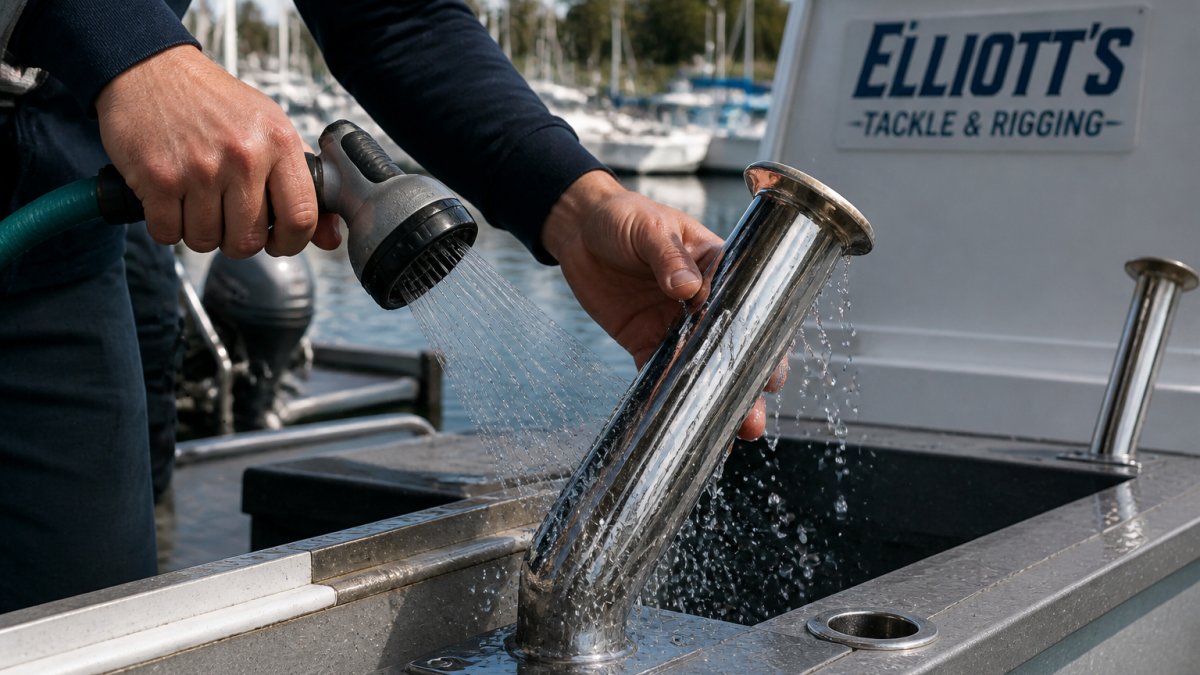
Do this every time the boat comes out of the water. Not weekly. Every trip.
Here's the routine:
- Hose down the rod holders with fresh water
- Pay attention to the base and the mounting flange
- Flush the drain holes so water doesn't pool inside the tube
- Wipe dry with a rag, or let them air dry in the sun
For heavy salt buildup, use a salt remover instead of plain water. Star brite Salt Off Concentrate bonds to the surface and resists future salt accumulation.
Step 2: Stainless Steel Rod Holder Maintenance for Lasting Shine
Stainless steel rod holder maintenance comes down to one truth: stainless stains, it just doesn't rust through as fast.

Tea staining happens when salt and moisture sit on the surface and pull trace iron out of the alloy. It looks like rust but it's surface-level.
Here's how to tell them apart before you decide whether to clean or replace:
| What You See | What It Usually Is | What To Do |
|---|---|---|
| Uniform brown film, wipes off with a rag | Tea staining | Clean and coat |
| Brown film that returns within days | Active surface contamination | Clean, rinse, coat, and inspect fasteners |
| Small dark pits, rough to the touch | Pitting | Clean, inspect depth, replace if pits are deep or clustered |
| Rust bleeding from under a mount or fastener head | Crevice corrosion | Remove the holder, inspect the deck, reinstall with sealant and isolation |
| Cracks at a weld or bend | Stress corrosion cracking | Replace the holder |
A quick field test: rub the spot with a soft cloth and a non-abrasive cleaner.
What works for routine stainless care:
- Wash with fresh water and a soft brush
- Remove stains with a non-abrasive cleaner
- Rinse and dry completely
- Apply a protective coating
Skip steel wool, Scotch-Brite pads, and harsh abrasives. They scratch the surface and give salt a place to hide.
For a polished 316-grade holder like the Attwood Standard Series Rod Holder, a quick wipe-down after each trip keeps the shine for years.
Step 3: Aluminum Boat Rod Holder Corrosion Prevention
Aluminum boat rod holder corrosion looks different from stainless. You'll see white powder instead of brown stains. That powder is aluminum oxide, and it's the metal breaking down.
Aluminum is more reactive than stainless. It needs a barrier, not just a rinse.
Three ways to protect it:
- Coat it. A corrosion inhibitor blocks moisture and salt from reaching the metal.
- Rinse it more often. Aluminum reacts faster than stainless, so don't skip trips.
- Keep it away from other metals. Bare aluminum touching stainless is a problem, covered in the next step.
If the white powder is already there, scrub it off with a soft brush and fresh water. Then coat the surface right away.
Step 4: Boat Rod Holder Installation Isolation to Stop Galvanic Corrosion
Galvanic corrosion happens when two different metals touch in saltwater. One becomes the anode and gives up metal to protect the other. Boat rod holder installation isolation stops this at the source, and the fix depends on what your holder and your deck are actually made of.
The classic setup: stainless steel fasteners through an aluminum hull or gunwale. The aluminum loses. Every time. The same thing happens when a stainless holder base sits directly on an aluminum gunwale, or when a stainless fastener threads into an aluminum backing plate.
Match the isolation to the material pair
| Holder Base | Deck or Gunwale | Fastener | Isolation Needed |
|---|---|---|---|
| Stainless | Fiberglass | Stainless | Sealant at every hole; isolation washers optional but cheap insurance |
| Stainless | Aluminum | Stainless | Nylon isolation pad under the base plus non-metallic washers at both ends of each fastener |
| Aluminum | Fiberglass | Stainless | Non-metallic washers under the screw head and nut; sealant at every hole |
| Aluminum | Aluminum | Aluminum or stainless | Isolate fasteners from the base with nylon washers; sealant at every hole |
| Plated or chromed | Any | Stainless | Treat as aluminum, plated layers are thin and fail fast at bare-metal contact |
Fastener rules that actually matter
- Use 316 stainless fasteners, not 304, for anything that lives in salt. The molybdenum in 316 resists crevice corrosion better.
- Never mix stainless fasteners with aluminum backing plates without a nylon or Delrin washer between them.
- Don't use stainless self-tapping screws into aluminum, the threads cut through the oxide layer and create a permanent galvanic couple. Through-bolt with isolation washers instead.
- Bed every fastener in a marine sealant rated for below-waterline use, even above the waterline. The sealant keeps saltwater out of the hole, which is where crevice corrosion starts.
Removing and reinstalling a corroded holder
If you already see rust bleeding from under a mount, don't just clean the top. Pull the holder and treat the interface.
Star brite Ultimate Corrosion Blocker Spray - 22 oz →
- Soak the fasteners. Apply a penetrating oil and let it sit. Stainless fasteners in aluminum gall and seize, and forcing them snaps the head.
- Back the fasteners out slowly. If a screw won't move, stop and apply more penetrant rather than adding torque.
- Lift the holder and inspect the deck. Look for white aluminum oxide powder, dark pitting, or a wet, dark ring where the flange sat. That ring is where crevice corrosion was working.
- Clean both surfaces. Scrub the holder base and the deck footprint with fresh water and a soft brush. Remove all old sealant with a plastic scraper, metal scrapers gouge gelcoat and aluminum.
- Dry completely. Sealant won't bond to a wet surface, and trapped moisture under a new bead is worse than no bead at all.
- Reinstall with isolation. Nylon or Delrin pad under the base, non-metallic washers at both ends of each fastener, marine sealant in every hole.
- Torque evenly. Snug, not gorilla-tight. Over-torquing crushes isolation washers and cracks gelcoat around the hole.
A flush-mount holder like the Lee's Stainless Steel Non-Swivel Flush Mount Rod Holder still needs isolation at the fasteners. The holder is stainless. Your deck might not be, and the fasteners are the path the current takes.
| Corrosion Type | Where It Shows Up | What Causes It | The Fix |
|---|---|---|---|
| Tea staining | Stainless surface | Salt and moisture | Clean and coat |
| White oxide powder | Aluminum parts | Air and salt exposure | Rinse and barrier coat |
| Galvanic corrosion | Fasteners and mounts | Dissimilar metals in saltwater | Isolate with non-metal parts |
| Crevice corrosion | Under flanges and fastener heads | Trapped saltwater with no oxygen | Remove, clean, seal, and isolate on reinstall |
| Pitting | Tube interior | Trapped water | Clear drain holes |
Step 5: Apply a Marine Corrosion Inhibitor for Boats
A marine corrosion inhibitor for boats is the last line of defense. It puts a barrier between your metal and the saltwater that's trying to get in.
Star brite Ultimate Corrosion Blocker Spray lays down an invisible polymer shield that blocks moisture, salt, and rust. It dries clear and tack-free, so it won't leave a sticky mess on your hands or your rods.
Apply it like this:
- Clean and dry the surface first
- Spray directly onto the metal
- Wipe away any overspray with a cloth
- Reapply as needed to keep the barrier intact
The formula is non-conductive, so it's safe on electronics too. We use it on rod holders, reels, and anything else that lives in the salt.
Common Mistakes That Speed Up Rod Holder Corrosion
The biggest mistake is skipping the rinse because the boat "looks clean." Salt is invisible once it dries. It's still there, and it's still working.
Other mistakes we see:
- Using steel wool or abrasive pads on stainless
- Letting water sit in the tube
- Mixing stainless fasteners with aluminum without isolation
- Coating over rust instead of cleaning it first
- Waiting until you see damage to do anything
The fix is a simple schedule. Rinse after every trip. Inspect monthly. Coat before long storage.
Saltwater is relentless. It finds every scratch, every trapped drop, and every bare metal contact point on your boat. The good news is that a simple routine, rinse, clean, isolate, and coat, keeps your rod holders working for years.
Frequently Asked Questions
What is the best corrosion inhibitor spray for boat rod holders?
Star brite Ultimate Corrosion Blocker Spray (22 oz) is a strong option. It lays down an invisible, tack-free polymer shield on metal surfaces that blocks moisture, salt, and rust without leaving a sticky residue. The non-conductive formula dries clear and repels dirt, so it works well on rod holders, fasteners, and nearby electronics. Spray it directly onto the surface and wipe away overspray with a cloth. Reapply as needed to maintain continuous protection, especially after repeated saltwater exposure.
Can stainless steel rod holders rust in saltwater?
Yes. Stainless steel resists corrosion but is not immune to it. In saltwater, chlorides break down the passive oxide layer on the surface, which can lead to tea staining or pitting over time. Rod holders that rarely get rinsed, or that sit in standing saltwater, are the most vulnerable. Regular freshwater rinsing, periodic polishing, and a protective coating keep stainless steel rod holder maintenance simple and extend the life of the hardware.
How do you prevent galvanic corrosion between stainless steel and aluminum?
Galvanic corrosion happens when dissimilar metals like stainless steel and aluminum touch in the presence of saltwater, which acts as an electrolyte. The fix is boat rod holder installation isolation: use a marine-grade barrier such as a nylon or polymer gasket, plastic washers, or a bedding sealant between the stainless hardware and the aluminum surface. Keep fasteners coated with a corrosion inhibitor and inspect the mounting area each season for early signs of white or chalky buildup.
How often should you clean boat rod holders?
Rinse boat rod holders with fresh water after every saltwater trip, since salt deposits start working on metal immediately. Do a deeper clean with a salt remover and soft brush every few weeks during heavy use. Polish stainless steel and reapply a corrosion inhibitor monthly, and inspect fasteners and the mounting area at the start of each season. If you store the boat near the coast, check more often, because airborne salt reaches hardware even when the boat is not on the water.
0 comments