

Table of Contents
- How to Choose Saltwater Downrigger Weights: Key Factors
- Understanding Downrigger Weight Size and Depth Control
- Downrigger Weight Shapes and Their Performance Differences
- Cable Angle, Blowback, and Hydrodynamic Drag
- How Trolling Speed Affects Weight Selection
- Material Types and Coating: Lead vs. Coated Weights
- Integration with Depth Sounders and Fish Finders
- Weight Storage, Transport, and Maintenance
Last Updated: July 23, 2026
How to Choose Saltwater Downrigger Weights: Key Factors
Learning how to choose saltwater downrigger weights is essential for serious anglers. Get this decision wrong, and your lure sits too shallow to reach active fish or dives so deep you lose sensitivity and catch fewer strikes. At Elliott's Tackle & Rigging, we've watched anglers waste entire seasons with the wrong weight setup, so we're breaking down exactly what matters.
The real challenge isn't just picking a weight, it's matching that weight to your specific water conditions, boat speed, and target depth.
This guide covers the exact factors that separate experienced riggers from guessers: weight sizing, shape performance, hydrodynamic drag, and material choices.
Understanding Downrigger Weight Size and Depth Control
Weight size is the most obvious factor, but it's also where most anglers get confused. Bigger isn't always better, and lighter weights can actually outperform heavy ones when conditions are right.
Heavier weights reach target depths faster and hold position better in current. A 4-pound weight will get you down to 60 feet quicker than a 2-pound weight at the same trolling speed. But heavier weights require more cable tension, which increases blowback and reduces your ability to detect subtle strikes.
Match your weight to the depth you're targeting and the speed you're trolling. For shallow water at 3-4 miles per hour, a 2-pound weight is plenty. For deep structure at 2 miles per hour in heavy current, you'll want 6-8 pounds. The sweet spot for most saltwater applications, salmon and trout in the 40-80 foot range, sits around 4-6 pounds.
Weight Size Chart and Selection Guidelines
Use this chart as your starting point, then adjust based on your specific conditions:
| Target Depth | Current Strength | Trolling Speed | Recommended Weight |
|---|---|---|---|
| 20-40 feet | Light | 3-4 mph | 2-3 lbs |
| 40-60 feet | Moderate | 2-3 mph | 4-5 lbs |
| 60-80 feet | Moderate to Heavy | 2-3 mph | 6-8 lbs |
| 80+ feet | Heavy | 1-2 mph | 8-12 lbs |
These are guidelines, not rules. A 4-pound weight that works perfectly in calm water might be too light when a 2-knot current is running. The key is understanding the principle: weight controls descent rate and position holding, but it also affects sensitivity and blowback.
Matching Weight to Your Trolling Depth
The depth you want to fish determines your starting weight more than anything else. When you increase trolling speed from 2 to 3 miles per hour, your weight will rise 10-15 feet unless you compensate. If you're targeting 50 feet and your weight drifts to 40 feet because you sped up, you've just moved out of the strike zone.
Start with the weight size that gets you to your target depth at your planned trolling speed, then make small adjustments based on what the depth sounder tells you. Most experienced anglers keep three weight sizes in their tackle box, light, medium, and heavy, and swap them based on water conditions rather than trying to find one perfect weight.
Downrigger Weight Shapes and Their Performance Differences
Shape matters more than most anglers realize. The wrong shape creates unnecessary drag, forces you to use heavier weights than needed, and reduces your ability to detect strikes. The right shape lets you fish efficiently and feel what's happening at depth.
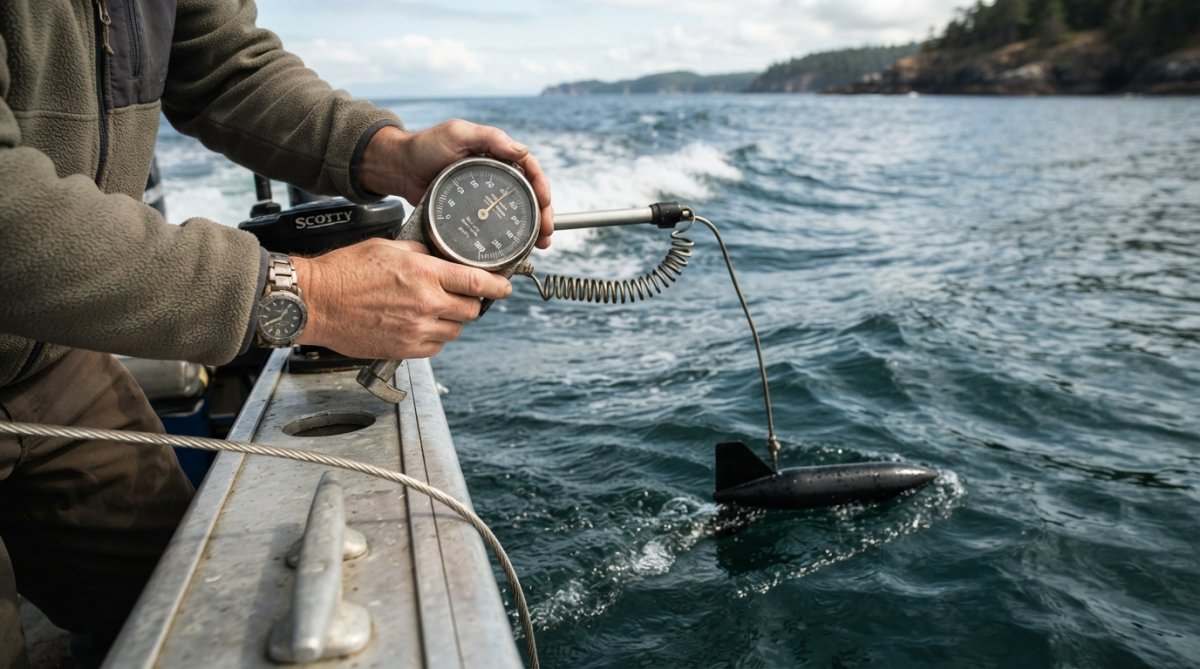
Three shapes dominate saltwater fishing: cannonball (round), pancake (flat), and fish-shaped (hydrodynamic). Each has distinct performance characteristics.
Cannonball Weights: Traditional and Reliable
Cannonball weights are the standard for a reason, they work. The spherical shape creates predictable drag and doesn't twist or spin as it descends. Setup is simple, they're durable, and they're affordable. If you're new to downrigger fishing, start here.
The downside is drag. A round weight creates significant water resistance, especially at higher trolling speeds. This means you need more weight to maintain depth, which increases cable tension and blowback. For fishing shallow to moderate depths (20-50 feet) at typical trolling speeds (2-3 mph), cannonball weights are perfectly adequate.
Pancake and Fish-Shaped Weights: Reduced Drag Benefits
Pancake weights are flat, disc-shaped weights that cut through water with minimal resistance. A pancake weight creates 30-40% less drag than an equivalent cannonball weight at the same trolling speed. This means you can reach the same depth with less weight, which reduces cable tension and blowback.
Fish-shaped weights are the premium option. They're designed to mimic the hydrodynamic profile of an actual fish, which minimizes drag while maintaining stability. A quality fish-shaped weight will outperform both cannonball and pancake weights in most conditions.
If you're fishing 60+ feet regularly or working strong currents, switch to pancake or fish-shaped weights. The reduction in cable tension alone will improve your strike detection. If you're fishing shallow to moderate depths in calm water, cannonball weights are fine.
Cable Angle, Blowback, and Hydrodynamic Drag
Blowback is the angle between your downrigger cable and the vertical. It's the single biggest factor affecting both depth accuracy and strike detection, and it's entirely controllable through weight selection.
When you troll at higher speeds or in current, your weight doesn't hang straight down; it trails behind the boat at an angle. A 30-degree angle is common; a 45-degree angle is excessive. The steeper the angle, the shallower your effective depth, and the harder it is to feel strikes.
As blowback increases, cable tension increases exponentially. A weight at 30 degrees requires about 40% more cable tension than the same weight hanging straight down. That tension translates directly into reduced sensitivity.
Understanding Blowback and Cable Tension
The relationship between weight and blowback is inverse: heavier weights reduce blowback, lighter weights increase it. But this creates a problem. If you use a heavy weight to minimize blowback, you sacrifice sensitivity. If you use a light weight for sensitivity, blowback increases and your depth control suffers.
The solution is matching your weight to your trolling speed and water conditions so blowback stays in the 15-25 degree range. Start with a weight that produces noticeable but manageable blowback, then adjust based on strike detection. If you're missing strikes or feeling nothing through the cable, reduce weight slightly. If blowback is excessive and your depth is drifting, increase weight.
Hydrodynamic Drag and Weight Selection
Hydrodynamic drag is the water resistance your weight encounters as it descends and holds position. It's affected by weight shape, size, trolling speed, and water density.
Drag increases with the square of velocity, double your trolling speed, and drag quadruples. A weight that performs perfectly at 2 mph becomes problematic at 4 mph. If you increase trolling speed, you need proportionally more weight to maintain the same depth.
Fish-shaped and pancake weights minimize drag, which means you can fish lighter and still maintain depth. This improves sensitivity without sacrificing position control.
How Trolling Speed Affects Weight Selection
Trolling speed is the variable that changes most throughout your day. Current, wind, and your own decisions about where to fish all affect how fast the boat moves through the water. Your weight selection must adapt.
As trolling speed increases, you need proportionally more weight to maintain the same depth. A 3-pound weight might hold 50 feet at 2 mph; at 3 mph, that same weight might only hold 40 feet. You need roughly 4 pounds to maintain 50 feet at 3 mph.
Most anglers fish in the 2-3.5 mph range for salmon and trout. This is the sweet spot where lure action is optimal and fish respond well.
Current Speed and Boat Speed Considerations
Current and boat speed combine to create effective trolling speed. If your boat is moving 2 mph and a 1-knot current is pushing you, your effective speed is 3 mph. If current is against you, effective speed drops to 1 mph. Your downrigger weight only knows effective speed.
In strong current, your weight works harder. The current pushes against it, increasing drag and blowback. A weight that holds depth perfectly in calm water might drift shallow when current increases. The fix is simple: use slightly heavier weight when current is running.
Choose your lure and trolling speed first, then select weight that maintains your target depth at that speed.
Material Types and Coating: Lead vs. Coated Weights
Lead is the traditional material for downrigger weights because it's dense, affordable, and easy to shape. But coated weights, typically vinyl-coated lead, offer advantages that matter for both performance and environmental responsibility.
Pure lead weights deteriorate over time. Saltwater corrodes lead, creating a rough surface that increases drag and reduces performance. A lead weight used for a few seasons develops pitting and surface degradation that noticeably affects how it tracks through water.
Vinyl-coated weights resist corrosion. The coating protects the lead underneath, maintaining smooth surface finish and consistent performance season after season. A coated weight fished hard for five years performs nearly as well as a new one.
Environmental Impact and Vinyl Coating Benefits
Lead contamination in marine environments is a real concern. Lead weights that break loose or corrode leach lead into the water column. Saltwater fisheries are increasingly restricted on lead use, and some regions have banned lead weights entirely. Vinyl-coated weights eliminate this concern.
Beyond environmental responsibility, coated weights perform better. The smooth vinyl surface creates less drag than corroded lead. A coated 5-pound weight performs like an uncoated 4.5-pound weight in terms of drag characteristics. This means you can fish lighter and still maintain depth, improving strike detection without sacrificing position control.
The cost difference is modest, coated weights typically cost 20-30% more than bare lead. Over a season or two, that difference disappears when you factor in longer lifespan and better performance.
Integration with Depth Sounders and Fish Finders
Your downrigger weight works in concert with your depth sounder and fish finder. The weight gets your lure to depth; the sounder tells you what depth you're actually at; the fish finder shows you what's happening below.
If your weight choice is wrong and your lure drifts 10-15 feet off target, your fish finder might show fish at 50 feet while your lure is actually at 40 feet. You'll see fish on screen but won't catch them because your lure isn't in the strike zone.
Trust your sounder, not your depth calculation. If the sounder shows 50 feet and you want to fish 45 feet, adjust weight until the sounder confirms you're at 45 feet. Many modern downriggers have integrated sounder displays that show real-time depth, letting you dial in the perfect setup in minutes.
Use your fish finder to confirm your weight is positioning your lure where active fish are concentrated. If fish are suspended at 55 feet and your lure is at 45 feet, adjust weight and verify with the sounder that you're now in the right zone.
Weight Storage, Transport, and Maintenance
Store weights in a dry location. Bare lead weights should be kept dry and, ideally, coated lightly with oil to slow oxidation. Vinyl-coated weights don't have this concern.
Transport weights in a padded bag or box. Weights bouncing around in a tackle bag get dinged and dented, which affects aerodynamics and tracking.
Inspect weights regularly. Look for cracks in vinyl coating, dents, or rough spots on bare lead. A cracked coating should be repaired or replaced. Clean weights occasionally with fresh water and a soft brush to remove saltwater deposits and algae buildup.
Selecting the right downrigger weight comes down to matching weight to your target depth, trolling speed, and water conditions. The weights Elliott's Tackle & Rigging carries are hand-selected for durability and performance in Pacific Northwest saltwater conditions. Our vinyl-coated options resist corrosion, maintain consistent performance season after season, and integrate seamlessly with modern depth sounders and fish finders. Start with a weight that matches your typical fishing conditions, then adjust based on what your sounder tells you. Within a few trips, you'll develop the intuition to make these calls instantly.
Frequently Asked Questions
What size downrigger weight do I need for saltwater fishing?
Downrigger weight size depends on trolling depth, boat speed, and water current. Weights typically range from 2 to 16 pounds for saltwater applications. Shallower depths (under 100 feet) generally require 4-8 pound weights, while deeper trolling may need 10-16 pounds. Current speed and boat speed significantly impact your choice, faster currents require heavier weights to maintain vertical depth control. Consult a downrigger weight size chart for your specific depth and speed combination to optimize strike zone positioning.
What is downrigger blowback and how do I prevent it?
Downrigger blowback occurs when the weight and cable angle away from vertical due to water drag and boat movement, moving your lure out of the intended strike zone. Heavier weights reduce blowback by maintaining cable tension and vertical depth more effectively. Cable angle and boat speed directly influence blowback severity, faster trolling speeds increase drag forces. Selecting the appropriate weight for your trolling speed and using proper cable tension adjustment helps minimize blowback and keeps your terminal tackle in the target zone.
How do downrigger weight shapes affect fishing performance?
Weight shape dramatically impacts hydrodynamic drag and depth control. Cannonball weights are traditional and reliable but create more drag. Pancake and fish-shaped weights reduce hydrodynamic drag, allowing lighter weights to achieve the same depth with less blowback. Fish-shaped designs improve vertical control in current. The shape you choose depends on your trolling speed, water conditions, and target fish species like salmon, trout, or kokanee. Lower-drag shapes are particularly beneficial when fishing fast-moving water or maintaining precise depth.
Can I use freshwater downrigger weights in saltwater?
While some weights function in both environments, saltwater-specific weights are recommended. Saltwater downrigger weights often feature vinyl coating for corrosion resistance and environmental protection, extending durability in harsh marine conditions. Uncoated lead weights corrode faster in saltwater and may leach into the environment. Coated weights provide better longevity and are more environmentally responsible. Always rinse and maintain weights after saltwater use, and consider vinyl-coated options designed specifically for marine environments to ensure reliable performance and compliance with environmental standards.
This article was written using GrandRanker
0 comments