

Table of Contents
- Start With the River, Not the Spool
- Line Types: Braid, Monofilament, and Fluorocarbon
- Braid vs Monofilament for Salmon: What Each Does Better
- Picking Salmon Fishing Line Pound Test by Species and Flow
- Mainline and Leader Combinations That Hold Up
- Salmon Fishing Leader Length for Drift, Float, and Plugs
- River Salmon Float Fishing Setup: Line From Reel to Hook
- Line Failures, Lost Fish, and How to Prevent Both
- Frequently Asked Questions
Last Updated: October 18, 2026
Start With the River, Not the Spool
Most anglers pick a salmon fishing line by reading a label in a store aisle. That is backwards.
Fast, boulder-strewn water punishes weak line. Slow, deep drifts reward a finer presentation. Wood and ledge rock chew through anything that lacks abrasion resistance.
Below, we break down how to choose salmon fishing line for rivers using a simple decision process: river type, line material, pound-test, then leader setup.
Line Types: Braid, Monofilament, and Fluorocarbon
Salmon fishing line comes in three materials, and each one solves a different problem.
- Monofilament is a single strand of nylon. It stretches, it is forgiving, and it is cheap. That stretch absorbs head shakes and protects light hooks.
- Braided line is woven from fibers, usually Dyneema. It has almost no stretch, so hook sets transmit straight to the fish. It also lasts for seasons, not trips.
- Fluorocarbon is denser than nylon and refracts light much like water does. It sinks, it resists abrasion, and fish have a harder time seeing it.
Here is the trade-off in plain terms:

| Line Type | Stretch | Visibility | Abrasion Resistance | Best Role |
|---|---|---|---|---|
| Monofilament | High | Moderate | Moderate | Mainline for beginners, float fishing |
| Braid | Almost none | High (needs leader) | High | Mainline for drift and plug fishing |
| Fluorocarbon | Low | Very low | High | Leader material, clear water |
A common mistake is treating these as competitors. They are not. Braid and fluorocarbon work best as a team, which we will get to.
Braid vs Monofilament for Salmon: What Each Does Better
Braid wins on sensitivity and durability. Monofilament wins on forgiveness and cost.
That is the short answer. The longer answer depends on how you fish.
Braid shines when you need to feel a soft take or set a hook through a long cast.
Mono earns its place in float fishing and in cold, snaggy water where you want a cushion.
What most guides miss is that line visibility matters more in low, clear water than in stained or high water. In off-color flows, a heavier mono mainline rarely spooks fish. In gin-clear conditions, drop to a fluorocarbon leader and the difference shows up in your hookup rate.
Picking Salmon Fishing Line Pound Test by Species and Flow
Pound-test is where most anglers guess. Here is how we think about salmon fishing line pound test in rivers: start with the fish, adjust for current, then fine-tune for clarity and cover.
A big king in fast current loads a rod very differently than a coho in a slow tailout. The table below gives working ranges, but the decision tree after it is what you should actually use.
| Species / Situation | Mainline Range | Leader Range | Why |
|---|---|---|---|
| Coho, small rivers | 10-15 lb braid | 8-12 lb fluoro | Light presentation, spooky fish |
| Chinook, moderate flow | 20-30 lb braid | 15-20 lb fluoro | Power and abrasion |
| Chinook, heavy current or wood | 30-40 lb braid | 20-25 lb fluoro | Control and break resistance |
| Chum and pink, coastal | 15-20 lb braid | 10-15 lb fluoro | Tough fish, simple water |
| Float fishing, any species | 15-20 lb mono or braid | 8-12 lb fluoro | Drag-free drift, soft takes |
A Simple Decision Tree for River Salmon
Use this sequence every time you spool up for a river trip:
- Identify the dominant species. Chinook and chum pull harder and rub harder than coho or pink. Start at the higher end of the range for the power fish.
- Read the current. Fast, boulder-strewn flows demand heavier mainline to control the drift and survive abrasion. Slow tailouts and deep pools let you drop a step.
- Check the cover. Wood, ledge rock, and bridge pilings are line killers. If you are fishing near them, go up one step in both mainline and leader.
- Assess clarity. Gin-clear water calls for a lighter fluorocarbon leader. Stained or high water lets you run heavier mono or fluoro without spooking fish.
- Match the method. Drift fishing rewards direct contact, so braid mainline with a short fluoro leader works well. Float fishing benefits from a softer mono mainline for a drag-free drift. Plug fishing needs a short, heavy leader to control the lure.
Two rules keep this simple. First, heavier current and heavier cover push you up the range. Second, clearer and slower water pushes you down. Do not overthink the exact number. A 20-pound braid mainline with a 15-pound fluorocarbon leader covers most river salmon situations and gives you room to adjust.
Mainline and Leader Combinations That Hold Up
The best river setup pairs a low-stretch mainline with a supple, abrasion-resistant leader. That combination gives you feel at the rod tip and stealth at the hook.
Here are three setups we would run tomorrow:
- Drift setup: 20 lb braid mainline, 12-15 lb fluorocarbon leader, 3-4 feet of leader.
- Float setup: 15-20 lb monofilament mainline, 8-12 lb fluorocarbon leader, 4-6 feet of leader.
- Plug setup: 30 lb braid mainline, 20 lb fluorocarbon leader, short 2-3 foot leader.
For the braid mainline, a tight four-strand weave holds knots cleanly and resists abrasion. The Daiwa J-BRAID x4 Braided Line is a solid pick here, with a slim diameter that loads more line onto the reel when capacity matters.
For leaders, a 100% fluorocarbon that sinks and stays nearly invisible underwater is the standard. The Berkley Vanish Fluorocarbon fits that role, and its non-absorbing formula holds wet strength and abrasion resistance through a long day on the water.

Salmon Fishing Leader Length for Drift, Float, and Plugs
Salmon fishing leader length controls how your bait rides and how much the fish sees. Get it wrong and the best mainline in the world will not save you.
Short leaders keep bait tight to the mainline and track straight. Long leaders let bait drift naturally but add slack and reduce hook-set power.
Use these starting points, then adjust to flow:
- Drift fishing: 3-4 feet. Short enough for direct contact, long enough to look natural.
- Float fishing: 4-6 feet. Longer leaders let bait ride below the float without dragging.
- Plug fishing: 2-3 feet. Plugs do the work; the leader just connects.
A common mistake is running a leader so long the hook set never reaches the fish.
River Salmon Float Fishing Setup: Line From Reel to Hook
A river salmon float fishing setup runs a simple chain: reel, mainline, bobber stop, float, swivel, leader, hook. Each link matters.
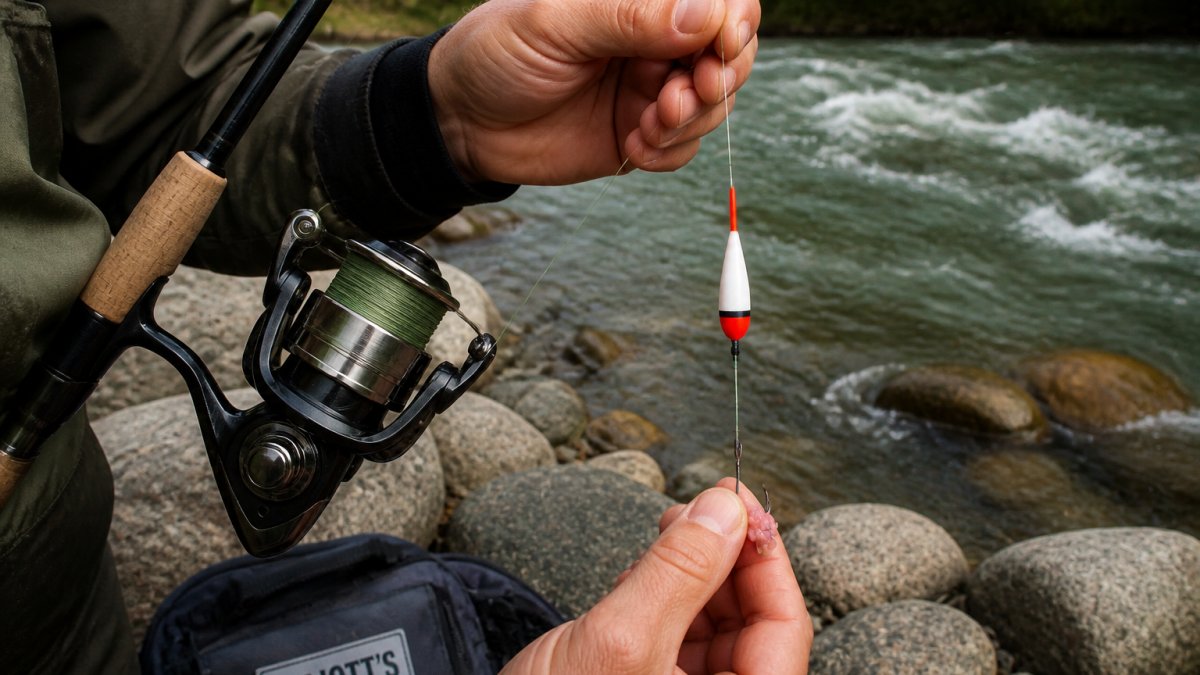
Start with 15-20 pound monofilament or braid on the reel. Thread a bobber stop onto the mainline, then a small bead and your float.
The float tells you when a fish takes. The leader controls whether the fish stays hooked.
For finesse float work in clear water, a fine-diameter braid with good body casts smoothly and cuts wind knots. The Sufix Revolve Braid - Coastal Camo is built for that kind of precise presentation, with a midpoint marker at 100 yards that splits the spool for two reels.

Line Failures, Lost Fish, and How to Prevent Both
Most lost salmon are not lost to bad luck. They are lost to line failure you could have prevented. The key is to diagnose the failure before you change tackle. Here is a practical troubleshooting sequence that covers the four most common break-off points.
Step 1: Check the Last Few Feet of Line
Abrasion is the silent killer. Line dragged over rock, wood, or even a rough boat rail weakens fast. After every snag or hooked fish, run the last three to four feet of line through your fingers. If it feels rough or looks chalky, cut back to clean line and retie. On braid, look for fraying or a fuzzy texture. On mono and fluoro, look for flat spots or cloudiness.
Step 2: Test Your Knot Before You Cast
A poorly seated knot fails before the line does. Wet every knot before you cinch it, and pull steadily to seat it. For braid-to-fluoro connections, a double uni or a small swivel works better than a direct knot. For terminal knots, a improved clinch or a Palomar knot seats reliably in fluoro. If a knot slips, the problem is the knot, not the line strength.
Step 3: Set Drag to Slip Before the Line's Limit
A drag set too tight is the most common cause of a snap during a hot fish's first run. Set drag by pulling line off the spool by hand: it should slip steadily before you reach the line's rated strength. For a 20-pound braid mainline with a 15-pound leader, the leader is the weak link, so set drag to protect the leader, not the braid.
Step 4: Never Lift a Fish by the Line
Lifting a salmon by the leader or mainline concentrates all the fish's weight on a small section of line. Use a net or tail the fish in shallow water. If you are bank fishing without a net, slide the fish onto a gravel bar rather than hoisting it.
Step 5: Replace Old Line on a Schedule
Monofilament degrades from sunlight, heat, and time. Replace it each season, or whenever it feels stiff or has been stored in a hot garage. Braid lasts longer but still collects grit and can lose color; a spool that has seen two hard seasons is worth replacing. Fluorocarbon leader material should be cut back after every few fish or any contact with structure.
Tie your knots carefully, check your line often, and loosen drag when a hot fish runs. Those three habits prevent more break-offs than any upgrade. When you are ready to build a setup that holds up on river salmon, our team at Elliott's Tackle & Rigging can help you match mainline, leader, and pound-test to the water you fish. Every product we carry is hand-selected by a captain with forty years on the water, and we will not sell you gear we would not run on our own boat. Browse our line and leader selection and rig it right the first time.
Frequently Asked Questions
What pound-test line should I use for salmon in a river?
For most river salmon, a 15 to 20 pound braided mainline paired with an 8 to 12 pound fluorocarbon leader covers the widest range of conditions. Small, clear-water fish and low flows favor the lighter end, while big kings in high, dirty water justify stepping up the leader. Match the leader to the weakest link you can get away with, because lighter line gets more bites and still lands fish when your drag is set correctly.
Is braided line or monofilament better for river salmon fishing?
Braid wins on sensitivity, line capacity, and abrasion resistance in current, which is why it dominates mainline choices for river salmon. Monofilament still has a place as a leader material when you want stretch to cushion head shakes, and it costs less to respool. Most anglers run braid as the mainline and mono or fluorocarbon as the leader, which combines the strengths of both.
Should I use a fluorocarbon leader when fishing for salmon in rivers?
Yes, in clear water it makes a measurable difference. Fluorocarbon refracts light similarly to water, so it stays less visible than mono, and it sinks for a more direct connection to the bait. Berkley Vanish fluorocarbon is a practical choice for leaders, and its non-absorbing formula maintains wet strength and abrasion resistance through a long day of fishing rocks and wood.
How much leader should I use for river salmon?
Leader length depends on the method. Drift fishing usually calls for 18 to 36 inches so the bait tumbles naturally near the bottom. Float fishing often runs 24 to 48 inches below the float, adjusted so the bait rides just off the rocks. Plugs and hardware typically use shorter leaders, around 12 to 24 inches, to keep action tight and hook sets direct.
Lost fish usually trace back to one weak link: a leader that was too heavy, too light, or too worn. Fix that link and your hookup rate changes fast. Elliott's Tackle & Rigging stocks captain-curated line and leader options with free shipping and 30-day returns, so you can rig with confidence. Search our line and leader collection and build a setup that holds up to river salmon.
0 comments