

Last Updated: October 25, 2026
Quick Summary
Set up your boat for salmon trolling by first deciding how many lines your hull can run safely, then building the spread in stages: downriggers, rod holders, electronics, and finally divers and planer boards. Mount downrigger bases with backing plates, space rod holders at least one rod length apart, and add speed-at-the-lure data before expanding to a full six-line spread.
- Boats commonly run 2 to 6 trolling rods depending on how many rod holders you have.
- Mount downrigger bases where the gunwale is flat and backed with a plate or plywood underneath.
- Keep at least one rod length between rod holders to separate every line.
- Set sonar about 10 feet deeper than your deepest downrigger weight to keep it on screen.
- Salmon trolling speed usually lands between 2 and 3 mph at the lure.
Table of Contents
- Start With a Small-Boat Rigging Plan Before You Drill
- Downrigger Setup for Salmon: Bases, Booms, and Cable
- Salmon Trolling Rod Holder Placement That Keeps Lines Apart
- Great Lakes Trolling Electronics: Sonar, Charts, and Speed Data
- Line, Divers, and Planer Boards: Deploying the Full Spread
- Salmon Trolling Speed and Direction Control
- Safety Gear and Rough-Water Prep for Big Water
- Build Your Trolling Spread With Captain-Curated Gear
- Frequently Asked Questions
Start With a Small-Boat Rigging Plan Before You Drill
Setting up a boat for Great Lakes salmon trolling starts with one decision: how many lines your hull can run safely. A 2026 trolling guide from FishingBooker's complete trolling guide notes that boats commonly run 2 to 6 trolling rods, depending on how many rod holders you have.
At Elliott's Tackle & Rigging, we've watched too many anglers drill first and think second. Holes in a gunwale are permanent. Plan the whole spread on paper before a single bolt goes in.
Match Your Spread to Hull Size and Budget
A 16-foot aluminum boat with two rod holders is a two-rod boat. Adding four more holders doesn't make it a six-rod troller; it makes it a tangle factory. Work up in stages:
- Two-line start: one downrigger, two holders, basic sonar
- Four-line step: two downriggers, track-mounted holders, speed data
- Six-line spread: planer boards, divers, and a full electronics package
Budget matters as much as length. Build the safety and electronics base first, then add trolling hardware as you learn the water.
Match your spread to what your hull and budget can actually handle, and build up in stages.
| Stage | Setup |
|---|---|
| Two-line start | One downrigger, two holders, basic sonar |
| Four-line step | Two downriggers, track-mounted holders, speed data |
| Six-line spread | Planer boards, divers, full electronics package |
Downrigger Setup for Salmon: Bases, Booms, and Cable
Downrigger setup for salmon comes down to three parts: a base that won't flex, a boom long enough to clear your hull, and cable rated for the weights you run. Get any of those wrong and you'll fight your gear all day instead of fishing.
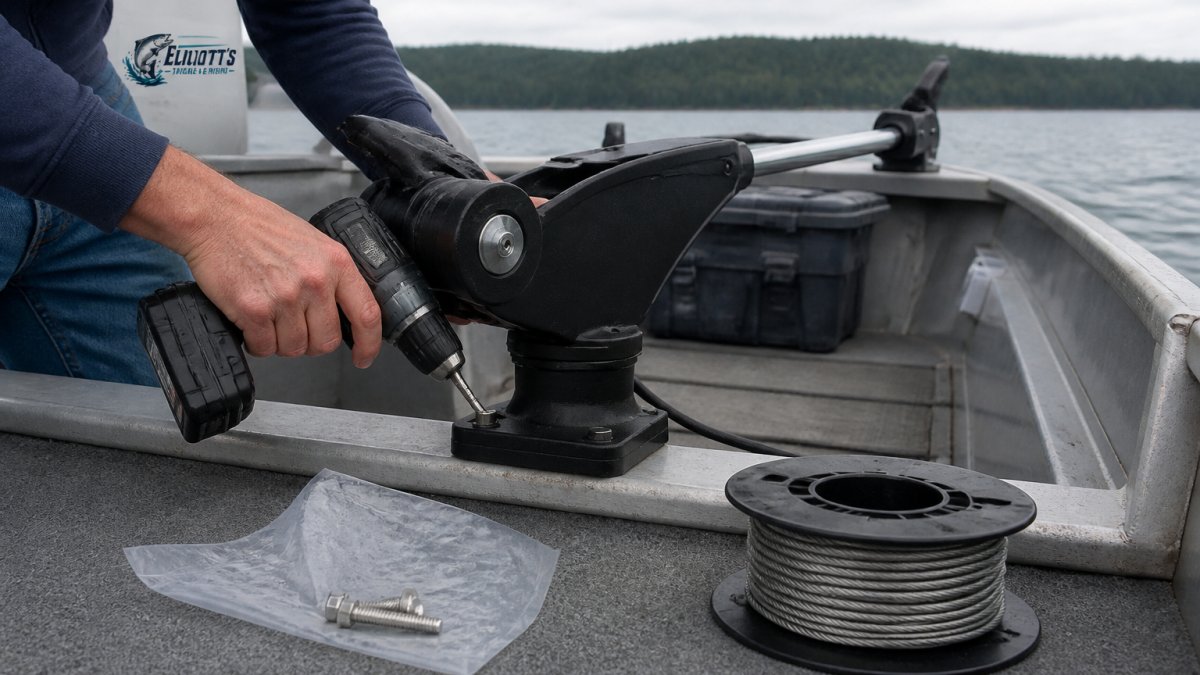
Manual downriggers suit smaller boats and tighter budgets. Electric models save your arms when you're resetting lines all morning. Anyone building a modern electric setup can use the Cannon Optimum 10 BT with its Bluetooth depth control.

Wiring and Mounting the Downrigger Base
Mount bases where the gunwale is flat and backed with a plate or plywood underneath. Through-bolt, don't screw. If you need a standalone mount, the Cannon Low Profile Swivel Base Mounting System lets the boom swing and lock securely.
Route electric downrigger wiring to a fused, dedicated circuit. Keep runs short and connections sealed. Watch out: skipping the backing plate is the most common mounting mistake, and a downrigger under load will crack an unsupported gunwale.
Salmon Trolling Rod Holder Placement That Keeps Lines Apart
Salmon trolling rod holder placement should separate every line by depth and distance, so no two rods fish the same water. Spread holders fore to aft along the gunwale, angle them outward, and keep the inside rods higher than the outside rods.
Track systems let you slide holders as your spread changes.
Cannon Optimum™ 10 BT Electric Downrigger →
Three placement rules we follow:
- Forward holders run deeper lines and divers
- Aft holders run high lines and flatlines
- Keep at least one rod length between holders
Great Lakes Trolling Electronics: Sonar, Charts, and Speed Data
Great Lakes trolling electronics need three things: sonar that marks deep targets, charts that show contour breaks, and speed data measured at the boat. Speed over ground lies to you in current; speed at the lure is what triggers strikes. Most competitors stop at naming those three needs. The gap is in how you actually read and set them, so here is the working setup.
Sonar: Marking Fish and Reading the Thermocline
Set your sonar to a manual depth range rather than auto so the scale stays fixed while you troll.
Mark individual fish as waypoints when you see them, then troll back through the same depth on the next pass. A combo unit like the Garmin GPSMAP 8610xsv covers sonar and charts in one screen, with built-in scanning sonar and preloaded coastal and inland mapping.
Charts: Setting the Scale for Contour Breaks
Set your chart scale so you can see the contour break you are trolling along, typically a half-mile to one-mile view. Zoom in too far and you lose the shape of the structure; zoom out too far and the break disappears. Mark the contour line you are following as a route so you can repeat the pass. Contour breaks, points, and inside turns concentrate bait, and bait concentrates salmon.
Speed Data: Speed at the Lure, Not Over Ground
Speed over ground reads the boat's movement across the bottom, which includes current. Speed at the lure is what the fish see. A paddle-wheel or GPS-derived speed sensor at the transom gets you closer to true trolling speed than the helm GPS alone. Log speed at the lure every time a rod fires; patterns show up fast, and the number that produced fish yesterday is the number to start with today.
Wiring the Electronics Package
Route sonar and network cables away from downrigger power runs to avoid interference. Use a dedicated fused circuit for the electronics, seal every connection, and leave a service loop at each unit so you can pull a head unit without cutting cable. A clean wiring job is the difference between electronics that work all season and a screen that flickers every time a downrigger motor kicks on.
Line, Divers, and Planer Boards: Deploying the Full Spread
Line choice sets your whole spread. A 2026 Great Lakes salmon gear guide from High Class Tackle Co. recommends pairing 30-pound braided mainline with a 25- to 30-foot leader. Braid cuts water and telegraphs releases; the long leader adds the stretch and stealth salmon respond to.
From there, build layers out from the boat:
- Downrigger lines: closest to the boat, straight down
- Divers: mid-distance, tracking out to the side
- Planer boards: farthest out, covering the shallows
A common pattern is to stagger setback distances so no two lures fish the same water: short setbacks on the downriggers, medium on the divers, long on the boards. Keep a written spread sheet at the helm and update it every time a rod fires.
Long-Lining Crankbaits and Running Dipsy Divers
Long-lining crankbaits means letting line way back behind the boat with no weight, which works well on spooky fish in clear water. Flatline a crankbait 100 feet back and let the lure's own dive curve do the work.
Dipsy divers take the opposite approach: they pull line down and out at a controlled angle.
Planer boards need reliable releases. The Scotty Power Grip Plus Planer Board Release keeps lines tracking correctly in the spread.
Managing Multiple Lines Without Tangles
A six-line spread only works if every line has its own lane. Three habits keep it clean:
Cannon Optimum™ 10 BT Electric Downrigger →
- Deploy in order: boards, then divers, then downriggers
- Turn wide: long, gentle turns keep outside lines from collapsing into inside ones
- Reset one rod at a time: clear the fired line, then redeploy it before touching another
When a fish hits a board line, reel the board in with the fish still on, unhook the board, and fight the fish from the rod. Trying to hand-line the board while the fish runs is how leaders break and boards go overboard.
Salmon Trolling Speed and Direction Control
Salmon trolling speed usually lands between 2 and 3 mph at the lure, but the right number changes with water temperature and what the fish want that morning. Watch your rod tips: a steady throb means the lure is working, a dead tip means you're dragging weeds or running too slow.
Control speed with a kicker motor or trolling plate, and fine-tune with servo controls if your boat has them. Direction matters just as much. Troll with the current when you can, and make long, gentle turns so lines speed up and slow down naturally; that speed change often triggers a strike.
Log your speed, depth, and direction every time a rod fires. Patterns show up fast.
Safety Gear and Rough-Water Prep for Big Water
Big water turns on you. A calm morning on Lake Michigan can build three-foot chop by noon, and a small boat loaded with downriggers, boards, and six rods handles badly when it gets rough.
Carry and check this before every trip:
- USCG-approved life jackets for everyone aboard, worn not stowed
- Working VHF radio plus a charged phone in a dry bag
- Throwable flotation and a boarding ladder
- Anchor, line, and a sharp knife at the helm
- Weather forecast checked the night before and again at the ramp
Rough-water prep is mostly about weight. Keep the heaviest gear low and centered, secure downrigger weights so they can't swing, and slow down before the bow starts slamming.
Build Your Trolling Spread With Captain-Curated Gear
Getting a boat ready for salmon trolling is a sequence, not a shopping spree. Plan the spread, mount the hardware right, space your lines, add electronics, and build out with divers and boards.
That's the whole reason Elliott's Tackle & Rigging exists.
Start with the hardware that anchors your spread: a downrigger, a proper swivel base, and rod holders that keep lines apart. Get started with Elliott's Tackle & Rigging and build a trolling setup that holds up to big water.
Frequently Asked Questions
What is the best trolling setup for salmon on a small boat?
A workable small-boat spread starts with two electric downriggers, four to six rod holders on track or rail mounts, and a sonar unit that shows speed at the ball. Run your deepest lines on the riggers, then add a Dipsy Diver or two and long-line a crankbait off the corners. Boats commonly run 2-6 trolling rods depending on how many rod holders you have, so build the holder count first and add rods as the mounting points allow.
How far behind the boat should I troll for salmon?
Distance depends on the presentation. Downrigger lines typically run short behind the ball, while long-lined crankbaits and board lines go much farther back to reach spooky fish. Stagger your distances so no two lines sit at the same setback, which keeps the spread from tangling on turns. Pairing 30-pound braided mainline with a 25-30-foot leader is often recommended, giving you a long cushion for fish that run at the net.
What speed should I troll for salmon?
Salmon trolling speed is usually judged at the lure, not the GPS. Current, wind, and cable drag all change what the bait is actually doing, so watch your downrigger cable angle and your sonar's speed reading at the ball. Adjust throttle in small increments and let the spread settle before changing again. Direction matters too: a steady heading with gentle S-turns changes lure speed on the outside rods and often triggers strikes.
What safety equipment should a boat have for Great Lakes trolling?
Carry wearable life jackets for everyone aboard, a throwable cushion, a charged VHF radio, flares, a first-aid kit, and a working bilge pump. Big water can turn rough fast, so check the marine forecast before launching and know your limits in chop. Keep a knife within reach at the helm for cutting lines, secure loose tackle so it does not slide in a swell, and file a float plan with someone on shore before you leave the dock.

0 comments