

Table of Contents
- Garmin Striker 4 Overview: What You Get
- Display and Screen Resolution
- CHIRP Sonar Technology and Frequency Range
- Key Features and Specifications
- Garmin Striker 4 Installation Guide and Setup
- Garmin Striker 4 Transducer Mounting Techniques
- Portable Fishfinder Battery Setup and Power Options
- Performance in Saltwater: Shallow vs Deep Water
- User Interface and Keypad Operation
- Durability and Waterproof Rating for Pacific Northwest Fishing
- Comparison with Newer Models
- Where Elliott's Tackle & Rigging Fits In
- Frequently Asked Questions
Garmin Striker 4 Review: Features, Setup, and Performance
Last Updated: August 2, 2026

The Garmin Striker 4 has become a go-to choice for anglers who want serious fishfinding capability without complexity. At Elliott's Tackle & Rigging, we've tested this unit extensively in Pacific Northwest saltwater conditions, and it delivers reliable performance for recreational and experienced anglers alike. Whether you're targeting salmon in Puget Sound or halibut off the Oregon coast, understanding what the Garmin Striker 4 offers matters before you invest.
This review covers installation specifics for saltwater rigging, transducer mounting techniques, and how to configure the unit for different fish species and water depths.
Garmin Striker 4 Overview: What You Get
The Garmin Striker 4 is a compact fishfinder built for anglers who prioritize simplicity and reliability. It pairs a 3.5-inch color display with built-in high-sensitivity GPS, CHIRP sonar technology, and a durable keypad interface designed to handle saltwater environments.

The display clarity is solid for its size. In bright Pacific Northwest sunlight, the screen remains readable thanks to adequate brightness settings. The unit comes in multiple configurations available at Elliott's Tackle & Rigging: the standard model with 4-pin transom-mount transducer for permanent boat installations, the Portable Bundle with battery and carrying case for kayaks and small boats, and the Worldwide Version with both transom and trolling motor mounting brackets.
Display and Screen Resolution
The 3.5-inch color LCD display clearly identifies sonar targets. Fish arches appear distinctly, bottom structure shows defined features, and depth numbers are readable from arm's length. The color palette distinguishes between different sonar returns, stronger signals appear in warmer colors, weaker signals in cooler tones.
Brightness adjusts across ten levels. In full sunlight on Pacific Northwest saltwater, mid-to-high brightness settings keep the display visible without washing out. The split-screen view option lets you run sonar on one half and a depth graph on the other, or show sonar with your waypoint list simultaneously.
CHIRP Sonar Technology and Frequency Range
CHIRP (Compressed High-Intensity Radar Pulse) sends a range of frequencies simultaneously, then analyzes returning signals to create a detailed picture of what's below your boat.
The Garmin Striker 4 operates at 77 kHz and 200 kHz frequencies. The 77 kHz frequency penetrates deeper water and covers more ground, useful when fishing depths beyond 150 feet. The 200 kHz frequency provides higher resolution in shallower water, showing finer detail of bottom structure and small fish at depths under 60 feet. In Pacific Northwest saltwater conditions, this dual-frequency setup works well for targeting king salmon in deep channels or hunting halibut over rocky bottom in 40-80 feet.

The high-sensitivity receiver picks up weak sonar returns that cheaper fishfinders miss. In murky saltwater where visibility is limited, that extra sensitivity translates to more targets on screen.
Key Features and Specifications
Built-in GPS and Waypoint Marking: The high-sensitivity GPS receiver locks onto satellites quickly and maintains accuracy within 10 feet in open water. You can mark up to 500 waypoints for marking fishing spots and navigation references.
Depth Sounder Capability: The unit displays real-time depth with accuracy to within one foot and includes depth alarms to alert you when entering shallower water than your preset threshold.
Bottom Structure Detection: The sonar clearly shows hard bottom (rocky areas, ledges, structure), soft bottom (sand, mud), and changes in bottom composition where fish often congregate.
Fish ID Symbol: This feature displays a small fish icon when the sonar detects fish-sized targets, useful for beginners learning to read sonar.
Temperature Display: If your transducer includes temperature sensing, the Garmin Striker 4 displays water temperature in real-time, valuable for understanding seasonal fish behavior.
Portable Kit Option: The bundle version includes a portable carrying case, internal battery, and all cables needed to run the unit from a kayak or small boat. The battery provides roughly 8-10 hours of runtime on a full charge.
Feature |
Specification |
Value for Saltwater Use |
|---|---|---|
Display Size |
3.5-inch color LCD |
Adequate for most boat types |
Frequency Range |
77/200 kHz CHIRP |
Covers shallow to deep saltwater fishing |
Waypoint Capacity |
500 waypoints |
Sufficient for marking fishing spots |
GPS Accuracy |
~10 feet |
Reliable for navigation and waypoint marking |
Transducer Options |
Transom, trolling motor, portable |
Flexible for different boat configurations |
Depth Range |
0-1,200+ feet |
Handles saltwater depths from flats to canyons |
Waterproof Rating |
IPX7 (submersible) |
Saltwater-resistant for deck spray |
Garmin Striker 4 Installation Guide and Setup
Installation difficulty depends on your boat type and electrical setup. A simple transom mount on a small boat takes 30-45 minutes. A full hardwired installation takes 2-3 hours if you're comfortable with basic electrical work.
Choosing Your Mounting Location
Mount the display unit somewhere visible from the helm. Common locations include the dashboard, a flush-mounted bracket on the console, or a rail-mounted arm. Choose a spot where you can glance at sonar without taking your eyes off the water for extended periods. Mount at a slight downward angle so you're looking slightly down at the screen.
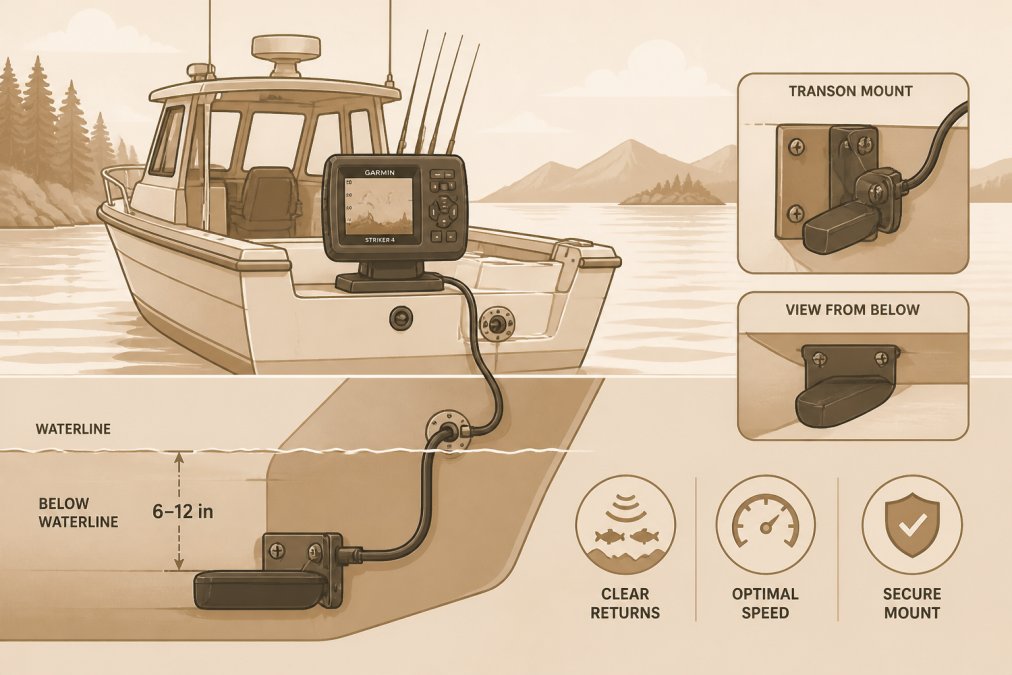
The transducer location matters more than display placement. For transom-mount transducers on saltwater boats, the transducer should be submerged at least 6 inches below the waterline, positioned away from the prop wash and engine exhaust.
Power Cable and Electrical Connection
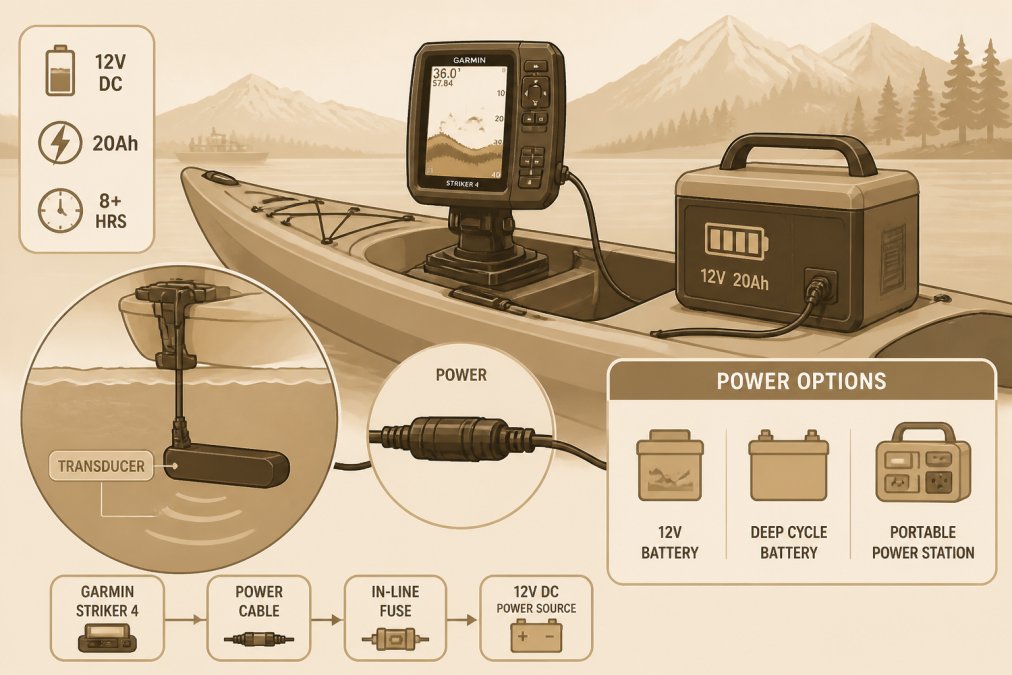
The Garmin Striker 4 draws minimal power, roughly 0.5 amps at 12 volts. For a permanent installation, run a dedicated power cable from your main battery through a 5-amp fuse or breaker. Use marine-grade 16-gauge wire for runs up to 15 feet. Always include a fuse within 18 inches of the battery.
For portable setups, the bundle version includes a sealed lithium battery pack that charges via USB and provides all-day runtime for kayak or small-boat fishing.
Garmin Striker 4 Transducer Mounting Techniques
The transducer is the eye of your fishfinder. A good mounting makes the difference between crisp, readable sonar and a display cluttered with noise.
Transom Mount vs Trolling Motor Mount
Transom mounting is the standard approach for conventional boats. The transducer bolts to the transom below the waterline, sending sonar straight down. This works well for boats running at speed.
Trolling motor mounting is better for boats with shallow-water fishing or drift-focused operation. The transducer mounts directly to your trolling motor head, moving with the motor as you pivot it. The Garmin STRIKER™ 4 Fishfinder Worldwide Version w/77/200kHz - 4-Pin Transducer w/Transom & Trolling Motor Mounts available at Elliott's Tackle & Rigging includes both mounting options.
Securing the Transducer for Saltwater Conditions
Saltwater is corrosive. Use marine-grade stainless steel bolts and washers for all transducer mounting hardware. Route the transducer cable away from moving parts and sharp edges. Apply a thin coat of marine grease to all exposed bolts and connections every 6-12 months.
Rinse the transducer with fresh water after each saltwater outing. If barnacles or marine growth accumulate, gently scrub with a soft brush.
Portable Fishfinder Battery Setup and Power Options
The Garmin STRIKER™ 4 Portable Fishfinder Bundle w/77/200kHz Transducer transforms the unit into a true go-anywhere fishfinder for kayak anglers, small-boat owners, and anyone who moves between different boats.
Portable Kit Configuration
The portable kit includes a sealed lithium battery pack, mounting bracket, and all necessary cables. The battery charges via standard USB. Setup takes under five minutes. The transducer for portable setups typically uses a suction-cup mount or a small pole mount. For kayaks, a side-mounted transducer on a short pole works well.
Power Bank Integration and Runtime
The portable battery provides 8-10 hours of runtime at standard display brightness. For all-day fishing, bring a second battery pack or integrate a larger portable power bank. Many anglers use a standard 20,000-mAh USB power bank to extend runtime to 15+ hours. For extended saltwater trips, some anglers bring a portable solar panel paired with a power bank.
Performance in Saltwater: Shallow vs Deep Water
The Garmin Striker 4 performs differently depending on water depth.
Beam Angle and Sonar Interpretation for Salt Conditions
The transducer's beam angle determines how wide an area the sonar covers. The 77 kHz frequency has a wider beam angle (roughly 50 degrees), covering more water but with less detail. The 200 kHz frequency has a narrower beam (roughly 20 degrees), providing finer detail in a smaller area.
In shallow saltwater (0-40 feet), the 200 kHz frequency is your primary tool. In deeper saltwater (60+ feet), the 77 kHz frequency penetrates better and covers more ground. Many experienced anglers use split-screen mode to run both frequencies simultaneously.
Saltwater conditions affect sonar performance. Murky water with high sediment load reduces sonar range slightly, but CHIRP technology compensates by using multiple frequencies. Kelp beds scatter sonar signals, sometimes creating false bottom readings. Lower your gain setting to reduce clutter.
Gain Settings and Fish Arch Display
Gain is the sensitivity of your sonar receiver. Too much gain creates noise and false targets. Too little gain causes you to miss fish and subtle structure. Auto gain works well for most situations. In clear saltwater, lower gain (40-50%) produces clean, readable sonar. In murky water, increase gain (60-70%) to detect targets that would otherwise be invisible.
Reading the raw sonar arch, the curved line that appears when a fish passes through the sonar beam, is more reliable than relying on automatic fish detection. A true fish arch shows a distinctive curved pattern as the fish moves through the beam.
User Interface and Keypad Operation
The Garmin Striker 4 uses a straightforward five-button keypad interface. There's no touchscreen and no complex menu hierarchies. This simplicity means you can operate the unit with wet hands, gloves, or in low-light conditions.
Screen Navigation and Split-Screen View
The five buttons control menu navigation, screen selection, and function adjustments. Available layouts include full sonar graph, sonar with waypoint list, sonar with depth graph, split-screen with two sonar frequencies, and map view. Navigation menus are organized logically with sonar settings, GPS waypoints, depth alarms, and system setup.
Depth Alarm and Fish ID Settings
The depth alarm alerts you when you enter water shallower than your preset threshold. If your boat draws 2 feet, set the alarm for 4 feet. Fish ID settings control whether the unit displays the automatic fish icon. For beginners, enable it. As you gain experience, disable it and learn to read the actual sonar data. Temperature display shows water temperature if your transducer includes a temperature sensor.
Durability and Waterproof Rating for Pacific Northwest Fishing
The Garmin Striker 4 is rated IPX7, meaning it's submersible to 1 meter for 30 minutes. This protects against splash, spray, and accidental submersion. The display housing is sealed plastic with gaskets at all connection points.
In Pacific Northwest saltwater conditions, the IPX7 rating is sufficient. The unit handles years of exposure to salt spray, fog, and frequent rain. Rinse the display and transducer with fresh water after each saltwater outing to prevent salt crystallization that can corrode connectors and degrade gaskets.
The keypad buttons can stick if salt residue accumulates. Spray them with fresh water and work them back and forth to clear the salt. The transducer cable is the most vulnerable component. Inspect it monthly for cracks, discoloration, or exposed wire. If you see damage, replace the cable before it fails completely. Many anglers are still running Garmin Striker 4 units after 8-10 years of heavy use.
Comparison with Newer Models
The Garmin Striker 4 has been superseded by newer models, primarily the Garmin Striker Vivid and Garmin Striker Plus series. The Striker Vivid adds a higher-resolution display and improved sonar processing. The Striker Plus adds WiFi connectivity and smartphone app integration. For most recreational anglers, the Garmin Striker 4 still delivers 90% of the functionality at a lower cost.
The real advantage of newer models is display quality. If you fish in very bright conditions or have vision challenges, the Vivid's improved display is worth the upgrade. WiFi and smartphone integration (Striker Plus) is convenient but not essential for serious anglers focused on catch rates.
Aspect |
Garmin Striker 4 |
Striker Vivid |
Striker Plus |
|---|---|---|---|
Display Size |
3.5 inches |
4.3 inches |
5 inches |
CHIRP Sonar |
Yes (77/200 kHz) |
Yes (77/200 kHz) |
Yes (77/200 kHz) |
GPS Waypoints |
500 |
1,000 |
1,000 |
WiFi Connectivity |
No |
No |
Yes |
Best For |
Budget-conscious anglers |
Improved display quality |
Advanced connectivity |
Where Elliott's Tackle & Rigging Fits In
Finding reliable fishfinding electronics that perform in Pacific Northwest saltwater conditions requires knowing what works on the water versus marketing claims. Elliott's Tackle & Rigging curates fishing electronics based on forty years of real-world saltwater experience.
The Garmin Striker 4 is available at Elliott's Tackle & Rigging in three configurations:
- The Garmin STRIKER™ 4 FishFinder w/4-Pin, 77/200kHz TM Transducer for $151.99 works for anglers with permanent boat installations.
- The Garmin STRIKER™ 4 Portable Fishfinder Bundle w/77/200kHz Transducer for $238.99 serves kayak fishermen and those moving between boats.
- The Garmin STRIKER™ 4 Fishfinder Worldwide Version w/77/200kHz - 4-Pin Transducer w/Transom & Trolling Motor Mounts for $149.99 provides both transom and trolling motor mounting options for maximum flexibility.
What distinguishes Elliott's Tackle & Rigging is the knowledge behind product selection. Every product carried has been tested in actual Pacific Northwest saltwater conditions. This focus on durability and real-world reliability means you're buying equipment that works in your conditions.
Frequently Asked Questions
Is the Garmin Striker 4 a good fishfinder for saltwater use?
Yes, the Garmin Striker 4 performs well in saltwater conditions typical of the Pacific Northwest. Its CHIRP sonar technology and high-sensitivity receiver detect fish structure and bottom composition effectively in both shallow and deep water. The waterproof rating handles saltwater spray and moisture. For serious saltwater anglers, the portable bundle option available at Elliott's Tackle & Rigging provides flexibility for different boat setups, including kayaks and small vessels.
What is the difference between the Garmin Striker 4 and the Striker 4 Plus?
The Striker 4 Plus adds a larger screen and more advanced mapping features, but the base Garmin Striker 4 still delivers core functionality: CHIRP sonar, GPS waypoint marking, and reliable fish detection. For anglers prioritizing portability and simplicity, the Striker 4 is sufficient. The decision depends on your boat size and whether you need detailed mapping for navigation versus basic depth and fish location.
Does the Garmin Striker 4 require an external battery for kayak or small boat setups?
The Garmin Striker 4 can run on internal power, but for kayak and small boat fishing, the portable fishfinder battery setup is recommended. The portable bundle includes a mounting bracket and battery configuration that simplifies deployment. Many anglers integrate portable power banks for extended fishing sessions, especially when using trolling motors or running the unit all day. Elliott's Tackle & Rigging offers the complete portable bundle to handle these requirements.
How does CHIRP sonar technology improve fishing in the Pacific Northwest?
CHIRP sonar sends a continuous sweep of frequencies rather than single pulses, improving target separation and clarity. In Pacific Northwest saltwater conditions, CHIRP helps distinguish individual fish from baitfish schools, detect rocky bottom structure where salmon hold, and identify kelp beds and underwater terrain. This technology is especially valuable when fishing deeper waters or areas with complex bottom composition common to the region.
Does the Garmin Striker 4 have built-in GPS mapping capabilities?
The Garmin Striker 4 includes built-in high-sensitivity GPS for marking waypoints, saving hot spots, and basic navigation. It does not include detailed cartography maps like larger Garmin units, but the GPS functionality is solid for marking productive fishing locations and plotting courses. You can mark docks, structure, and fishing spots for future reference, making it practical for anglers who fish familiar waters.
0 comments