

Table of Contents
- What You Need to Know Before You Buy Saltwater Fishing Tackle Online
- Saltwater Fishing Rods and Reels: Choosing the Right Combo
- Best Saltwater Fishing Lures for Your Target Species
- Saltwater Fishing Line Types: Monofilament, Fluorocarbon & Braided
- Terminal Tackle Essentials: Hooks, Swivels & Sinkers
- Saltwater Fishing Gear Maintenance and Corrosion Prevention
- How to Buy Saltwater Fishing Tackle Online with Confidence
- Beginner Saltwater Tackle Kits: What Serious Anglers Actually Need
Buy Saltwater Fishing Tackle Online: A 2026 Guide
Last Updated: July 28, 2026
When you're ready to buy saltwater fishing tackle online, the sheer volume of options can feel paralyzing. At Elliott's Tackle & Rigging, we've spent four decades helping serious anglers cut through the noise and find gear that actually works on the water. This guide walks you through exactly what you need to know before making your purchase, from understanding inshore versus offshore setups to recognizing why captain-curated selection matters when you can't touch equipment before it arrives.
What You Need to Know Before You Buy Saltwater Fishing Tackle Online
The biggest mistake anglers make when shopping online is treating all saltwater gear as interchangeable. A rod rated for 20-pound fish in calm bays behaves completely differently than one designed for 40-pound stripers in heavy surf.
Before you buy, ask yourself three questions: Where will I fish? What species am I targeting? How much saltwater experience do I have? Your answers determine whether you need a beginner's kit or professional-grade components.
Inshore vs. Offshore Gear: Understanding the Difference
Inshore fishing, bays, estuaries, shallow flats, demands lighter, more sensitive equipment where feel matters more than raw power. Spinning reels dominate because they cast lighter lures with precision.
Offshore fishing requires larger species in deeper water with stronger currents. Conventional reels become essential because they handle heavier line and larger fish with mechanical advantage spinning gear can't match. Offshore rods are stiffer with larger guides for thicker braided line, and their drag systems are engineered for extended runs by 50-pound fish. Corrosion-resistant components matter more in offshore work since saltwater exposure is relentless.
Why Captain-Curated Selection Matters
When you can't physically inspect gear before purchase, the curator's reputation becomes your quality control. A captain who's spent forty years on the water has tested thousands of rods, reels, and lures under real conditions and knows which equipment performs when it matters most.
The online fishing tackle market is flooded with budget options that look fine in photos but perform poorly when fighting fish in heavy current or dealing with wind and waves. A captain-curated selection means someone with skin in the game has already filtered out the mediocre stuff. When you buy saltwater fishing tackle from a source that stands behind every product, you're buying confidence that this specific model has proven itself in the field.
Saltwater Fishing Rods and Reels: Choosing the Right Combo
The rod and reel combo is your foundation. Get this wrong, and no amount of premium line or lures will save you. A 7-foot medium-action spinning rod excels for inshore work, casting light lures accurately with enough power to set hooks on feeding fish. A 9-foot heavy-action spinning rod is perfect for surf fishing where you need distance and power to punch through wind.
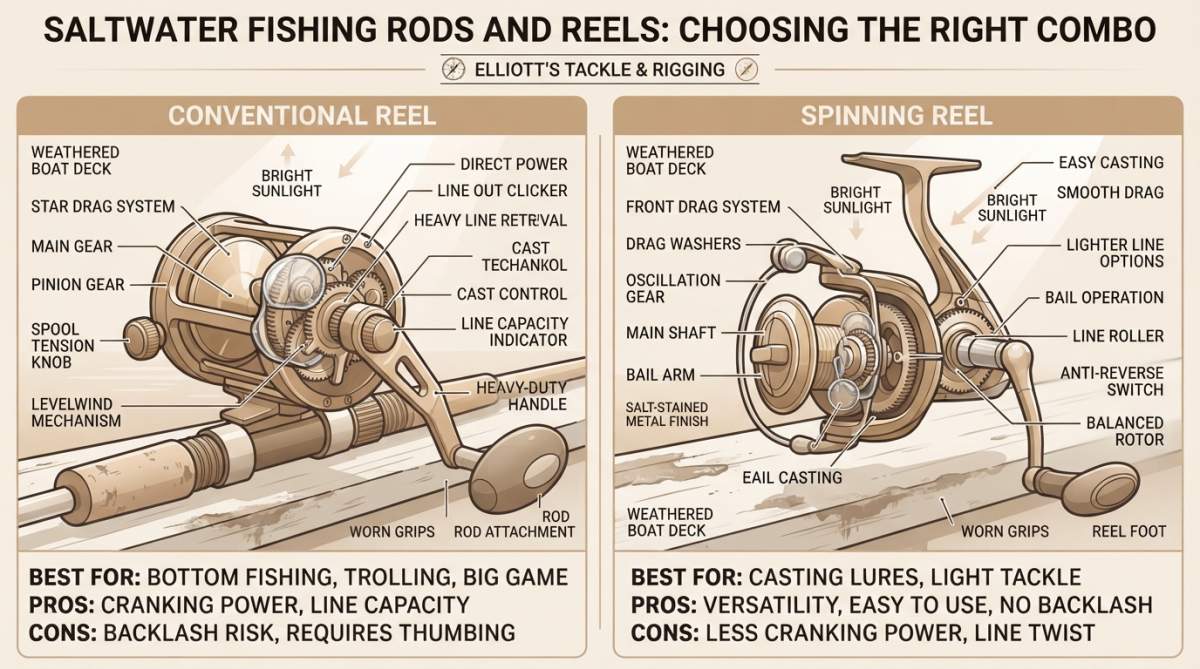
Spinning vs. Conventional Reels
Spinning reels are the choice for most saltwater anglers, especially beginners. They're intuitive: thumb the line, cast, and release. A quality spinning reel has a smooth drag system that protects light line from breaking under sudden pressure.
Conventional reels require more skill but reward precision. They hold more line capacity than comparably sized spinning reels, which matters when fishing deep or chasing large fish that make long runs. The mechanical advantage means easier cranking during extended battles. The tradeoff is backlashes, frustrating tangles where the spool spins faster than your thumb can control it.
Gear Ratio and Drag System Essentials
Gear ratio tells you how many times the reel spool rotates with each turn of the handle. A 5.1:1 ratio means the spool spins 5.1 times per crank. Higher ratios (6.2:1 or 7.1:1) retrieve line faster, helping you stay connected to moving fish.
The drag system is critical. A smooth, progressive drag that engages gradually prevents line breakage and lets you fight fish longer. Test the drag by pulling line directly from the spool, it should feel smooth and consistent from light pressure to maximum setting. Any grinding, stuttering, or sudden changes indicate a reel that will frustrate you on the water. The best drag systems use felt or composite materials that wear evenly over time and perform consistently across temperature changes.
Best Saltwater Fishing Lures for Your Target Species
Lures are where saltwater fishing becomes creative. Understanding which lure types work for different species and conditions separates productive anglers from those who cast randomly.
Jigs, Spoons, and Soft Plastics Explained
Jigs are the workhorse of saltwater fishing, a weighted hook with a head molded around it, usually dressed with hair or synthetic material. They sink quickly and stay in the strike zone longer than floating lures, working well in current, wind, and deep water.
Spoons mimic injured baitfish. When retrieved, they wobble side to side, creating vibration and light reflection that trigger predatory instincts. The Rapala X-Rap® Twitchin' Mullet 3-1/8" Electric Chicken combines walk-the-dog action with glide-and-drop presentation that keeps fish interested.
Soft plastics, worms, swimbaits, creature baits, offer versatility hard lures can't match. They compress when fish bite, feeling more natural in the mouth, and fish hold them longer, giving you a better hook set. Match jighead weight to water depth, current speed, and casting distance.
Saltwater Fishing Line Types: Monofilament, Fluorocarbon & Braided
Your line is your only connection to the fish. Monofilament is traditional and forgiving, stretching under load to absorb shock, but it's visible in clear water. Fluorocarbon is nearly invisible underwater because its refractive index matches water, making it ideal for leader material, though it costs more and offers less forgiveness under sudden pressure.
Braided line offers the best sensitivity and strength-to-diameter ratio. A 20-pound braided line has the diameter of 6-pound monofilament, letting you cast farther and feel subtle bites. The downside is visibility in clear water.
When to Use Braided Line vs. Fluorocarbon Leader
The winning combination for most saltwater situations is braided main line with a fluorocarbon leader. You get sensitivity and casting distance of braided line paired with invisibility of fluorocarbon where fish see your lure. The leader should be 12-18 inches for inshore work and 24-36 inches for offshore. Use a surgeon's knot or improved Albright knot to tie your connection.
Use braided line exclusively in heavy vegetation, around structure, or in low-visibility water. Use fluorocarbon as main line only in very clear water where visibility is critical and you're not fishing around heavy cover. Sufix 832 Braid combines eight fibers with precision braiding that delivers consistent performance, the type serious anglers trust.
Terminal Tackle Essentials: Hooks, Swivels & Sinkers
Terminal tackle, small components at the end of your line, often gets overlooked but determines whether you land fish or lose them at the last moment.
Hooks must match your target species and lure type. Circle hooks hook fish in the corner of the mouth, reducing injuries and improving catch-and-release survival. J-hooks require aggressive hook sets but offer better penetration with live bait. Swivels prevent line twist and allow both sections to rotate independently, use ball-bearing swivels for heavy use because they rotate more freely. Sinkers keep your presentation at the right depth; match sinker weight to water depth and current strength.
Saltwater Fishing Gear Maintenance and Corrosion Prevention
Saltwater is relentless. The difference between gear that lasts five years and gear that lasts fifteen years is maintenance.
Protecting Corrosion-Resistant Components
"Corrosion-resistant" doesn't mean "corrosion-proof." Even stainless steel degrades in saltwater without maintenance. Immediately after fishing, rinse your entire setup with fresh water using a gentle spray. High-pressure water forces salt into bearings and seals.
Pay special attention to your reel's drag system. Salt deposits reduce smoothness and cause inconsistent performance. Spray fresh water directly into the spool area and around the bail. For conventional reels, remove the spool and rinse thoroughly. Apply a thin coat of reel oil to external metal surfaces after rinsing to create a protective barrier against salt spray.
Post-Fishing Cleaning Routine
Establish a cleaning routine you'll actually follow. After every saltwater trip: rinse your rod, reel, and line with fresh water; wipe dry with a soft cloth; apply light reel oil to metal surfaces; and store in a cool, dry location away from direct sunlight. Once monthly, soak your reel's spool in fresh water for 30 minutes to dissolve salt deposits. Once per season, inspect drag materials for wear or discoloration, a professional reel technician can replace components for less than a new reel costs.
How to Buy Saltwater Fishing Tackle Online with Confidence
Buying gear you can't touch requires trust in the source and understanding what to look for in product descriptions and reviews.
Reading Reviews and Ratings Before Purchase
Read reviews from verified buyers who actually purchased and used the equipment. Look for specific details about performance, durability, and issues encountered. A review saying "great reel" is useless; a review saying "smooth drag but the bail froze after two saltwater trips" tells you exactly what to expect.
Pay attention to negative reviews. If multiple reviews mention the same problem, that's a pattern to take seriously. Look for reviews from anglers fishing similar environments to yours, context matters.
| Review Signal | What It Means | Action |
|---|---|---|
| Specific performance details | Reviewer has real experience | Trust this review |
| Vague praise or complaints | Reviewer may not have used it much | Weigh less heavily |
| Multiple reviews mentioning same issue | Potential design problem | Reconsider the product |
| Reviews from different environments | Understand where it performs best | Match to your fishing style |
| Recent reviews (last 6 months) | Current production quality | Prioritize these |
Return Policies and 30-Day Guarantees
When you buy saltwater fishing tackle online, you need security knowing you can return it if it doesn't perform as expected. A 30-day return policy gives you time to test equipment under real conditions and make an informed decision. Some retailers offer free returns; others charge return shipping. Look for retailers that offer free returns on defective items and reasonable restocking fees on other returns.
Elliott's Tackle & Rigging offers 30-day returns because we believe in our products. Every piece of gear is hand-selected by our captain, and we're confident it will perform. If it doesn't work for you, return it without hassle.
Beginner Saltwater Tackle Kits: What Serious Anglers Actually Need
If you're new to saltwater fishing, a complete kit simplifies decision-making. You get matched components that work together and avoid pairing incompatible rod and reel sizes.
A beginner kit should include a 7-foot medium-action spinning rod, a spinning reel with at least 200 yards of line capacity, 20-pound monofilament main line, a selection of soft plastic lures in natural colors, and basic terminal tackle: hooks, swivels, and sinkers. This setup covers most inshore situations. Avoid ultra-budget kits that bundle cheap components together. Spend a bit more for quality components that will actually perform.
When you're ready to buy saltwater fishing tackle online, remember that the cheapest option rarely delivers the best value. Equipment that performs reliably, lasts through multiple seasons, and handles your specific conditions costs a bit more upfront but saves you money and frustration over time. Elliott's Tackle & Rigging curates every product based on forty years of field experience, so you're investing in gear proven on the water. Start with fundamentals, a quality rod-and-reel combo, appropriate line, and basic terminal tackle, and you'll be set for productive days on the water. Get started with Elliott's Tackle & Rigging and fish with confidence that comes from using equipment a captain actually trusts.
Additional Resources
Looking for specific product recommendations? Explore NOAA saltwater fishing regulations by region to understand local rules and seasonal closures. For deeper dives into tackle selection, consult American Sportfishing Association best practices for sustainable saltwater fishing. Finally, Fishing Tackle Retailer industry standards for reel maintenance offers detailed maintenance protocols that extend equipment lifespan.
Frequently Asked Questions
What are the essential pieces of saltwater fishing tackle I need to buy online?
Start with a quality saltwater fishing rod and reel combo matched to your target species, braided line or monofilament main line, fluorocarbon leader material, terminal tackle (hooks, swivels, sinkers), and a selection of lures or jigs. Beginners benefit from tackle kits that bundle these essentials together. Captain-curated selections ensure you're buying field-tested gear that performs under real saltwater conditions, not just inventory fillers.
How do I choose between spinning reels and conventional reels when buying saltwater fishing tackle?
Spinning reels are easier to learn and ideal for lighter lures and inshore fishing. Conventional (baitcasting) reels offer better line capacity and control for heavier offshore applications. Consider your target species, fishing environment (inshore vs. offshore), and experience level. Look for corrosion-resistant materials and reliable drag systems regardless of which type you choose. Most serious anglers maintain both for different situations.
What's the difference between monofilament, fluorocarbon, and braided fishing line for saltwater?
Monofilament is affordable and easy to handle, making it beginner-friendly. Braided line offers superior strength and sensitivity but is more visible to fish. Fluorocarbon leader material is nearly invisible underwater and resists abrasion, making it ideal as a leader between braided main line and lures. Most saltwater anglers use braided line as their main line with a fluorocarbon leader for the best combination of sensitivity, stealth, and durability.
How do I maintain saltwater fishing gear to prevent corrosion?
Rinse all equipment with fresh water immediately after each use, paying special attention to reels, rod guides, and metal components. Use dedicated bilge cleaners or marine-grade products to remove salt buildup and residue. Dry thoroughly before storage. Store in a cool, dry location away from direct sunlight. Inspect drag systems regularly and apply marine grease to moving parts. Proper maintenance extends gear life and ensures reliability on the water.
Why should I buy from Elliott's Tackle & Rigging instead of larger online retailers?
Elliott's offers captain-curated selection, every product is hand-selected by an experienced angler with forty years of fishing expertise. You're buying gear that's been tested on the water and proven to work, not just inventory. We stand behind our products with 30-day returns and free shipping. When you buy from us, you're investing in reliability and performance chosen by someone who wouldn't run anything on their own boat they wouldn't sell to you.
What should a beginner saltwater tackle kit include?
A solid beginner kit includes a medium-power saltwater rod, a quality spinning reel with adequate drag and line capacity, braided main line, fluorocarbon leader material, assorted hooks and swivels, sinkers appropriate for your fishing depth, and a variety of lures or jigs. Look for kits that match your primary target species and fishing environment. Captain-curated beginner kits eliminate guesswork by bundling proven combinations that work together effectively.
How do I know if saltwater fishing tackle will work with my specific setup?
Check compatibility specs before purchasing: rod power and action must match your reel's line capacity and drag rating, line weight should suit your rod's rating, and lure weights should fall within your rod's recommended range. Read detailed product descriptions and specifications carefully. Elliott's 30-day return policy gives you confidence, if gear doesn't work for your setup, you can return it. Don't hesitate to ask questions before buying if you're unsure about compatibility.
0 comments