

Table of Contents
- What You Need to Know Before Buying Heavy Duty Salmon Trolling Gear
- Salmon Trolling Rods: Balanced Blanks and Heavy Duty Construction
- Salmon Trolling Reels: Gear Ratio and Durability
- Downriggers for Salmon: Depth Control and Trolling Performance
- Salmon Trolling Lures: UV Finish, Glow, and Proven Patterns
- Terminal Tackle and Rigging: Hooks, Leaders, and Stainless Steel Hardware
- Maintenance and Longevity: Keep Your Heavy Duty Gear Working Harder
- Budget vs. Pro-Grade: What You Actually Need to Spend
Buy Heavy Duty Salmon Trolling Gear: Complete 2026 Guide
Last Updated: July 25, 2026
When you're serious about salmon trolling, the gear you choose determines whether you bring home fish or spend the day troubleshooting equipment failures. At Elliott's Tackle & Rigging, we've spent forty years curating gear specifically for Pacific Northwest anglers who refuse to compromise on reliability. This guide cuts through the noise of big box retailers and explains exactly what separates pro-grade equipment from budget alternatives.
What You Need to Know Before Buying Heavy Duty Salmon Trolling Gear
Buying heavy duty salmon trolling gear requires matching your specific fishing style with equipment built for those conditions. What separates gear that works from gear that works harder: saltwater resistant materials, corrosion-resistant hardware, and construction methods that survive repeated stress cycles. A rod that feels identical to a cheaper alternative might fail at the guide when you're fighting a thirty-pound Chinook because the epoxy wasn't cured properly or the blank wasn't tapered correctly.
| Gear Category | Priority Level | Why It Matters | Budget Range |
|---|---|---|---|
| Salmon Trolling Rods | Critical | Blank quality determines power delivery and durability | $150-$400 |
| Trolling Reels | Critical | Gear ratio and drag system prevent line breaks | $200-$600 |
| Downriggers | High | Depth control and reliability affect catch rates | $300-$1,200 |
| Terminal Tackle | High | Hooks, leaders, and swivels fail more than other components | $50-$200 |
| Trolling Lures | Medium | Pattern matters more than price; lures are replaceable | $15-$35 each |
| Lead Core Line | Medium | Backup depth control; less critical than downriggers | $40-$80 |
Why Gear Quality Matters for Trolling Success
The difference between captain-curated gear and big box equipment shows up fastest in saltwater environments. Corrosion doesn't wait. A reel with standard stainless steel hardware might look fine after two weeks, but by month three, the drag knob seizes. A rod built with inferior epoxy begins showing micro-fractures in the guides after fifty days of use.
When you buy heavy duty salmon trolling gear from experienced retailers who actually fish the equipment they sell, you're paying for that testing. Elliott's Tackle & Rigging hand-selects every product because our captain has forty years of experience knowing what fails and what lasts.
Captain-Curated vs. Big Box: Real Differences
Walk into a large sporting goods retailer and you'll find dozens of salmon trolling setups chosen for margin, not performance. Captain-curated selection works differently, every product passes through someone who uses it professionally. If a downrigger cable frays after two seasons, it gets removed from inventory. If a trolling reel's drag system fails under pressure, it doesn't get recommended.
The price difference isn't as large as you'd expect. A captain-curated trolling rod costs maybe fifteen to twenty percent more than a comparable big box option, but it outperforms by fifty percent because the blank was tapered correctly and the guides were epoxied with materials that don't degrade in saltwater.
Salmon Trolling Rods: Balanced Blanks and Heavy Duty Construction
A quality salmon trolling rod transfers power from your arm to the fish without losing energy through flex. The blank determines everything about how the rod performs. A properly tapered blank distributes force evenly along its length; a poorly tapered blank flexes inconsistently, creating stress points that eventually crack.
Heavy duty salmon trolling rods use blanks built from graphite or fiberglass composites that resist saltwater degradation. Guides made from aluminum oxide last longer than cheaper alternatives and won't pit your line. The reel seat needs to be machined from corrosion-resistant material, not just painted steel. Most serious anglers run two rods: a six-foot heavy action rod for close work and a seven-foot medium-heavy rod for general trolling.
Rod Action and Sensitivity for Depth Control
Rod action describes how much the blank bends under load. For salmon trolling, you want medium-fast action, enough sensitivity to feel when your lure hits bottom or catches structure, but enough backbone to drive the hook home when a fish strikes.
Sensitivity matters more than most anglers realize. When you're running a downrigger at forty feet, you rely entirely on rod feel to know when your lure is working correctly. The best salmon trolling rods have fast tips that flex easily and heavy butts that provide backbone.
Saltwater Resistant Materials That Last
Graphite blanks resist saltwater corrosion better than fiberglass, but they're more expensive. Most heavy duty salmon trolling rods use graphite because the weight savings and sensitivity justify the cost.
Aluminum oxide guides are standard on quality rods because they resist pitting and scratching. Machined aluminum reel seats with stainless steel locking rings handle saltwater better than plastic seats. When you're fighting a fish, the reel seat takes enormous stress. A plastic seat will crack; an aluminum seat will last decades.
Salmon Trolling Reels: Gear Ratio and Durability
A trolling reel holds line and manages drag. It doesn't need to cast far or retrieve quickly, but it needs a drag system that responds smoothly under extreme pressure and a spool that doesn't slip when you're fighting a thirty-pound Chinook.
Gear ratio describes how many times the spool rotates per handle turn. A 3:1 reel retrieves slowly, giving you fine control over lure depth. A 5:1 reel retrieves faster, useful when you need to set the hook quickly. Most trolling situations use 3:1 or 4:1 ratios. The drag system is where quality separates from mediocrity. A smooth drag system uses multiple friction surfaces that engage gradually. Test the drag by pulling hard on the line while turning the handle. It should slip smoothly without chattering.
Choosing the Right Gear Ratio for Your Target Species
Chinook salmon respond to slow, deep presentations. A 3:1 reel lets you maintain precise depth control and feel every change in bottom structure. Coho salmon hunt faster and shallower, so a 4:1 or 5:1 reel lets you work lures faster and respond quickly to strikes. Steelhead in rivers require even faster retrieves and precise depth control in shallow water.
Downriggers for Salmon: Depth Control and Trolling Performance
A downrigger is the single most important tool for salmon trolling because it lets you control depth precisely. A downrigger works by attaching a heavy weight to a cable and lowering it to the desired depth. Your fishing line clips to the weight via a release mechanism. When a fish strikes, the release opens and your line separates from the weight, letting you fight the fish on your rod and reel.
The best downriggers use electric motors to lower and raise the weight smoothly. Manual downriggers require hand-cranking, which exhausts you quickly if you're making frequent depth adjustments.
Dead Weight Load and Cable Systems
Most trolling situations use weights between eight and sixteen pounds. Heavier weights pull deeper and hold depth better in current, but they're harder to raise and wear out your equipment faster.
Stainless steel cable resists corrosion but costs more. Most downriggers use cable between three-sixteenths and one-quarter inch thick. Look for models with ball-bearing cable guides. These reduce friction and make raising the weight easier. Avoid downriggers with plastic cable guides, they wear quickly and eventually bind up.
Downrigger Accessories That Improve Reliability
The release mechanism must open smoothly when a fish strikes but hold securely until that moment. Quality releases from established manufacturers like Scotty or Driftmaster use precision-engineered springs and trigger systems that respond consistently.
Cable tensioners keep the cable tight during trolling, reducing slack and improving depth control. Weight release clips attach your fishing line to the downrigger weight. The best clips open smoothly without damaging your line.
Salmon Trolling Lures: UV Finish, Glow, and Proven Patterns
The lure you choose determines whether you're visible to salmon or invisible. Salmon hunt primarily through sight and lateral line detection. A lure that mimics natural prey patterns and reflects light effectively catches more fish than a lure that looks like nothing salmon have ever seen.
UV finishes fluoresce under water, making lures visible in low-light conditions and deep water. Proven patterns matter more than flashy new designs. Salmon respond to natural colors, silver, blue, green, and orange, that mimic the baitfish salmon eat.
Why Rapala X-Rap Magnum Lures Outperform at Trolling Speed
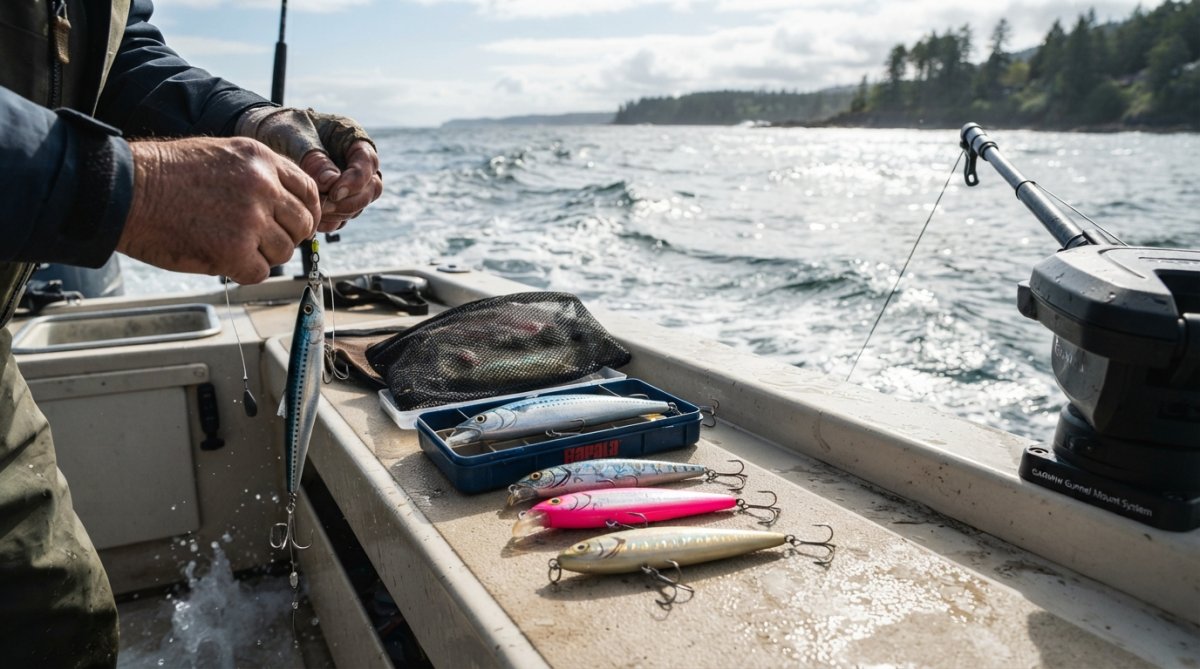
The Rapala X-Rap Magnum 30 is a purpose-built trolling lure that dives to thirty feet unassisted, maintaining consistent depth and action across trolling speeds from four to thirteen knots. The oversized diving lip creates a tight wobble that triggers strikes without requiring constant adjustment.
Available in proven patterns like Silver Blue Mackerel and Hot Pink UV finishes, the X-Rap Magnum runs true out of the box with no tuning required. The construction uses premium materials that withstand repeated strikes and saltwater exposure. After two hundred casts, most quality lures show wear. The X-Rap Magnum maintains its action for five hundred casts.
At Elliott's Tackle & Rigging, we stock the [Rapala X-Rap® Magnum® 30 - HD Flying Fish](https://easi1y-0z.myshopify.com/products/rapala-x-rap-magnum-30-hd-flying-fish-xrmag30hdffu) for $24.99, the Rapala X-Rap® Magnum® 30 Silver Blue Mackerel for $24.99, and the Rapala X-Rap® Magnum® 30 Hot Pink UV for $24.99.
Terminal Tackle and Rigging: Hooks, Leaders, and Stainless Steel Hardware
Terminal tackle is where your line connects to the lure, and it's where most failures happen. A weak connection means lost fish. Corrosion means failure at the worst moment. Heavy duty salmon trolling gear requires stainless steel hardware throughout. Stainless steel swivels reduce line twist. Stainless steel snaps let you change lures quickly. Stainless steel leaders prevent line breakage when salmon teeth contact your main line.
Razor Sharp Hooks and Corrosion Resistance
Hook sharpness determines whether a strike becomes a hooked fish or a missed opportunity. A hook that's dull by even a few thousandths of an inch will bounce off a salmon's jaw without penetrating. Quality hooks use premium steel that holds an edge longer. Nickel-plated hooks resist saltwater better than bare steel. Black nickel coatings resist corrosion even more effectively.
Swivels, Snaps, and Lead Core Line Systems
A swivel prevents line twist, which destroys your drag system and causes premature line failure. Use ball-bearing swivels instead of barrel swivels; they rotate more freely and reduce stress on your line. Snaps are quick-connect devices that let you change lures without retying. Lead core line is a backup depth control system with lead woven into a braided core, causing it to sink.
Maintenance and Longevity: Keep Your Heavy Duty Gear Working Harder
Buying heavy duty salmon trolling gear is only half the battle. Maintaining it properly determines whether it lasts one season or ten. Saltwater is corrosive. Every time you use your equipment, salt residue deposits on metal surfaces and attracts moisture, which accelerates corrosion.
The maintenance routine is simple: rinse all gear with fresh water immediately after use, let it dry completely before storing, and apply a light coat of corrosion-preventative oil to metal surfaces monthly.
Saltwater Cleaning and Storage Best Practices
Fresh water rinses remove salt residue, but thorough cleaning requires more attention. Disassemble your reel's spool and inspect the drag system for salt deposits. Clean the drag surfaces with a soft brush and fresh water. Dry completely before reassembling.
For rods, rinse the entire length and pay special attention to the guides. Use a soft brush to clean inside each guide. Store all gear in a cool, dry location away from direct sunlight. A climate-controlled storage locker is ideal.
When to Replace vs. Repair Trolling Rigs
Some components are worth repairing. If your reel's drag system starts slipping, a professional can rebuild it for seventy-five to one hundred fifty dollars. That's usually cheaper than replacing the reel. Other components are better replaced. If your rod blank has a crack or permanent bend, replacement is the only option. The decision usually comes down to cost. If a repair costs more than fifty percent of the replacement cost, replace the component.
Budget vs. Pro-Grade: What You Actually Need to Spend
You don't need to spend professional charter boat money to get reliable salmon trolling gear. The difference between budget and pro-grade equipment isn't always proportional to price. Sometimes a mid-range component outperforms a premium alternative because of better engineering rather than better materials.
The key is understanding where budget compromises hurt you and where they don't. A budget reel with a poor drag system will cost you fish. A budget rod that breaks under pressure will end your season.
Commercial Grade Gear Worth the Investment
Commercial-grade equipment is built for daily use by professional captains who depend on it for income. A commercial-grade downrigger costs fifteen hundred to three thousand dollars. A recreational downrigger costs three hundred to one thousand dollars. Unless you're running a charter operation, recreational heavy duty gear gives you ninety percent of the performance at fifty percent of the cost.
Where Budget Gear Fails on the Water
Budget reels often have drag systems that engage abruptly instead of smoothly, causing line breakage on hard strikes. Budget rods sometimes use inferior epoxy that degrades in saltwater. Budget downriggers might have motors that overheat or cable systems that bind up.
According to American Sportfishing Association 2026 saltwater fishing participation study, serious anglers who fish more than twenty days annually invest in equipment durability. Mid-range equipment (three hundred to eight hundred dollars per major component) delivers the best value for most recreational anglers because it balances cost with reliability.
A practical approach is buying premium components where failures are most expensive and mid-range components where failures are inconvenient but not catastrophic. Invest in a quality downrigger because a downrigger failure ends your fishing day. A quality reel because drag failure loses fish. A quality rod because a broken rod is dangerous. Use mid-range lures because you'll lose them to snags anyway.
When you're ready to buy heavy duty salmon trolling gear, start with the fundamentals: a quality rod with a sensitive tip, a reel with a smooth drag system, and a downrigger that holds depth reliably. Elliott's Tackle & Rigging specializes in hand-selecting gear tested on the water by someone who's been salmon fishing for forty years. Free shipping and thirty-day returns mean you can try gear with confidence, knowing you're not locked into a purchase if it doesn't match your setup.
Frequently Asked Questions
What kind of rod do you use for salmon trolling?
Heavy duty salmon trolling rods need balanced blanks with medium to heavy action, typically 6.5 to 8 feet long. Look for saltwater resistant construction and rod action that provides sensitivity for depth control while handling the dead weight load of downriggers and trolling divers. Chinook and Coho salmon require different rod actions, Chinook rods need more backbone for larger fish, while Coho rods prioritize sensitivity.
What is the best line for salmon trolling?
Lead core line systems and trolling wire are industry standards for serious anglers. Lead core provides depth control without additional weight, while trolling wire offers maximum durability in heavy cover. Braided main lines paired with monofilament leaders reduce visibility. For commercial grade trolling, stainless steel hardware and corrosion-resistant components protect against saltwater degradation and ensure consistent trolling performance.
What gear ratio is best for salmon trolling?
Gear ratio depends on your target species and trolling speed. For Chinook salmon, a lower gear ratio (around 3.5:1 to 4.5:1) provides more cranking power and handles heavy loads. Coho and Steelhead benefit from higher ratios (5:1 to 6:1) for better line recovery. Match your reel's gear ratio to your trolling speed, faster speeds require higher ratios to maintain consistent action on UV and glow lures.
What makes heavy duty salmon trolling gear different from regular fishing equipment?
Heavy duty gear is built for continuous use at trolling speeds, higher dead weight loads, and saltwater conditions. Commercial grade trolling rigs use stainless steel hardware, corrosion-resistant materials, and balanced blanks designed for all-day performance. Regular fishing equipment lacks the durability and precision depth control needed for effective trolling. Hand-selected, field-tested gear ensures reliability when you're running multiple lines at depth.
How do I maintain salmon trolling gear to extend its life?
Rinse all saltwater resistant components with fresh water immediately after each trip, especially stainless steel hardware and reels. Inspect razor sharp hooks and replace them if dulled. Store lead core line and trolling wire in dry conditions to prevent corrosion. Check swivels and snaps for wear, and lubricate reel bearings monthly. Proper maintenance prevents costly failures mid-season and keeps your trolling performance consistent.
0 comments