

Table of Contents
- Best Saltwater Downrigger Release Clips: Top Picks for 2025
- 1. Scotty Power Grip Plus 1170: Adjustable Downrigger Release Clips for Precision Control
- 2. Off Shore Tackle OR18 Snapper Release: Versatile Multi-Line Compatibility
- 3. Roemer Release Clip: Stackable Design for Multi-Lure Setups
- 4. Cannon Pinch Pad Release Clip: Spring-Action Ease for Solo Anglers
- 5. Troll-Master Seahorse Hydrodynamic: Heavy Tension Downrigger Release for Big Fish
- 6. DUBRO Downrigger Release Clip: Saltwater Corrosion-Resistant Build
- 7. Big Jon Free N' Easy Release: Tournament-Grade Sensitivity
Best Saltwater Downrigger Release Clips: 2026 Guide
Last Updated: July 20, 2026
When trolling in saltwater, your downrigger release clip often determines whether you land fish or lose them. The best clips balance tension settings, line compatibility, and corrosion resistance, three factors that separate tournament-grade gear from equipment that fails when you need it most. This guide covers seven top-tier options tested by charter captains and serious anglers, plus the specific features that matter when selecting release clips for your setup.
How We Selected These Releases
We evaluated each clip based on real-world performance: adjustable tension range, compatibility with mono and braid lines, corrosion resistance, ease of one-handed operation, and reliability on aggressive strikes from salmon, striped bass, and halibut. Field-tested by professionals, these releases minimize line damage, maintain consistent trigger sensitivity across depths, and withstand saltwater corrosion without constant maintenance. Tension adjustment methods vary dramatically between brands, some use screw mechanisms, others rely on line positioning, and a few employ spring-action designs. The best approach depends on your fishing style, line weight, and whether you need quick adjustments between drops.
Quick Comparison Table
| Release Clip | Tension Type | Best For | Key Advantage |
|---|---|---|---|
| Scotty Power Grip Plus 1170 | Adjustable screw | General trolling | Patented tension doubler |
| Off Shore Tackle OR18 Snapper | Screw adjustment | Planer boards & downriggers | Multi-line compatibility |
| Roemer Release | Line-position adjustment | Stackable setups | Automatic stacking feature |
| Cannon Pinch Pad | Spring-action | Solo anglers | One-handed operation |
| Troll-Master Seahorse | Heavy tension | Large saltwater fish | Hydrodynamic design |
| DUBRO Downrigger | Screw adjustment | Saltwater durability | Marine-grade corrosion resistance |
| Big Jon Free N' Easy | Adjustable tension | Light-bite sensitivity | Tournament-grade reliability |
1. Scotty Power Grip Plus 1170: Adjustable Downrigger Release Clips for Precision Control
The Scotty Power Grip Plus 1170 is the industry standard because it delivers adjustable tension that adapts to different conditions without swapping clips. The patented tension adjuster doubles holding power by allowing you to position the line deeper or shallower within soft rubber pads. This means you can fish aggressively at 80 feet, then switch to finesse presentations at 40 feet without touching anything except your downrigger cable.
The soft pads grip monofilament and fluorocarbon without abrading the line. After hundreds of drops, you'll notice zero fraying at the clip contact point. The simplified design prevents snagging when stacked, making it ideal for multi-lure setups.
Scotty includes an 18-inch monofilament leader and cannonball snap with each clip. The tension system requires some practice to master, test it on your first few outings to understand how line positioning affects release pressure. Once dialed in, this clip handles everything from delicate bites to aggressive strikes.
2. Off Shore Tackle OR18 Snapper Release: Versatile Multi-Line Compatibility
The Off Shore Tackle OR18 Snapper solves a common frustration: finding a single release that works reliably across planer boards and downriggers. This adjustable tension in-line release accepts super lines, lead core, and monofilament without complaint, making it genuinely versatile.
The adjustable screw mechanism gives precise control over jaw tension, and the design sits cleanly on planer board brackets without excessive drag. Internal construction resists corrosion after repeated saltwater exposure. One limitation: internal replacement parts aren't readily available, so you replace the entire clip if a jaw pad wears out. For most anglers, these clips last multiple seasons of regular use.
The OR18 shines when mixing trolling methods. Set it light on planer board lines for quick releases, then tighten it on downrigger cables for more holding power.
3. Roemer Release Clip: Stackable Design for Multi-Lure Setups
The Roemer Release Clip becomes invaluable when running multiple lures at different depths on a single downrigger cable. The stackable design allows automatic stacking during retrieval, saving time and reducing line tangling. Adjustable tension comes from line positioning within the jaws, similar to Scotty's approach but with a slightly different feel.
The simple, dependable design has earned trust among trout and salmon specialists. The main tradeoff is availability, Roemer isn't stocked everywhere, and international shipping adds cost. The clip itself is built to endure, and it performs exceptionally well with dodgers and flashers without pinching or damaging these attachments.
4. Cannon Pinch Pad Release Clip: Spring-Action Ease for Solo Anglers
Solo anglers struggle with traditional releases requiring two hands to set tension. The Cannon Pinch Pad solves this with spring-action design that operates one-handed, genuinely changing how you work the boat alone.
The padded jaw design prevents line damage across monofilament and braided lines, with tension range from 2 to 12 pounds covering most saltwater species. Variable tension control based on line depth in the pads gives flexibility across different fishing conditions.
The spring mechanism requires occasional inspection. In heavily salted environments, rinse the clip between outings to prevent corrosion of spring components.
5. Troll-Master Seahorse Hydrodynamic: Heavy Tension Downrigger Release for Big Fish
The Troll-Master Seahorse Hydrodynamic Release is engineered for large saltwater fish on heavy tackle. The hydrodynamic design minimizes water resistance and blow-back, allowing your lure to present naturally at high trolling speeds or in strong current.
Recommended for 20 to 50 pound tackle, this release works with downriggers, outriggers, flat lines, and kites. Heavy tension holding power prevents premature releases from aggressive bites or rough water. The tradeoff is that this clip isn't for subtle, light-bite applications. For striped bass, large salmon, and halibut, the Seahorse's power and durability justify the choice.
6. DUBRO Downrigger Release Clip: Saltwater Corrosion-Resistant Build
The DUBRO Downrigger Release Clip prioritizes durability in harsh saltwater environments. Marine-grade, corrosion-resistant materials prevent degradation that standard steel components experience after repeated saltwater exposure. The adjustable tension system provides fine-tuning without sacrificing durability.
The compact, ergonomic design minimizes drag when running multiple clips. Compatibility with all major downrigger brands means you're not locked into a specific system. Achieving your desired release sensitivity requires some fine-tuning, particularly when matching specific fish sizes or lure weights, but most anglers dial this in within a few outings.
What sets DUBRO apart is engineering focus on saltwater longevity. After a season of saltwater use, you'll notice DUBRO's materials holding up better than competitors, translating to fewer replacements and less downtime.
7. Big Jon Free N' Easy Release: Tournament-Grade Sensitivity
Tournament fishermen and Great Lakes charter captains trust the Big Jon Free N' Easy Release because it delivers adjustable release tension that responds to even the lightest bites. The design tracks straight through the water without tangling, eliminating frustration when running multiple lines.
The clip doesn't abrade fishing line across hundreds of drops throughout a season. The sensitive trigger mechanism signals when fish strike, giving confidence that you're not missing subtle bites. This is the release for anglers prioritizing light-bite sensitivity over heavy-tackle power.
Real-world durability is strong, though this clip may not be as widely available as Scotty or Cannon options. In clear-water conditions where fish study your presentation before committing, the Free N' Easy's light-touch trigger mechanism becomes your competitive advantage.
Key Features to Compare When Choosing Saltwater Downrigger Release Clips
Several technical factors determine whether a clip performs reliably or fails when conditions get challenging.
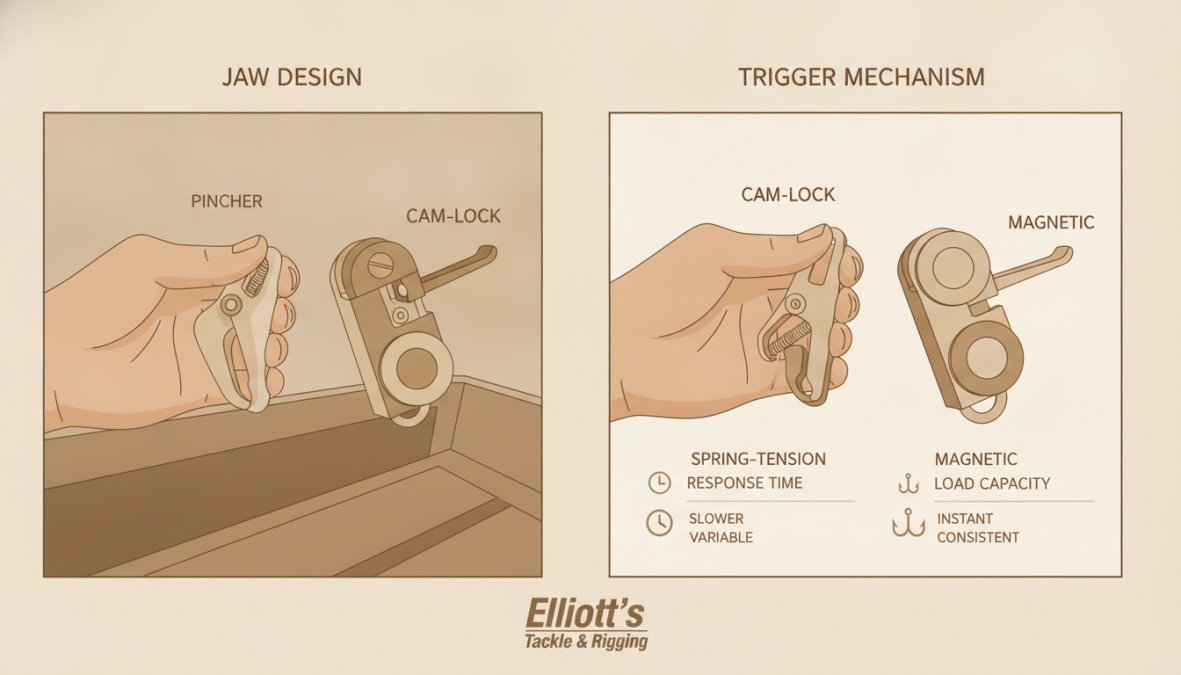
Adjustable tension settings represent the most important variable. Mono and lighter lures typically need lighter tension (2-6 pounds), while heavy tackle demands 8-12 pounds or more. Clips offering screw adjustment, line-position adjustment, or spring-action mechanisms each have merit, the best choice depends on whether you need quick mid-session adjustments.
Mono versus braid line compatibility matters significantly. Monofilament requires softer pads to prevent cutting, while braided line needs firmer grip because it's slippery. If you switch between mono and braid throughout a season, compatibility across both becomes essential.
Mounting position affects how the clip sits on your downrigger cable. Thimble-style mounts wrap around the cable itself and are extremely secure in rough water. Ball-style mounts attach to a ball connector and allow easier clip swapping. Your downrigger system typically dictates which style you need.
Replaceable jaw maintenance determines long-term cost. Some clips have replaceable rubber pads; others require replacing the entire unit. For heavy-use situations, replaceable components save money over multiple seasons.
Saltwater corrosion resistance separates clips lasting three seasons from those lasting ten. Marine-grade materials, stainless steel components, and protective coatings make the difference. Clips need either regular rinsing or inherent corrosion resistance.
Release sensitivity directly impacts hook-ups on light bites. Heavy-tension releases hold firm but might miss subtle bites. Sensitive releases catch hesitant fish but can slip prematurely in rough water.
Mono vs. Braid Line Compatibility in Downrigger Release Clips
Monofilament and braided line behave differently under tension. Monofilament stretches slightly, compressing gradually into jaw pads, requiring softer, more forgiving pads. Braided line has zero stretch, loading instantly into jaws with full force, requiring firmer grip because braid is inherently slippery.
Many anglers switch between line types seasonally. Mono dominates in spring and early summer for salmon; braid becomes popular later for deep-water applications. If you fish this way, choosing a clip with good compatibility across both line types becomes essential.
Tension adjustment interacts with line type. A clip set to 5 pounds might hold mono perfectly but slip braid consistently. Test your specific line-clip combination before committing to a full day on the water.
Adjustable Tension Settings: Getting the Balance Right
Tension setting represents the most adjustable variable in release clip performance. Too light, and your line slips on the strike. Too heavy, and you miss subtle bites or damage your line during deployment.
Light tension settings (2-6 pounds) work best with lighter lures and sensitive presentations. Medium tension (6-10 pounds) represents the sweet spot for most general saltwater trolling. Heavy tension (10-15+ pounds) becomes necessary when targeting large fish or trolling in rough conditions.
Adjustable-tension clips let you dial in the exact setting for your conditions. Start with medium tension (8 pounds) and adjust up or down based on whether you're experiencing slippage or missed bites. Most anglers find their ideal setting within three or four fishing trips.
Saltwater Corrosion Resistance and Durability
Saltwater accelerates corrosion dramatically compared to fresh water. Material selection drives corrosion resistance, stainless steel components resist rust better than standard steel, while marine-grade coatings add extra protection. Rubber pads and seals also matter; poor seals allow saltwater to migrate into mechanisms.
Regular freshwater rinsing extends any clip's life dramatically. After each saltwater outing, a quick spray with fresh water removes salt deposits. This simple practice takes two minutes and can add years to your equipment's lifespan.
Some clips feature protective coatings that reduce maintenance requirements. These typically cost more upfront but save time and money over multiple seasons. For anglers running a charter operation or fishing 100+ days per year, corrosion-resistant construction becomes essential.
Choosing Between Thimble and Ball Mounting Positions
Thimble-style mounts wrap around the downrigger cable itself, gripping directly to the wire. This design is extremely secure in rough water or when running heavy tackle. The disadvantage is that swapping clips requires removing the old one and installing the new one.
Ball-mount clips attach to a ball connector that slides onto your downrigger cable. The major advantage is quick swapping, you can change clips in seconds without tools. The disadvantage is that ball mounts can slip down the cable in rough conditions if not properly secured, though quality systems include locking mechanisms.
Your downrigger system typically dictates which mounting style you need. Before purchasing a new clip, verify which mounting style your downrigger accepts.
Replacing Jaw Pads and Maintaining Downrigger Release Clips
Rubber jaw pads wear over time from repeated line contact and saltwater exposure. Some clips feature replaceable pads; others require replacing the entire unit. Inspect jaw pads regularly for cracks, flattening, or hardening. Worn pads lose gripping power and allow line slippage.
Spring mechanisms need occasional cleaning to prevent corrosion or stiffening. A quick freshwater rinse after saltwater use prevents mineral deposits from building up. Tension adjustment screws can seize if not maintained, a light coating of marine grease on screw threads prevents this problem.
Store clips in a dry location between outings. A simple plastic container with a desiccant packet keeps clips dry and ready for the next trip.
Choosing the best saltwater downrigger release clips comes down to matching the right clip to your fishing style, target species, and tackle setup. Whether you prioritize corrosion resistance, adjustable tension, or one-handed operation, the clips covered in this guide represent the most reliable options available in 2026. Start with a clip matched to your fishing style, test it for a few outings, then refine your setup based on what actually works for your boat and target fish.
Frequently Asked Questions
What are the best downrigger release clips for saltwater fishing?
The best saltwater downrigger release clips depend on your target species, trolling depth, and line type. Scotty Power Grip Plus 1170 excels for adjustable tension control, while Troll-Master Seahorse Hydrodynamic handles heavy tackle and large fish. DUBRO stands out for corrosion-resistant, marine-grade construction. Off Shore Tackle OR18 offers versatility across mono, fluorocarbon, and braid lines. Choose based on your specific saltwater conditions and whether you prioritize sensitivity, durability, or stackability.
How do adjustable downrigger release clips improve your hook-up rate?
Adjustable downrigger release clips let you fine-tune tension to match your lure weight, line diameter, and target species. A properly tensioned release trips at the right pressure, not so light that waves trigger false releases, not so heavy that fish can't pull free. Scotty and Roemer clips feature patented tension adjusters that double holding power while minimizing line slippage. This precision reduces missed strikes and ensures consistent, reliable hook-ups across varying trolling conditions.
Can you use the same release clips for braided and monofilament lines?
Not all release clips work equally well with both line types. Off Shore Tackle OR18 Snapper Release is specifically designed for super lines, lead core, and monofilament, making it versatile across line types. However, braided line requires different jaw pressure than mono due to its thinner diameter and lack of stretch. Always verify the manufacturer's compatibility before switching line types. Rubber pad quality and jaw design directly affect how securely each clip grips different line materials.
What are downrigger stacker clips and when should you use them?
Downrigger stacker clips allow you to deploy multiple lures on a single downrigger cable at different depths. The Roemer Release Clip excels here with its stackable design, when you retrieve the cannonball weight, the stacked releases automatically stack on the cable without tangling. Use stackers when you want to cover multiple depth zones simultaneously, fish multiple species, or increase your odds on a single downrigger. They're essential for tournament fishing and high-volume saltwater trolling where efficiency matters.
How do I maintain saltwater downrigger release clips to prevent corrosion?
Rinse all clips with fresh water immediately after each saltwater outing to remove salt residue. Inspect rubber pads and jaw mechanisms for wear or salt buildup. DUBRO clips are engineered with marine-grade, corrosion-resistant materials specifically for this environment. Store clips in a dry location away from direct sun. Check jaw tension periodically, salt can stiffen adjustment mechanisms. Replace rubber pads when they harden or lose grip. Proper maintenance extends clip life and ensures reliable releases throughout the season.
This article was written using GrandRanker
0 comments