

Table of Contents
- How to Compare Marine Electronics for Halibut
- The Best Fish Finder for Halibut: Garmin GPSMAP 8610xsv
- The Best Transducer for Deep Water Fishing: Raymarine P79S Smart Sensor
- Fish Finder Settings for Bottom Fishing Halibut
- The Best Marine GPS for Fishing: Garmin GPSMAP 8616
- Depth Displays and VHF Radios: The Rest of the System
- Complete Marine Electronics Packages by Budget
- Conclusion: Matching Electronics to How You Fish Halibut
- Frequently Asked Questions
Last Updated: October 6, 2026
How to Compare Marine Electronics for Halibut
The best marine electronics for halibut come down to one thing: can the system show you a fish sitting tight on the bottom in 300 feet of cold, moving water? Everything else is secondary.
Halibut don't suspend. They sit. They tuck against structure, bury in sand, and hold so close to the seafloor that a weak return looks identical to the bottom itself.
Below, we break down the units, transducers, and settings that actually put halibut on the deck, plus complete system builds by budget.
NOAA Fisheries halibut species profile
Quick Comparison: Halibut Electronics at a Glance
| Product | Category | Price | Best For |
|---|---|---|---|
| Garmin GPSMAP 8610xsv | GPS / Fish Finder Combo | $2,108.99 | All-around halibut setup |
| Garmin GPSMAP 8616 | GPS Chartplotter | $4,499.99 | Large-helm offshore boats |
| Raymarine P79S Smart Sensor | Transducer | $489.99 | In-hull depth, no drilling |
| Raymarine i50 Depth Display | Depth Instrument | $529.99 | Dedicated depth readout |
| Raymarine i40 Depth System | Depth Instrument | $252.99 | Budget depth monitoring |
| Raymarine Ray53 VHF | VHF Radio | $489.99 | Offshore communication |
What Actually Matters on a Halibut Boat
Four specs decide whether your electronics find halibut or just draw a pretty picture.

- Transducer power. Deep water eats signal. A 1 kW transducer holds bottom in 400+ feet where lower-power units lose it.
- Frequency choice. Low frequency punches deep. High frequency gives detail. You need both.
- Target separation. This is the ability to show a fish as distinct from the bottom. Weak separation means halibut disappear into the seabed.
- Screen visibility. Cold, bright, glare-heavy mornings kill cheap displays. Look for sunlight-readable screens that work with polarized sunglasses.
Get those four right and the brand on the bezel matters far less than most people think.
The Best Fish Finder for Halibut: Garmin GPSMAP 8610xsv
The Garmin GPSMAP 8610xsv is our top pick for halibut fishing because it does the whole job in one unit: chartplotter, 1 kW CHIRP sonar, and Ultra High-Definition scanning sonar with no black box required. Fewer boxes means fewer failure points offshore.

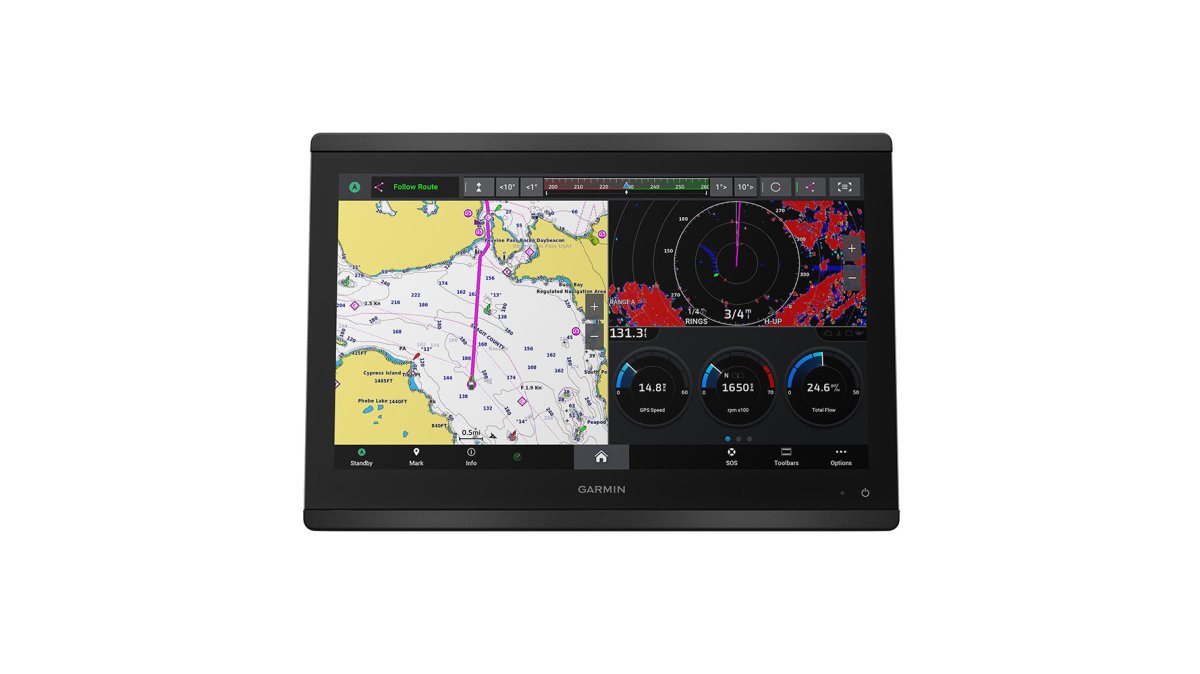
Built-In Sonar Without a Black Box
The 8610xsv carries dual-channel 1 kW traditional CHIRP sonar plus CHIRP ClearVü and SideVü scanning built right in.
The 10-inch full HD IPS touchscreen stays readable in direct sun and through polarized sunglasses, which sounds minor until you're squinting at a washed-out screen with a fish on.
Networking is where this thing earns its keep. NMEA 2000 and Garmin Marine Network support let you tie in radar, autopilot, and instruments across multiple displays. If you're building a system rather than buying one screen, that expandability matters.
Where It Falls Short
Transducers are sold separately, so budget for one. And a 10-inch screen is a compromise: great on a center console, tight on a big pilothouse where you want more real estate. If you fish a large boat and want the helm to feel like a command center, step up to the larger display below.
The Best Transducer for Deep Water Fishing: Raymarine P79S Smart Sensor
The Raymarine P79S Smart Sensor is the best transducer for deep water fishing when you want clean depth data without drilling holes in your hull. It's an in-hull unit designed for solid-fiberglass boats up to 25 feet, and it installs while the boat sits in the water.

That last part is the real selling point. No haul-out, no hull penetrations, no exterior protrusions to snag.
Airmar transducer technology overview
Depth Limits and Hull Fit
The P79S runs 235 kHz with a narrow 7-degree beam, which keeps it from interfering with your other echosounders.
Here's the honest limitation. It's depth function only, and it's built for solid fiberglass hulls up to 25 feet.
The embedded Airmar Smart Sensor technology processes the signal inside the sensor itself, so what reaches your display is already clean. For a halibut boat that needs reliable bottom numbers without a haul-out, that's a smart trade.
Fish Finder Settings for Bottom Fishing Halibut
Fish finder settings for bottom fishing are where most anglers lose fish they never knew were there. A halibut hugging the bottom produces a return that blends into the seabed unless you set up your unit to separate them.
Start with these baselines, then adjust to your water:
- Gain: Manual, not auto. Auto gain smooths out the very returns you're hunting. Raise it until you see a light speckle of noise, then back off slightly.
- Frequency: Low frequency (50 kHz) for deep water and holding bottom. High frequency (200 kHz) for detail in shallower water.
- Range: Set it slightly deeper than the actual depth so the bottom return sits high on the screen, leaving room to see a fish mark just above it.
- Target separation: Turn it on. Without it, a halibut on the bottom reads as one thick line.
- Noise rejection: Low to medium. Crank it too high and you filter out real fish along with the interference.
The telltale halibut mark is a distinct return just above the bottom line, often with a small gap between it and the seabed. If you're only seeing a solid bottom trace, your gain or target separation is wrong.
Garmin GPSMAP® 8610xsv Combo GPS/Fishfinder GN+ →
The Best Marine GPS for Fishing: Garmin GPSMAP 8616
The 16-inch full HD IPS touchscreen is sunlight-readable and works through polarized sunglasses.
U.S. Coast Guard navigation and boating safety resources
Where it separates from the smaller unit is networking and layout. You can flat-mount multiple units edge-to-edge for a glass helm look, or flush-mount them.
The tradeoff is obvious: it costs more than twice what the 8610xsv does, and it needs a helm with the space to hold it.
Depth Displays and VHF Radios: The Rest of the System
A halibut setup isn't complete without dedicated depth readout and reliable communication. These two pieces round out the system and add redundancy when a main display goes down.
Depth Displays: i50 and i40
The Raymarine i50 Depth Display gives you depth, max depth, and min depth on a high-contrast monochrome LCD with extra-large digits and red backlighting for night runs.
The Raymarine i40 Depth Display System covers the same job at a lower cost. Three-button operation, extra-large digits, red backlighting, and shallow and deep alarms for both navigation and anchoring.
If you want a depth instrument paired with a thru-hull transducer out of the box, the Raymarine i50 Depth Display System with Thru-Hull Transducer bundles both.
VHF Radio: Raymarine Ray53
The Raymarine Ray53 Compact VHF Radio packs full Class D DSC performance into a small form factor for boats where panel space is tight. A built-in GPS/GNSS receiver supplies position data for DSC distress calls once your MMSI is programmed, and dual NMEA 2000 and NMEA 0183 networking integrates it with the rest of your electronics. There's a connection point for an optional external GPS antenna if you're mounted below deck or inside a metal enclosure.
Complete Marine Electronics Packages by Budget
How you build a halibut electronics package depends on your boat and your water.
Depth-only starter build. The Raymarine i40 Depth Display System at $252.99 gives you reliable depth monitoring, alarms, and SeaTalk networking without a big spend.
Full offshore build. The Garmin GPSMAP 8616 at $4,499.99 as the helm centerpiece, networked with the i50 Depth Display at $529.99 and the Ray53 VHF at $489.99.
| Build | Key Components | Total | Best For |
|---|---|---|---|
| Starter | i40 Depth System | $252.99 | Nearshore, shallow water |
| Core | 8610xsv + P79S + Ray53 | $3,088.97 | Most halibut anglers |
| Offshore | 8616 + i50 + Ray53 | $5,519.97 | Large boats, deep water |
BoatUS Foundation on marine electronics and safety
Conclusion: Matching Electronics to How You Fish Halibut
The right marine electronics for halibut are the ones matched to your depth, your boat, and your budget, not the biggest screen on the shelf. A 1 kW transducer and correct gain settings will out-fish a premium display every time. Get the sonar foundation right first, then build the system around it.
That's exactly how we stock at Elliott's Tackle & Rigging. Every unit on our shelves is hand-selected by a captain with forty years on the water, and we won't sell gear we wouldn't run on our own boats.
Frequently Asked Questions
What fish finder works best for finding halibut in deep water?
A unit with built-in 1 kW CHIRP sonar and a compatible high-power transducer does the heavy lifting. The Garmin GPSMAP 8610xsv runs dual-channel 1 kW traditional CHIRP plus ClearVü and SideVü scanning sonar without a black box, so it holds bottom contact and separates a halibut mark from structure in 200 to 600 feet of water. Pair it with a transducer rated for your actual fishing depth, and keep the display in a spot where you can read it while the boat drifts.
What transducer frequency is best for halibut fishing?
Lower frequencies, roughly 50 to 80 kHz, punch through deep water and hold bottom at range, which is what you want when scanning for halibut in 300 feet or more. Higher frequencies near 200 kHz give sharper detail but lose bottom sooner. The Raymarine P79S Smart Sensor runs 235 kHz with a narrow 7-degree beam and reaches 500 feet on the NMEA 2000 model, so it suits shallower halibut grounds and boats up to 25 feet with solid fiberglass hulls.
Is CHIRP sonar or traditional sonar better for halibut?
CHIRP sends a swept range of frequencies instead of one, which improves target separation and signal clarity in deep water. That matters for halibut because the fish sit tight to the bottom and often read as a thin mark against hard structure. The GPSMAP 8610xsv and GPSMAP 8616 both support CHIRP traditional, ClearVü and SideVü scanning, plus Ultra High-Definition scanning sonar, so you can switch modes as conditions change.
Do I need a chartplotter for halibut fishing?
A chartplotter earns its place when you fish structure you return to. Preloaded Garmin Navionics+ charts on the GPSMAP 8616 show bottom contours and bathymetry, and the ActiveCaptain app lets you plan trips and update maps from a phone or tablet. Marking productive drifts and hard bottom lets you repeat them instead of hunting. Pair it with a VHF radio such as the Raymarine Ray53, which has a built-in GPS/GNSS receiver for DSC position data.
How do you set up a fish finder to locate halibut near the bottom?
Start with the bottom locked on screen and the depth range set slightly deeper than the water you are fishing. Raise gain until you pick up a faint second echo off hard bottom, then back it off one step so noise does not clutter the display. Watch for a thin mark lifting just off the seafloor, and note bottom hardness changes, since halibut sit on sand and gravel edges next to structure. Adjust beam angle and frequency for the depth you are drifting.
Halibut fishing rewards preparation, and your electronics are the difference between guessing and knowing. Elliott's Tackle & Rigging carries captain-curated marine electronics built for serious saltwater anglers, backed by free shipping, 30-day returns, and gear chosen by someone who's actually fished it. Get started with Elliott's Tackle & Rigging and put a system on your boat that finds fish where they actually live.
0 comments