

Table of Contents
- Why Flashers and Flies Catch Lake Michigan King Salmon
- Salmon Flasher Sizes and Colors That Produce
- Best Salmon Flasher Fly Combos, Side by Side
- How to Rig a Flasher and Fly for Chinook
- Flasher Fly Leader Length: Getting the Spacing Right
- Seasonal Picks: June Through Fall on Lake Michigan
- Common Rigging Mistakes That Cost You Fish
- Conclusion
- Frequently Asked Questions
Why Flashers and Flies Catch Lake Michigan King Salmon
King salmon chase flash and movement, and a flasher-fly combination delivers both in a package that keeps working at trolling speed.
At Elliott's Tackle & Rigging, we build our salmon trolling spreads around that principle. A flasher is an attractor: a rotating blade that creates flash, vibration, and a lateral kick.
The pairing matters more than either piece alone. Get the size, color, and spacing right and a Lake Michigan king will commit.
Salmon Flasher Sizes and Colors That Produce
Flasher size drives action, and action drives strikes. Most Lake Michigan trolling spreads run attractors in the 8-inch to 11-inch range, and the bigger blades earn their keep when kings are aggressive and water is off-color.
An 11-inch flasher like the Luhr-Jensen Money Roll Flasher in Blue Kamikaze UV throws a wide, thumping rotation that starts working at speeds down to 1 mph.

Smaller 8.5-inch blades, like the Ice Strong Dual Fin Flasher Series, spin faster and kick harder at a given speed.
Matching Flasher Color to Light, Water Clarity and Depth
Color selection comes down to two questions: how much light is down there, and how far can a fish see?
- Bright sun, clear water: go natural and subtle. Pearl, white, and chrome finishes with a UV accent.
- Overcast, stained water, or first light: go loud. Glow, chartreuse, aqua, and UV-bright patterns earn their place.
- Deep water below 70 feet: light fades fast, so glow and UV finishes carry the load. The Money Roll in Glow Blue Crush was built for exactly this.
- Below 100 feet: run glow-first, and let the fly match the flasher's dominant color.
Best Salmon Flasher Fly Combos, Side by Side
Here is how we would set up four proven pairings for Lake Michigan kings, matched to conditions rather than guesswork.
| Flasher | Fly | Best Conditions | Why It Works |
|---|---|---|---|
| Luhr-Jensen Money Roll 11" Blue Kamikaze UV | Too Strong UV Blue Ice | Clear water, bright light, suspended kings | Blue-on-blue reads natural in clear water |
| Luhr-Jensen Money Roll 11" Glow Blue Crush | Too Strong Darth Vader Glow | Low light, deep water, early season | Glow matches glow for maximum visibility |
| Ice Strong 8.5" Dual Fin Painted Glow/UV | Too Strong UV Aqua Jelly | Summer, mixed clarity, active fish | Fast blade action plus aqua flash |
| Ice Strong 8.5" Dual Fin Painted Glow/UV | Too Strong Pickled Mirage | Overcast, stained water, post-storm | High-contrast pattern triggers reaction strikes |
The Too Strong Premium Trolling Flies come fully rigged with 50 lb fluorocarbon leader, a Size 1/0 VMC Vanadium hook, Super Glow/UV beads, and a Face Grabber harness. That hardware matters when a 20-pound king rolls at the net. If you prefer to build your own leaders, the 3-pack unrigged version gives you the same flies without the terminal tackle.


How to Rig a Flasher and Fly for Chinook
Rigging a flasher and fly for Chinook is straightforward: main line to a snap swivel, flasher to the swivel, then a leader of 25 to 30 inches from the flasher's rear ring to the fly.
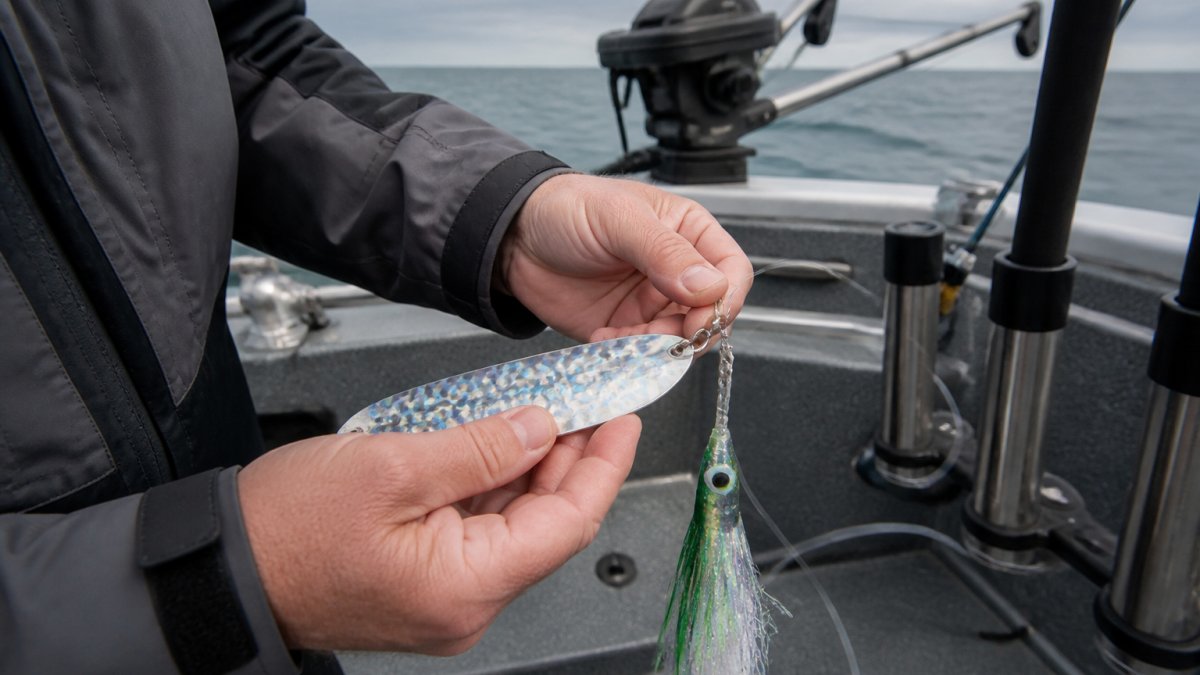
Step by step:
Ice Strong Outdoors - Too Strong Premium Trolling Flies - Fully Rigged →
- Tie your main line to a quality ball-bearing snap swivel.
- Clip the flasher to the snap. Confirm it spins freely by hand.
- Cut a leader of 25 to 30 inches of 40 to 50 lb fluorocarbon.
- Loop or tie the leader to the flasher's rear ring.
- Attach the fly to the leader with a loop knot so the fly swings freely.
- Set the rod in the holder, lower the downrigger, and watch the rod tip for the flasher's rhythm.
A common mistake is running too long a leader. A fly that trails too far loses the side-to-side snap the flasher imparts, and the whole presentation goes flat.
Flasher Fly Leader Length: Getting the Spacing Right
Leader length is the single most overlooked variable in a flasher-fly spread. Too short and the fly loses action. Too long and it stops tracking the flasher's kick.
The sweet spot for most Lake Michigan king setups is 25 to 30 inches, which is exactly what Ice Strong recommends for the Too Strong lineup. That spacing lets the fly snap side to side in rhythm with the flasher without drifting out of the strike zone.
Adjust from there based on what the fish tell you:
- Shorten to 22 to 25 inches when kings are aggressive and you want a tighter, faster action.
- Stretch to 30 to 36 inches when fish are shy and you want a subtler presentation.
- Keep it consistent across the spread so you can compare colors and depths fairly.
Trolling Speed and Depth Control
Speed sets the flasher's rotation, and depth sets the light level. Most Lake Michigan king trolling happens between 2.0 and 2.8 mph at the ball, but slow-speed flashers let you drop below that when fish are cold and sluggish.
Match your depth to the season and the thermocline. Early and late in the year, kings run high. In midsummer, they push below 70 feet and often below 100 feet, where glow and UV finishes take over. Watch your sonar for marks and adjust the downrigger rather than guessing.
Seasonal Picks: June Through Fall on Lake Michigan
A month-by-month progression beats a generic seasonal overview because king salmon behavior shifts on a fairly predictable schedule.
June: Transition and early summer Kings are moving from spring feeding areas toward summer structure. Start with an 11-inch flasher in a UV blue or glow pattern, the Luhr-Jensen Money Roll in Blue Kamikaze UV is a solid default, paired with a Too Strong UV Blue Ice fly. As the sun climbs, switch to a glow flasher like the Money Roll in Glow Blue Crush with a Darth Vader Glow fly for low-light periods.
July: Deep summer patterns The thermocline sets up and kings push below 70 feet, often 80-120 feet down. Run 11-inch glow flashers on downriggers and 8.5-inch Ice Strong Dual Fin Flashers on divers for a faster, tighter action.
August: Peak deep and staging Kings are concentrated and often suspended.
September: Early fall transition Kings begin moving shallower and feeding heavily before the spawn. Big flashers with bright, high-contrast flies shine.
Ice Strong Outdoors - Too Strong Premium Trolling Flies - Fully Rigged →
October: Late fall and spawn Kings are shallow and aggressive. Large flashers with bright flies still work, but natural patterns can also produce in clear water.
Common Rigging Mistakes That Cost You Fish
Most flasher-fly failures trace back to a handful of rigging errors that are easy to fix once you know what to look for. Here are the mistakes we see most often, along with the specific adjustments that keep your spread running correctly.
- Leader length that kills action. A fly that trails too far behind the flasher loses the side-to-side snap that triggers strikes. Keep leaders in the 25-30 inch range for most conditions. Shorten to 22-25 inches when kings are aggressive, and stretch to 30-36 inches only when fish are shy and you want a subtler presentation. Never run leaders longer than 36 inches, the fly stops tracking the flasher's kick.
- Mismatched flasher speed and trolling speed. A big 11-inch flasher blows out its rotation above 2.8 mph, turning into a spinning blur that fish ignore. Smaller 8.5-inch blades spin faster and can handle 2.8-3.0 mph. Check the action at the boat before sending it down: the flasher should rotate smoothly, not wobble or spin wildly.
- Weak or binding swivels. A cheap swivel that binds kills the flasher's rotation and twists your line. Use ball-bearing snap swivels rated for at least 50 lb test. Replace any swivel that feels gritty or does not spin freely by hand.
- Inconsistent leader lengths across the spread. If every rod runs a different spacing, you cannot tell whether a strike came from color, depth, or leader length. Standardize leader length within a spread so you can compare variables fairly.
- Dull or corroded hooks. A king's jaw is tough, and a dull hook costs fish at the net. Touch up hooks with a file or replace them before every trip. The Too Strong Premium Trolling Flies come with a Size 1/0 VMC Vanadium hook that holds up well, but check it after every fish.
- Skipping the pre-set check. Run your hand down every leader before it goes in the water. Feel for nicks, knots, or rough spots. A leader that fails on a 20-pound king is a leader you did not check.
- Ignoring flasher rotation direction. Most flashers are designed to rotate in a specific direction. If yours spins backward, it will not produce the intended action. Test it alongside the boat before deploying.
Conclusion
Building a spread that produces on Lake Michigan comes down to matching flasher size and color to light and depth, spacing your flies correctly, and rigging with hardware you trust. The variables are few, but each one matters when a king is deciding whether to commit.
Elliott's Tackle & Rigging stocks captain-curated flashers and flies built for serious trolling, with free shipping and 30-day returns so you can gear up with confidence.
Search our flasher and fly lineup and build a spread you can trust this season.
Frequently Asked Questions
What size flasher should I use for king salmon?
Most Lake Michigan king salmon trolling runs on 8.5-inch to 11-inch flashers. The 11-inch models, like the Luhr-Jensen Money Roll, throw a wider flash and more thump, which helps in deeper water and low light. The 8.5-inch dual fin flashers spin easier at slow speeds and pair well with trolling flies when fish are pressured. Run bigger flashers deep and in stained water, and drop to the smaller size when Chinook are feeding high in the water column or you need a faster trolling presentation.
How long should the leader be between a flasher and a fly?
Flasher fly leader length usually lands between 25 and 30 inches, measured from the back of the flasher to the fly. That spacing gives the fly a wide side-to-side kick without tangling on turns. Shorten toward 22 to 25 inches for a tighter, faster action in cold water, and stretch toward 30 inches when fish are sluggish and you want a lazier roll. Too Strong Premium Trolling Flies are built to run in that 25 to 30 inch window behind your attractor.
What colors of flashers and flies work best for king salmon?
Blue, green, pearl, white and glow patterns cover most days. Bright sun and clear water favor blue and aqua flashers with pearl or UV flies. Overcast skies, early morning and deep water call for glow and UV finishes, such as Luhr-Jensen's Glow Blue Crush or Ice Strong flies with Super Glow/UV beads. Gold and sunshine patterns earn a spot when the water is off-color. Carry a mix and let light, clarity and depth decide the color pattern rather than locking into one favorite.
How fast should you troll a flasher and fly for king salmon?
Most Chinook trolling with flashers and flies runs around 2.0 to 2.8 mph at the ball, with speed at the downrigger checked rather than GPS speed. Slow down toward 1.5 to 2.0 mph in cold water or when fish are neutral, and speed up when kings are actively feeding. The Luhr-Jensen Money Roll flashers are built to start rotating at speeds down to 1 mph, so they keep flashing when you have to slow the trolling presentation for finicky fish.
When should I run a flasher and fly instead of a spoon?
Reach for flashers and flies when kings are deep, when the water is cold, or when you need to cover water with a trolling presentation that triggers reaction strikes. Flies behind an attractor shine below 70 feet and in low light, where flash and vibration do more work than a spoon's wobble. Spoons still earn their place high in the water column and when fish are keyed on bait size. Many crews run a spread with both and let the fish tell them which one is working.
0 comments