

Last Updated: November 6, 2026
Quick Summary
The best downriggers for lake ontario salmon fishing are electric models like the Cannon Magnum 10 TS for multi-line trolling and manual units like the Cannon Uni-Troll 10 for smaller boats. Match your choice to your boat size and number of lines. Pick a weight that keeps your cable angle steep so your bait stays in the strike zone.
- The Cannon Magnum 10 TS is the top pick for anglers wanting automation and precision.
- The Cannon Uni-Troll 10 Manual Downrigger costs $399.99 and suits smaller boats.
- Heavier weights hold depth better in current, while lighter weights suit shallower presentations.
- Watch your cable angle at trolling speed to tell whether your weight is holding depth.
- Match your mount, such as transom, track, or gunnel, to your boat's layout before buying.
Table of Contents
- Why Downriggers Matter for Lake Ontario Salmon
- How We Chose These Downriggers
- Best Electric Downriggers for Lake Ontario Salmon
- Best Manual Downrigger Choices for Smaller Boats
- Downrigger Weights for Salmon Trolling
- Downrigger Mounting Options and Adapter Plates
- Pick Your Lake Ontario Downrigger Setup and Get on the Water
- Frequently Asked Questions
Why Downriggers Matter for Lake Ontario Salmon
Downriggers are the most reliable way to put your bait at the depth where Lake Ontario salmon are feeding. The depth question comes up every single season. Surface lures and copper lines only cover so much water. A downrigger lets you hold a bait at a precise depth, and that precision is what turns a slow day into a productive one.
The core job is simple. A weight drops to the depth you choose, and your line releases from the weight, so your lure or bait trolls at that depth while you keep the boat moving. Salmon tend to hold in a narrow band of water, so being a few feet off can mean the difference between marks on the screen and fish in the cooler.
Here is the tradeoff most guides gloss over: the downrigger you pick affects how smoothly you can adjust depth, how much cable you deal with, and how easily you manage a fish once it hits. That is why the choice between electric and manual models matters more than the brand name on the box.
How We Chose These Downriggers
This list is built around the features that matter to Lake Ontario trollers. The criteria are:
- Retrieval speed and control: How fast the weight comes back up and how precisely you can set depth.
- Boom design and reach: Whether the boom extends far enough to clear the rail and keep lines separated.
- Build and saltwater protection: Stainless steel components and corrosion resistance for seasons on the water.
- Ease of use: Auto-stop features, depth counters, and how simple the unit is to adjust mid-trip.
- Value for the boat: Whether the price fits a serious setup, from a single rod to a multi-line spread.
Every model here is sold through our store. These picks reflect the features the manufacturers document.
Best Electric Downriggers for Lake Ontario Salmon
Electric downriggers take the work out of raising and lowering weights. For a lot of anglers running multiple lines, that alone makes them worth the cost. Here are the electric options we recommend.
Cannon Magnum 10 TS Electric Downrigger
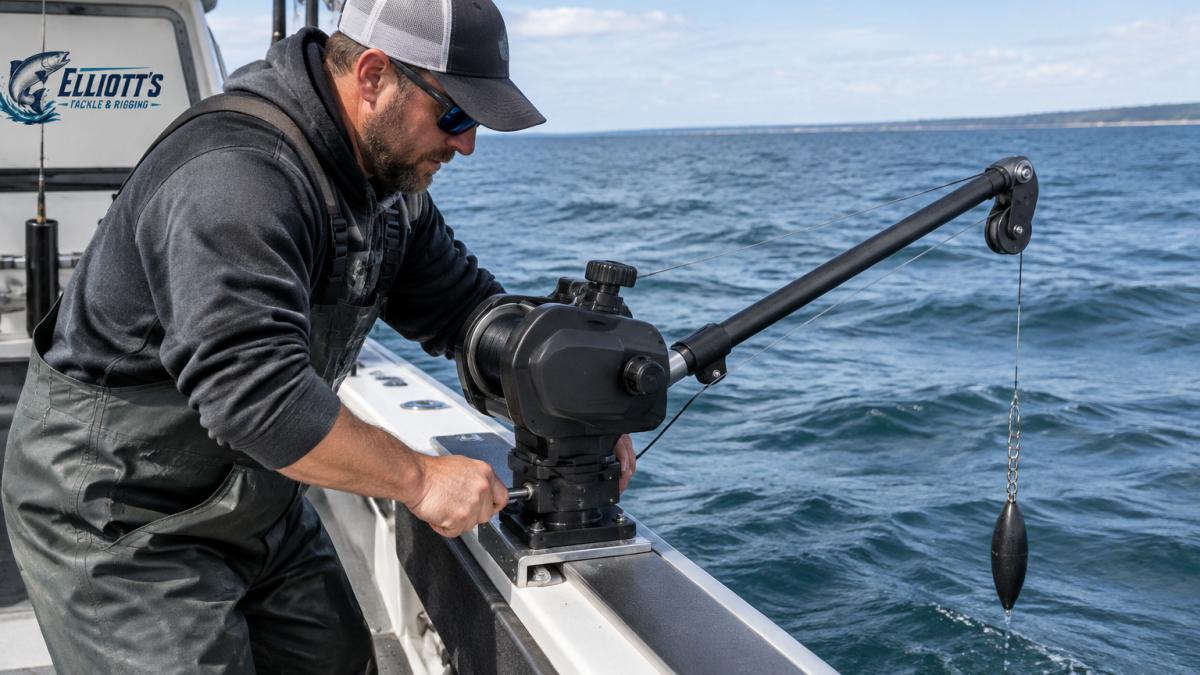
The Cannon Magnum 10 TS Electric Downrigger is our top pick for anglers who want the most features. It runs Auto Up retrieval, so you flip a switch and the weight returns to the waterline on its own. Its Short-Stop feature halts the weight at the surface, which cuts down on cable strain and hull strikes. Positive Ion Control is another useful addition, since it addresses the negative energy field from onboard electronics that can push fish away from your presentation.

The telescopic 316 marine-grade stainless steel boom extends from 24 to 53 inches, and the spool retrieves at 250 feet per minute. It is priced at $929.99.
Best for: serious salmon trollers running multiple lines who want automation and precision. Skip if: you only fish one line from a small boat and budget is the main concern.
Cannon Magnum 5 and Scotty 1106 Options
If the Magnum 10 TS is more than you need, the Cannon Magnum 5 Electric Downrigger covers the same core functions for less. It has the same 250 feet per minute retrieval rate and Auto Up with Short-Stop, paired with a 24-inch boom and a $599.99 price tag. For most single-line setups on Lake Ontario, it does the job well.

For anglers who need extra reach, the Scotty 1106 Depthpower offers a telescoping boom from 36 to 60 inches. It lifts 7-pound weights at 235 feet per minute and includes a multi-position auto-stop. At $699.99, it sits between the Cannon options, and its extended boom suits larger boats with wider rail layouts.

The Scotty 1101 Depthpower is the compact alternative at $655.99, with a 30-inch boom and a complete rod-holder and swivel-base package. It is a good match for a clean, straightforward setup on a smaller boat.
The electric models below are the ones the article recommends, with their key specs and prices side by side.
| Downrigger | Price | Best for |
|---|---|---|
| Cannon Magnum 10 TS | $929.99 | Multi-line salmon trolling |
| Cannon Magnum 5 | $599.99 | Single-line setups |
| Scotty 1106 Depthpower | $699.99 | Larger boats with wider rails |
| Scotty 1101 Depthpower | $655.99 | Smaller boats, clean setup |
Price
Best Manual Downrigger Choices for Smaller Boats
Manual downriggers cost less, weigh less, and have fewer parts to fail. Many anglers on smaller boats prefer them for that simplicity, and the reality is that a well-run manual unit catches just as many fish. The tradeoff is the crank work, especially when you are lifting heavy weights repeatedly.
The Cannon Uni-Troll 10 Manual Downrigger is a strong choice for smaller boats. Its 2:1 retrieval ratio and One-Hand Clutch Deploy let you set bait depth with one hand, and the enclosed boom-end pulley helps prevent line jumping. It ships with 200 feet of 150-pound stainless cable and carries a limited lifetime warranty. Priced at $399.99, it offers a lot of function for the money.
If you want a lower-cost manual option, the Cannon Uni-Troll 5 ST Manual Downrigger delivers the same 2:1 retrieval and one-handed clutch at $319.99. It is a practical pick for anglers who run one or two lines from a compact boat.
The Scotty 1085 Strongarm at $321.99 is built for heavier use. Its high-speed spool retrieves 2 feet per turn, and its clutch brake pays out line during a bottom hang-up. For the lowest entry cost, the Scotty 1050 Depthmaster at $227.99 is a compact, one-hand-operable unit that works well from a seat.
Downrigger Weights for Salmon Trolling
Weight selection affects how deep your lure actually swims. The number on the downrigger counter is not the depth of your bait. Cable angle, trolling speed, current, and weight all combine to create blowback, which lifts your lure shallower than the counter reads.
The fix starts with weight. Heavier weights sink faster, track straighter, and hold depth better in current, but they are harder to retrieve and put more load on the boom, cable, and mount. Lighter weights are easier to manage but blow back more at trolling speed. Weight selection depends on depth, trolling speed and current. Heavier weights generally hold depth better in current, while lighter weights suit shallower, slower presentations.
Match the weight to the depth band you are fishing. For fish in the top 40 feet, a lighter weight keeps the presentation clean and is easier to retrieve. For fish holding 60 to 100 feet down, step up to a heavier weight so the cable angle stays steep and the lure stays in the strike zone.
For retrieving weights efficiently, the Cannon Retro Ease Weight Retriever makes the job cleaner, especially when you are running heavier weights over a long drop. For a versatile option, the Cannon 6lb Flash Weight is a practical starting point for shallow setups and early-season work.
Check the manufacturer's weight rating before you step up.
A simple field test is to watch your cable angle at trolling speed. If the cable enters the water at a steep angle, your weight is holding depth well. If it trails back at a shallow angle, add weight or slow down. Adjust in small steps and note what your line counter and fish finder tell you, because the counter is only a reference point, not a depth guarantee.
Downrigger Mounting Options and Adapter Plates
Your mounting setup matters as much as the downrigger itself, and the right mount depends on your boat's layout, not just the brand of rigger you buy. A solid base keeps the unit stable under load and stops it from shifting when a fish hits.
Start by identifying where the rigger will live. Transom mounting puts the rigger at the stern, which keeps lines clear of the cockpit and works well for boats with a flat, reinforced transom. Track mounting uses a length of track along the gunnel or rail, which lets you slide the rigger forward or back and remove it when not in use.
For Cannon downriggers, the Cisco Fishing Systems Cannon Downrigger Adapter Plate is a 5 by 5 inch steel plate that lets any Cannon downrigger with a stationary or swivel base connect to Cisco's mounting systems. It is priced at $38.75, and it is available in several mount configurations. For Scotty bases, the Cisco Fishing Systems Scotty Downrigger Adapter Plate at $39.99 handles swivel, stationary, and tilt-up configurations.
Boat size should drive the decision. On a smaller boat with limited gunnel space, a track mount with a low-profile base keeps the rigger out of the way and lets you stow it between trips. On a larger boat with a wide transom, a fixed transom mount with a swivel base gives you more reach and easier line management.
Before you buy, check your rail or deck layout and confirm the mount fits your boat. A mount that sits off-center or sits too low can cause line tangles and make the boom harder to manage. Reinforce the mounting area before you drill.
A practical approach is to mock up the mount location with the rigger in place before final installation. Check that the boom clears the rail, that the cable drops cleanly, and that you can reach the controls without leaning over the side. If the layout forces you to stretch or the cable rubs the hull, move the mount before you commit.
Pick Your Lake Ontario Downrigger Setup and Get on the Water
Start with the boat you run and the number of lines you plan to fish. Manual units such as the Uni-Troll 10 or Scotty 1050 suit smaller setups, while electric models such as the Magnum 10 TS or Scotty 1106 suit multi-line trolling. Add the right weights and an adapter plate that fits your mount, and you have a complete setup.
Browse the full range at Elliott's Tackle & Rigging and pick the downrigger that fits your boat and budget.
Frequently Asked Questions
What is the 100-foot rule for downriggers?
The 100-foot rule is a common starting guideline for downrigger use: for every 100 feet of line you let out behind the boat, you can expect a weight to run in a similar depth range. Anglers use it as a rough estimate, then adjust based on what their sounder shows and what fish are doing. Because current, boat speed and line angle all change the actual depth, the rule should be a starting point rather than a fixed rule. Check your depth readings on the sounder and fine-tune from there.
What is the best downrigger rod for salmon fishing?
Downrigger rods are typically matched to the mounted holder and the species you target. Many Lake Ontario anglers pair a medium to medium-heavy rod with the downrigger's dual-axis or boom-mounted holder so the line can be set and fished without fighting the boat's motion. The Cannon Uni-Troll and Scotty Rodmaster holders included with these units are designed to take a standard rod, so choose a rod that suits your trolling style and the line weight you run.
What's better for salmon fishing, a Cannon or a Scotty downrigger?
Both brands are widely used on Lake Ontario, and the better choice depends on your boat and how you fish. Cannon's Magnum electric models offer Auto Up retrieval and Short-Stop protection, while Scotty's Depthpower electrics offer telescoping booms and low amperage draw. Compare the boom length, retrieval speed and mounting base against your boat layout before choosing. Elliott's Tackle & Rigging carries both lines, so you can compare them side by side.
What is the best downrigger weight for trolling salmon?
Weight choice depends on boat speed, desired depth and current. Heavier weights hold depth better in current and at faster trolling speeds, while lighter weights suit slower presentations and shallower water. Match the weight to the downrigger's rated capacity, and watch the sounder to confirm the weight is holding the depth you set. Adjust in small steps until fish are consistently hitting.

0 comments