

Table of Contents
- Best Downrigger Line for Salmon: What Actually Works
- Monofilament vs. Braided Line for Downriggers
- Recommended Line Test Weight and Diameter for Salmon Trolling
- Understanding Blowback and Line Diameter Impact
- Setting Up Your Downrigger Rod and Reel System
- Leader Material, Length, and Swivel Selection
- Line Maintenance and Replacement Cycles
- Knot Strength and Terminal Tackle for Downrigger Connections
Last Updated: July 19, 2026
Best Downrigger Line for Salmon: What Actually Works
Choosing the best downrigger line for salmon directly impacts your depth control, blowback management, and whether you're consistently putting fish in the boat. At Elliott's Tackle & Rigging, we've spent decades testing gear in Pacific Northwest waters, and the difference between mediocre line and the right choice is measurable: better hook sets, fewer line failures, and more consistent depth holding.
Most anglers overthink this decision, worrying about breaking strength when they should focus on diameter, stretch, and how the line behaves under specific conditions. The physics of trolling with a downrigger is straightforward once you understand what's actually happening below the surface.
The best downrigger line for salmon balances strength with sensitivity, resists abrasion from the boom and release clip, and maintains consistent diameter to minimize blowback.
Monofilament vs. Braided Line for Downriggers
Monofilament: Stretch, Visibility, and Blowback Control
Monofilament has been the downrigger standard for decades for good reason. The stretch acts like a shock absorber, protecting your rod and reel from sudden loads when your weight hits structure or a fish strikes. For salmon trolling, this matters because you're often working rough bottom where a hard line shock could snap your rod tip.
Big Game monofilament, specifically designed for saltwater applications, has superior abrasion resistance compared to freshwater mono. This is critical because your line rubs against the boom, release clip, and pulley system constantly. Mono's stretch and diameter characteristics also minimize the arc your line makes behind the downrigger, giving you better depth control and fewer variables.
The downside: mono has memory and requires replacement every 1-2 seasons depending on usage.
Braided Line: Sensitivity and Direct Depth Control
Braided downrigger line offers near-zero stretch and direct feedback from the weight. However, braid has almost no forgiveness, a sudden load can snap your rod or break your release clip. More importantly, braid's thin diameter creates a much larger blowback angle, meaning your actual fishing depth is shallower than your depth sounder reads. This inconsistency is why most salmon trollers avoid braid on the downrigger itself.
Recommended Line Test Weight and Diameter for Salmon Trolling
The best downrigger line for salmon typically falls in the 20-30 pound test range. Your downrigger line doesn't need to fight a fish, it needs to hold a weight and release a lure cleanly. A 20-pound mono line easily handles a 10-12 pound downrigger weight, even accounting for drag and water pressure at depth.
Diameter matters more than test weight for downrigger applications. A thin line minimizes surface area pushing against water resistance. For monofilament, 0.017" to 0.021" diameter is the sweet spot, roughly 15-25 pound test in quality saltwater mono. When comparing brands, check the actual diameter specification rather than just the pound rating, different manufacturers' 20-pound lines can vary by 0.003", which measurably affects blowback.
| Downrigger Weight | Recommended Line Test | Line Diameter | Best For |
|---|---|---|---|
| 6-8 lbs | 15-20 lb mono | 0.017"-0.019" | Shallow trolling, light current |
| 8-12 lbs | 20-25 lb mono | 0.019"-0.021" | Standard salmon trolling |
| 12+ lbs | 25-30 lb mono | 0.021"-0.023" | Deep water, strong current |
Understanding Blowback and Line Diameter Impact
Blowback is the arc your downrigger line makes behind the boat when moving forward. It directly affects where your lure actually runs versus where your depth sounder says it runs.
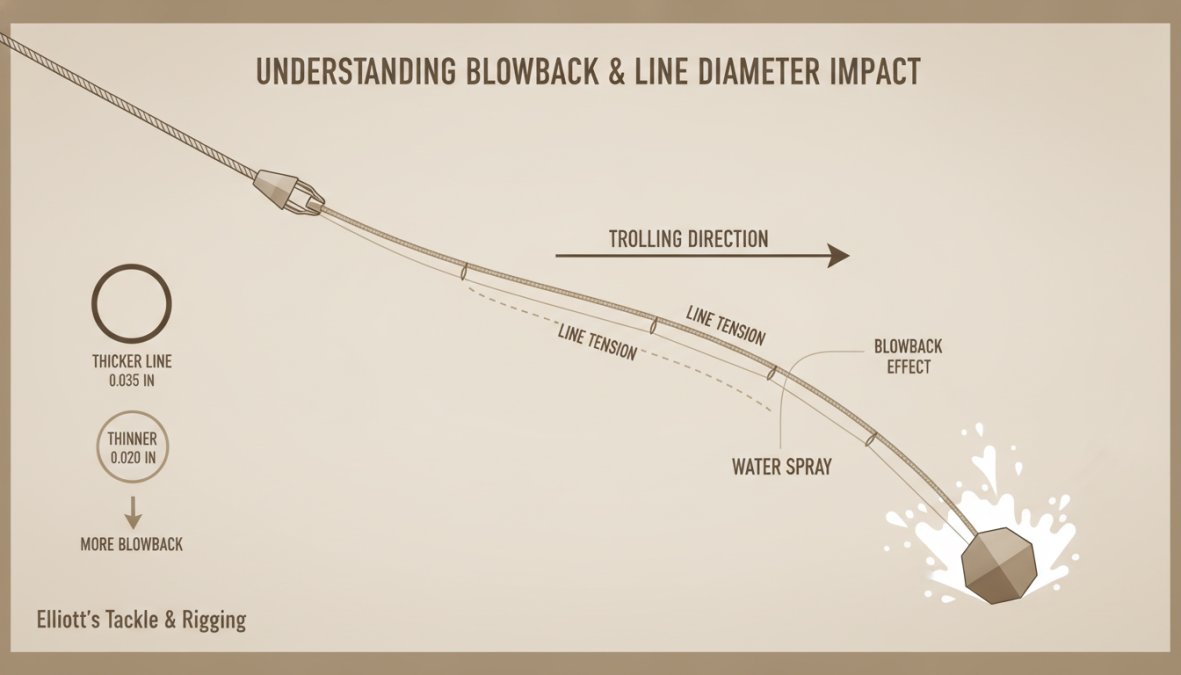
When you set your downrigger to 80 feet, you're measuring straight down from the boom. But if blowback creates a 30-degree angle, your lure is actually running at 65-70 feet. Thinner line creates less water resistance and reduces blowback angle. Thicker line catches more water and bows more dramatically.
Your trolling speed directly influences blowback severity. At 1.5 knots, blowback is minimal, maybe 10-15 degrees. At 2.5 knots, you might see 25-35 degrees. At 3+ knots, blowback can exceed 45 degrees, meaning your actual fishing depth is significantly shallower than your target. Many salmon anglers intentionally set their downrigger 5-10 feet deeper than their target to compensate for blowback at their typical trolling speed.
Setting Up Your Downrigger Rod and Reel System
Your downrigger rod and reel are separate from your trolling rod. The downrigger rod's job is to hold the weight and release the lure, not fight fish.
Rod Action and Flexibility for Salmon Fishing
The best downrigger rod for salmon has moderate flexibility. You want enough give to absorb the shock of the weight hitting structure or the sudden load when a fish strikes and the release clip opens. A medium-action rod, typically 5.5 to 6.5 feet in length, is ideal. Flexibility is more important than sensitivity, a stiff rod can snap under sudden loads, while a medium-flex rod bends and survives.
Drag System and Release Clip Configuration
Your downrigger reel needs a smooth, reliable drag system with a sealed design to resist corrosion in saltwater. Your release clip should hold the lure line with enough tension that normal trolling doesn't trigger it, but light enough that a salmon's strike opens it cleanly. Test your clips regularly, they wear and lose tension over time.
Many anglers use two release clips on the same downrigger line, one at depth with the primary lure and a second 15-20 feet shallower with a backup lure. This doubles your coverage without adding another downrigger.
Leader Material, Length, and Swivel Selection
A 3-4 foot leader in 20-30 pound fluorocarbon is standard for salmon trolling. Fluorocarbon is less visible underwater than monofilament and resists kinking better when the lure trolls at speed.
Use a ball-bearing swivel rated for at least 50 pounds. The swivel prevents line twist, which is especially important when trolling with spinners or rotating lures. Connect your downrigger line to the swivel using a Palomar knot or improved clinch knot, both are reliable when tied correctly.
The leader should be slightly lighter than your downrigger line test weight. If your downrigger line is 20 pounds, use a 15-20 pound leader. This creates a designed break point, if something goes wrong, the leader breaks before the downrigger line, preserving your line and weight.
Line Maintenance and Replacement Cycles
The best downrigger line is only as good as its condition. Monofilament degrades from UV exposure, salt spray, and mechanical wear. Most experienced anglers replace their downrigger line annually or every 100-150 hours of trolling, whichever comes first.
Inspect your line every few weeks during the season for discoloration (UV damage) and rough spots (abrasion damage). Store your downrigger line out of direct sunlight during the off-season, wrapped loosely on the reel.
When replacing the line, use quality saltwater monofilament like Big Game, Ande, or Berkley Big Game. These lines have superior abrasion resistance and UV stability compared to freshwater mono. Keep a spare spool of downrigger line on your boat for unexpected failures.
Knot Strength and Terminal Tackle for Downrigger Connections
The Palomar knot is the gold standard for connecting your downrigger line to the swivel. Thread the line through the swivel eye, tie a simple overhand knot without pulling it tight, thread the line back through the eye, then tighten. This creates a knot with nearly 100% of the line's rated strength.
The improved clinch knot is the alternative, wrap the line around the swivel eye 5-7 times, thread back through the first loop near the eye, then through the larger loop. This knot is slightly weaker but still reliable at 85-90% of line strength when tied correctly.
Your terminal tackle should all be rated for at least 50 pounds. Stainless steel swivels and clips resist corrosion better than chrome-plated alternatives. Replace your swivels and release clips every 1-2 seasons, they wear, corrode, and lose strength over time.
Selecting the best downrigger line for salmon comes down to understanding what the line actually does, it's a delivery system, not a fishing line. The right choice balances strength, diameter, and durability. Monofilament in the 20-25 pound range consistently outperforms alternatives for salmon trolling. The combination of blowback control, abrasion resistance, and proven reliability makes it the choice serious anglers depend on. Start with quality saltwater monofilament, maintain it properly, and you'll spend more time fishing and less time dealing with line failures on the water.
Frequently Asked Questions
What is the best downrigger line for salmon fishing in saltwater?
The best downrigger line for salmon depends on your fishing environment and preference. Big Game monofilament offers excellent stretch and blowback control, making it ideal for Pacific Northwest waters like Puget Sound. Braided line provides superior sensitivity and direct depth control, though it requires careful attention to blowback and line diameter. Most experienced salmon anglers use monofilament in the 20-30 pound test range for standard trolling applications, paired with fluorocarbon leaders for abrasion resistance.
Should I use monofilament or braided line for my downrigger?
Monofilament excels at absorbing shock and managing blowback, making it forgiving for variable trolling speeds and depth changes. Braided line offers zero stretch and superior sensitivity to bottom contact, but requires precise trolling speed control to minimize blowback. For salmon trolling in moderate depths (60-150 feet), monofilament is typically the safer choice. Braided line works best for experienced anglers targeting specific depth zones with consistent speed control and depth sounder monitoring.
What line test weight should I use for downrigger salmon fishing?
For salmon downrigger fishing, 20-30 pound test monofilament is the standard recommendation for most applications. Lighter test (15-20 pounds) works in shallow, clear water with minimal structure, while heavier test (30-40 pounds) suits deeper water, heavy cover, or when using larger lures. Line diameter also matters, thinner diameters reduce blowback and improve depth control. Terminal tackle including swivels and leaders should match or slightly exceed your main line test weight to prevent system failure during hook-sets.
How often should I replace my downrigger line?
Inspect your downrigger line every 10-15 fishing days for signs of UV damage, line memory, or abrasion. Replace monofilament annually or after 100+ hours of trolling, as UV exposure and saltwater exposure degrade line strength over time. Braided line lasts longer (18-24 months) but requires more frequent inspection for fraying or damage. In high-UV environments like Puget Sound, consider replacing more frequently. Always replace immediately if you notice discoloration, stiffness, or reduced knot strength.
What knot strength matters for downrigger connections?
Knot strength is critical at three connection points: main line to swivel, swivel to leader, and leader to terminal tackle. Use improved clinch knots or Palomar knots that retain 85-95% of line strength. Test your knots regularly, a properly tied knot should hold 100% of line strength when tied correctly. Poor knot technique is a leading cause of lost fish and equipment failure. Practice tying on land before fishing, and retie connections every 5-8 fish or if you notice any abrasion at the connection point.
This article was written using GrandRanker
0 comments