

Table of Contents
- Pacific Northwest Salmon Trolling Techniques: The Foundation
- Essential Salmon Trolling Gear Setup
- Trolling Speed for Chinook Salmon and Other Species
- Downrigger Techniques for Salmon in the Pacific Northwest
- Best Salmon Trolling Lures for PNW Waters
- Marine Electronics and Sonar Interpretation
- Troubleshooting and Real-Time Adjustments
- Safety and Marine Regulations for Puget Sound Trolling
Pacific Northwest Salmon Trolling Techniques: A Captain's Guide
Last Updated: July 16, 2026
Pacific Northwest Salmon Trolling Techniques: The Foundation
I've spent four decades on the water in the Pacific Northwest, and successful trolling separates consistent anglers from those hoping for luck. The truth is simple: it's not about fancy equipment, it's about understanding what salmon are doing beneath your boat and adjusting your presentation to match.
Trolling works because salmon are migratory feeders moving through specific zones at specific depths. You're placing your lure in front of actively feeding fish rather than waiting for them to find stationary bait. But you must know where those fish are moving, how deep they're feeding, and what speed triggers a strike.
Why Trolling Works in the Pacific Northwest
Salmon migrate through predictable corridors as open-water hunters moving between feeding zones and spawning grounds. The Pacific Northwest's geography creates natural funnels, Puget Sound, the Strait of Juan de Fuca, and coastal areas force salmon into channels where they concentrate. Trolling through these zones puts your lure in front of dozens of fish per hour.
The water column is layered with different temperatures, light penetration, and oxygen levels. Salmon position themselves where conditions favor feeding. Seasonal patterns matter too: spring and early summer bring aggressive feeding salmon moving toward spawning grounds, while fall brings different species with different behaviors. Understanding which species you're targeting and the time of year determines your entire approach.
Understanding Salmon Migration and Feeding Patterns
Salmon migration follows a biological clock. Chinook salmon typically migrate in spring (April-June) and fall (August-October). Coho follow slightly later in fall, and Pink salmon have their own two-year cycle.
Feeding behavior changes with water temperature and light. Warmer summer water means salmon feed more aggressively and burn calories faster. Cold winter water slows their metabolism, so they eat less frequently but are often larger and more selective. On bright days, salmon move deeper to avoid surface glare; on overcast days, they feed shallower.
Different species have different food preferences. Chinook prefer larger baitfish like herring and sand eels and are aggressive hunters. Coho and Pink salmon are less selective and will strike smaller presentations. Knowing what your target species eats determines whether you throw a 4-inch spoon or a 2-inch spinner.
Essential Salmon Trolling Gear Setup
Rod and Reel Specifications for Trolling
A medium-heavy rod designed for trolling is non-negotiable: 6.5 to 7 feet long with enough backbone to set hooks in hard mouths and handle 15-25 pound fish. Pair it with a conventional reel with a level-wind, at least 250 yards of line capacity, and a smooth drag system. A quality drag is the difference between landing a 20-pound Chinook and watching it snap your line.
Test your drag before leaving the dock. Set it to slip at about one-third of your line's breaking strength.
Line Selection: Braided vs. Fluorocarbon Leaders
Use 30-40 pound braided mainline for most Pacific Northwest trolling. Braided line has almost no stretch, so you feel every vibration from your lure and every subtle take. It's also thinner for its breaking strength, allowing more yardage on your reel.
Connect a 2-3 foot fluorocarbon leader to your braided mainline. Fluorocarbon is nearly invisible underwater and has less stretch than braided line, improving hook sets. Use 15-20 pound fluorocarbon for most situations. Connect them using an Albright knot or surgeon's knot, these connections must be smooth and strong.
Trolling Speed for Chinook Salmon and Other Species
Trolling speed is critical. Too slow, and your lure lacks the action that triggers strikes. Too fast, and you're moving past feeding fish before they react.
For Chinook salmon, troll at 2.5 to 3.5 knots. This speed gives larger spoons and plugs the wobble and flash that Chinook find irresistible. Coho salmon prefer slightly faster speeds, 3 to 4 knots. Pink salmon can be caught at speeds up to 4.5 knots.
Adjusting Speed by Species and Water Conditions
In cold water (below 50 degrees), slow down, salmon metabolism is slower and they're less willing to chase fast-moving targets. In warmer water (above 55 degrees), you can speed up slightly. Turbid water calls for faster speeds because fish need to react quickly. Clear water allows slower speeds because fish can see your lure from farther away.
Pay attention to your GPS. Don't guess at speed based on engine RPM alone. Tide and current affect your actual speed through the water. Adjust your engine speed to match your target speed through the water, not over the ground.
Downrigger Techniques for Salmon in the Pacific Northwest
A downrigger is the single most important tool for consistent salmon trolling. It gets your lure to the exact depth where salmon are feeding. A downrigger lowers a weighted cable to a specific depth. Your fishing line attaches to a release mechanism on the cable. When a fish strikes, it pulls your line free from the release, and you fight the fish on your rod.
Downriggers vs. Divers: When to Use Each
Downriggers are the standard for Pacific Northwest trolling. They're accurate, reliable, and let you fish multiple depths simultaneously. A typical setup uses two downriggers, one on each side of the boat, each set to a different depth.
Divers (trolling sinkers) are cheaper but less precise and harder to fish with multiple lines. Use downriggers when you have access to them and the budget allows. Use divers when fishing shallow (under 30 feet) or in areas where downriggers aren't practical.
Depth Control and Water Column Management
Salmon position themselves at specific depths based on water temperature, light, and food availability. Check your fish finder to see where salmon are holding. If your sonar shows fish at 60 feet, set your downrigger to 55-60 feet. If you see fish at multiple depths, run one downrigger at 50 feet and another at 70 feet.
Temperature is the key variable. Most Pacific Northwest salmon feed in water between 48 and 56 degrees. A quality fish finder with temperature capability tells you where the thermal layer is and where salmon are likely to be.
Best Salmon Trolling Lures for PNW Waters
Spoons, Plugs, and Spinners: Lure Action and Selection
Spoons are the workhorse of Pacific Northwest salmon trolling. A spoon wobbles and flashes as it moves through the water, triggering strikes through flash and vibration. Use 3.5-inch to 4-inch spoons for Chinook salmon. Smaller spoons (2.5-3 inches) work better for Coho and Pink salmon. The wobble should be pronounced, you want to feel it through your rod.
Plugs mimic baitfish and are particularly effective for Chinook because they have a more natural appearance than spoons. A 3-4 inch plug running at the right depth can be deadly.
Spinners are smaller, lighter lures with a rotating blade. They're excellent for Coho and Pink salmon, especially in shallow water (under 30 feet).
Using Flashers and Scent for Bait Presentation
A flasher is a large, reflective device that attracts salmon from a distance through flash and vibration. A typical flasher setup uses a 2-3 foot leader from your downrigger cable to the flasher, then a 2-3 foot leader from the flasher to your lure.
Scent matters more than most anglers realize. Salmon hunt using multiple senses. Use scent-infused lures or apply scent to your spoons and plugs. Herring oil, anise, and salmon egg scent all work. A lure with scent will produce more strikes than the same lure without scent, especially in turbid water.
Marine Electronics and Sonar Interpretation
Your fish finder shows you the bottom, the water column, and the fish. Look for the depth of the bottom, the presence of structure (drop-offs, rocks, vegetation) where salmon feed, and actual fish marks.
Fish marks appear as arches or blobs. The location tells you what depth the fish are using. If you see marks at 60 feet, set your downriggers to 55-65 feet.
Reading Drop-Offs and Finding Feeding Salmon
Drop-offs are where salmon feed. A drop-off is a steep change in bottom depth, usually from shallow to deep water. Salmon position themselves on the edge where they can quickly move between shallow feeding areas and deep refuge.
Your fish finder shows drop-offs clearly. When you see one, troll along the edge and run your lures at the depth where the drop-off begins. Look for other structure too: rocks, vegetation, underwater canyons. These features disrupt water flow and create feeding zones.
Temperature is crucial. Look for the temperature zone where salmon feed, typically 48-56 degrees in the Pacific Northwest. If you see a sharp temperature change (a thermocline), salmon often position themselves just above or below it.
Troubleshooting and Real-Time Adjustments
The best anglers adjust quickly when something isn't working. The water changed. The fish moved. Your speed was wrong. These things happen every day on the water.
Common Mistakes and How to Fix Them
You're not getting strikes. Check your depth using your fish finder to verify that your downrigger is actually at the depth you think it is. Cable stretch and current can throw off your settings.
Your lure isn't wobbling properly. Pull it in and inspect it. A lure that doesn't wobble won't catch fish.
You're getting strikes but not hooking fish. This is usually a hook-set problem. Slow down and make sure your rod tip is positioned to drive the hook home when a fish strikes.
Adapting to Tide Changes and Seasonal Patterns
Tide changes affect salmon behavior dramatically. During slack tide (the period between tidal changes), salmon feed more aggressively. During strong tidal current, they're less active.
Seasonal patterns are even more important. Spring Chinook (April-June) are aggressive and feed in shallower water. Summer Chinook move deeper as water warms. Fall Coho are aggressive feeders preparing for spawning. Winter fishing is slower but produces larger fish.
Safety and Marine Regulations for Puget Sound Trolling
Before you leave the dock, verify current regulations for the area you're fishing. Check Washington State Department of Fish and Wildlife regulations for current season dates, catch limits, and size restrictions.
Safety on the water is non-negotiable. Wear a life jacket. Keep your boat maintained. Check weather before you leave. Puget Sound weather can change fast, and a small boat in rough water is dangerous. File a float plan with someone on shore.
Downrigger safety is specific. Keep your hands clear of the cable when the downrigger is running. Make sure your release mechanism is functioning properly before every outing.
Research from the National Oceanic and Atmospheric Administration on marine safety guidelines emphasizes the importance of proper equipment maintenance and weather awareness.
Respect the resource. Salmon populations in the Pacific Northwest have faced significant pressure. Follow catch limits. Practice catch-and-release when appropriate.
Situation |
Adjustment |
Expected Outcome |
|---|---|---|
No strikes all morning |
Check depth with sonar; adjust downriggers up or down 10-15 feet |
Locate the feeding zone |
Strikes but no hookups |
Slow trolling speed by 0.5 knots; verify hook sharpness |
Better hook penetration |
Fish marks on sonar but no bites |
Switch lure color or size; try a different flasher pattern |
Match the current forage preference |
Water temperature below 48°F |
Slow to 2.5 knots; use larger spoons; add scent |
Match reduced salmon metabolism |
Strong tidal current |
Wait for slack tide; troll perpendicular to current |
Reduce energy expenditure by salmon |
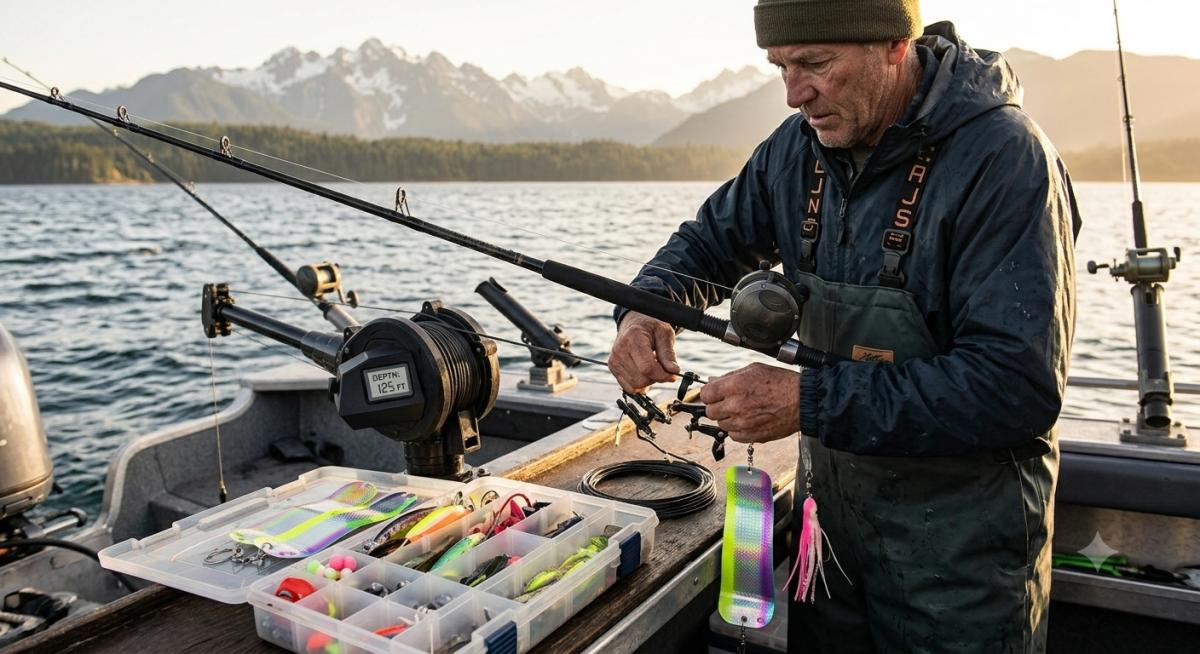
Captain rigging a medium-heavy trolling rod with downrigger cable and tackle box visible on a fishing boat in Puget Sound, showing hands-on gear preparation with morning light on the water
Salmon trolling in the Pacific Northwest rewards preparation, attention to detail, and willingness to adapt. Proper depth control, lure selection, speed adjustment, and real-time problem-solving aren't secrets, they're the result of decades of testing on the water. Start with quality equipment, understand the fundamentals, and adjust based on what the fish are telling you. That's how you fill your cooler.
Frequently Asked Questions
What is the best trolling speed for Chinook salmon in the Pacific Northwest?
Chinook salmon typically respond well to trolling speeds between 2.0 and 3.5 knots, depending on water temperature and season. In cooler waters, slower speeds (2.0–2.5 knots) trigger strikes better. During warmer months, increase to 2.5–3.5 knots. Coho prefer slightly faster speeds (2.5–3.5 knots), while Pink salmon often respond to 2.0–3.0 knots. Always adjust your trolling speed based on fish activity and water conditions you observe on sonar.
What gear do I need to start Pacific Northwest salmon trolling?
You'll need a medium-heavy rod (6–7 feet), a quality reel with good line capacity, braided main line with fluorocarbon leaders (12–24 inches), a downrigger or diver for depth control, and appropriate lures (spoons, plugs, or spinners). Marine electronics with sonar help locate feeding salmon near drop-offs and structure. A fishing sinker kit, flashers, and scent options round out essential salmon trolling gear setup. Ensure your boat meets all Puget Sound safety and marine regulations.
How do I choose between downriggers and divers for salmon trolling?
Downriggers offer precise depth control and are ideal for deeper water (40+ feet) and trolling multiple lines simultaneously. Divers work better in shallow to medium depths (15–40 feet) and don't require electrical power. For Pacific Northwest salmon trolling techniques, downriggers excel in Puget Sound and deeper channels, while divers suit river mouths and shallower coastal zones. Choose based on your target depth, boat setup, and water conditions you'll fish most often.
What are the best lures for Pacific Northwest salmon trolling?
Spoons (1–3 ounces) with natural finishes like silver and chartreuse work year-round for Chinook and Coho. Plugs mimic baitfish and trigger aggressive strikes, especially during migration. Spinners create vibration and flash that attract feeding salmon. Best salmon trolling lures PNW vary by season: silver spoons in spring, darker colors in fall. Pair lures with flashers and scent for enhanced bait presentation. Match lure size and action to water clarity and salmon species targeted.
How do tide changes affect Pacific Northwest salmon trolling?
Salmon feed most actively during tide changes, particularly slack water and the first hour of incoming tide. Changing tides increase water movement, pushing baitfish and triggering feeding behavior. In Puget Sound, major tide shifts create predictable feeding windows. Monitor tide tables and plan trolling around these windows. Adjust your depth control and trolling speed as current strength changes—faster speeds during strong outgoing tides, slower speeds during slack periods.
What leader length should I use for salmon trolling in the Pacific Northwest?
Use fluorocarbon leaders between 12 and 24 inches for most Pacific Northwest salmon trolling. Shorter leaders (12–15 inches) work well with spoons and flashers in clear water. Longer leaders (18–24 inches) provide more natural bait presentation and reduce visibility in stained water. Test different leader lengths based on water clarity and fish response. Ensure your hook and line setup matches your lure weight and target species to maintain proper lure action throughout your trolling pass.
0 comments