

Table of Contents
- Electric vs Manual Downriggers: Head-to-Head Comparison
- How Electric Downriggers Work vs Manual Operation
- Downrigger Depth Control: Precision and Ease of Use
- Downrigger Installation and Wiring Requirements
- Cost Comparison and Long-Term Value
- Downrigger Accessories and Compatibility
- Downrigger Buying Guide: Which Type Fits Your Fishing
- Repairability and Field Maintenance: A Practical Reality
Electric vs Manual Downriggers: Which Wins for Your Boat?
Last Updated: July 18, 2026
When you're serious about trolling, the electric downrigger vs manual comparison becomes unavoidable. At Elliott's Tackle & Rigging, we've spent four decades helping anglers make this exact choice, and the answer depends far more on your fishing style than on which technology is "better." Electric downriggers trade physical effort for electrical complexity and cost. Manual downriggers demand your muscle but ask nothing of your boat's battery.
Electric vs Manual Downriggers: Head-to-Head Comparison
Electric downriggers shine when you're running multiple lines at precise depths for extended periods. Manual downriggers excel when you're fishing shallow water, making constant adjustments, or running a single line where hand-crank speed doesn't matter. The real difference emerges when you factor in boat electrical systems, maintenance demands, and what happens when equipment fails mid-fishing day.
| Feature | Electric Downriggers | Manual Downriggers |
|---|---|---|
| Descent/Retrieval Speed | 200-250 ft/min | 100-150 ft/min (hand-crank dependent) |
| Depth Control | Automated with line counter | Mechanical depth counter |
| Battery Requirement | Yes, 12V or 24V system | None |
| Initial Cost | $700-$1,700+ | $185-$400 |
| Maintenance | Motor, electrical connections, wiring | Spool, cable, clutch mechanism |
| Best For | Deep water, multiple lines, precision trolling | Shallow water, frequent adjustments, solo anglers |
| Reliability | Depends on boat electrical system | Mechanical simplicity, field-repairable |
| Physical Effort | Minimal | Significant during retrieval |
How Electric Downriggers Work vs Manual Operation
Electric downriggers automate descent and retrieval through a 12V or 24V motor connected to your boat's electrical system. You control descent speed through a toggle switch or LCD display. The advantage emerges when managing multiple downriggers simultaneously, something exhausting with manual hand cranks.
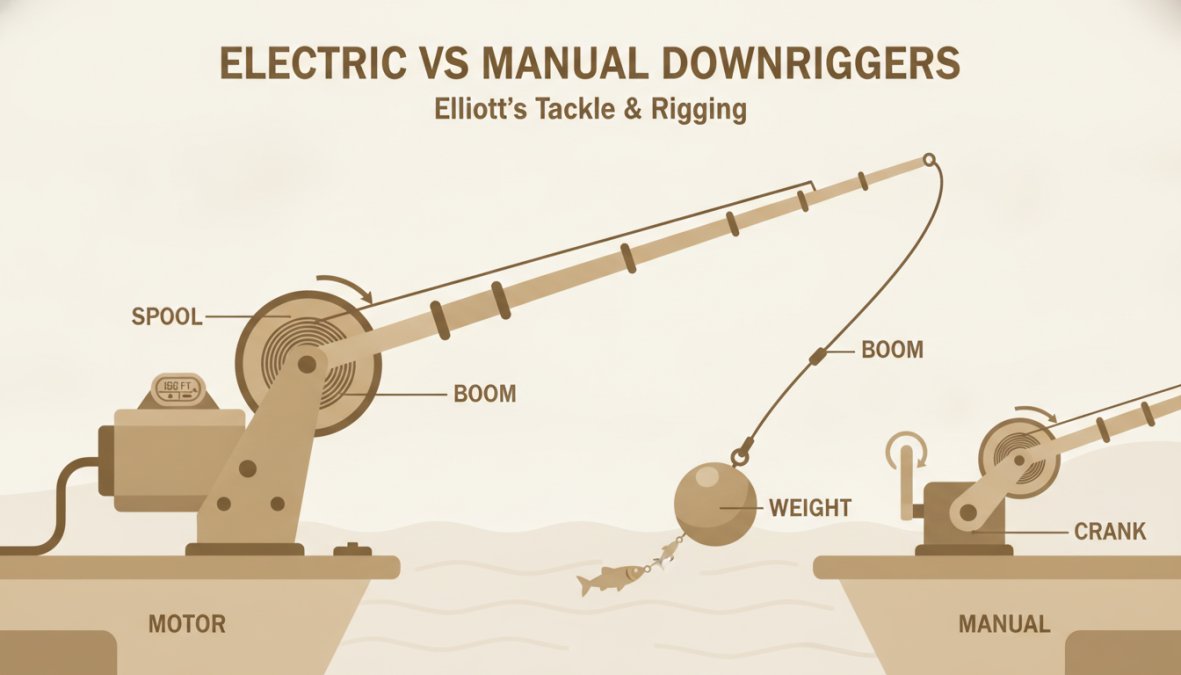
Manual downriggers operate through mechanical advantage. A hand crank connected to a gear system winds cable onto a spool. A 2:1 ratio means one full rotation moves the cable two feet. This simplicity is the entire appeal: no batteries, no wiring, no electrical troubleshooting.
Over eight hours of fishing, the physical difference is significant. With an electric downrigger, you deploy your weight, set your depth, and your hands are free for other tasks. With a manual downrigger, you're doing the physical work every time you adjust depth or retrieve.
Downrigger Depth Control: Precision and Ease of Use
Electric downriggers excel at depth control through automated management that manual systems can't match. A line counter tells you exactly how much cable is deployed. Many models include auto-stop features that halt descent at a preset depth, critical when fishing structure and needing repeatable precision.
Manual downriggers use a mechanical depth counter, which is reliable but requires you to watch the gauge and manually stop descent. This works for most freshwater trolling but introduces human error. For deep saltwater fishing where you need to hold a specific depth band within five feet, an electric downrigger with auto-stop becomes essential.
Bottom tracking automatically adjusts your depth as the lake or ocean floor rises or falls, keeping your weight at constant distance from bottom. Manual downriggers can't do this; you're constantly adjusting by hand. For anglers fishing variable bottom structure, bottom tracking saves hours of fidgeting and ensures your bait stays in the strike zone.
Advanced models like the Cannon Optimum 10 BT add wireless connectivity and LCD displays. You can adjust depth from your helm station without walking to the downrigger, and your depth data syncs with your sonar, transforming how you fish.
Downrigger Installation and Wiring Requirements
Installing an electric downrigger means integrating it into your boat's electrical system. You're running power from your battery, installing a dedicated fuse in the power line, running a toggle switch to your helm or downrigger location, and ensuring proper grounding. Poor installation creates voltage drop, slow descent speeds, and potential electrical fires.
Standard installation uses 10-gauge marine-grade wire for power and ground, with a 30-amp fuse located within 18 inches of the battery. Grounding is critical: use a dedicated ground wire back to the battery negative terminal, not a chassis ground, which introduces resistance.
Manual downriggers need no electrical integration. You bolt them to your gunwale and you're done. This simplicity is why many anglers prefer them on small boats or when running multiple boats with varying electrical systems.
Your battery must have enough reserve capacity to power the downrigger throughout a full fishing day. A standard 100-amp-hour marine battery handles a single electric downrigger for eight hours, but dual downriggers demand either a larger battery or a second dedicated battery.
Cost Comparison and Long-Term Value
The initial investment gap is substantial. A quality manual downrigger like the Scotty 1050 Depthmaster runs $185-$230. The Cannon Uni-Troll 10 manual costs around $400. Electric models start at $725 and reach $1,700. The upfront cost difference is real.
But the comparison doesn't end at purchase price. Electric downriggers demand ongoing electrical system investment: upgraded battery, additional wiring, or upgraded alternator. These hidden costs often total $500-$1,500. Manual downriggers have no hidden costs; cable replacement is rare and inexpensive.
Long-term reliability favors manual downriggers for simplicity. A mechanical spool and clutch last decades with minimal maintenance. Cable replacement costs $100-$200. Electric downriggers have more failure points: motor burnout, corroded connections, and wiring failure. Repair costs typically run $200-$600.
The real value question comes down to time. If you fish 30+ days per year and run multiple lines, electric downriggers justify the cost through labor savings and improved fishing success. If you fish 10 days per year on a small boat with one or two lines, manual downriggers offer better value.
Downrigger Accessories and Compatibility
Electric downriggers integrate with modern fish finders through One-Boat Network technology. The Cannon Optimum 10 BT syncs with Humminbird fish finders, displaying downrigger depth directly on your sounder screen. This integration eliminates guesswork and lets you adjust trolling depth in real time based on sounder data.
Cable and weight selection matters more with electric downriggers because the motor handles the work. You can use heavier weights, 15-20 pounds, without hand-crank fatigue. This deeper reach is essential for offshore trolling and water deeper than 200 feet. Manual downriggers typically max out at 8-10 pound weights for comfortable operation.
Most electric downriggers come with 250-300 feet of 150-pound test stainless steel cable, covering most freshwater and light saltwater applications. Manual downriggers typically offer 200-250 feet of cable, adequate for most applications but limiting for deep-water fishing.
Boom extensions increase your lateral spread when running multiple downriggers. The telescoping boom on most modern downriggers extends from 24 to 53 inches, giving you flexibility in positioning.
Downrigger Buying Guide: Which Type Fits Your Fishing
Solo anglers and convenience seekers almost always benefit from electric downriggers. If you fish alone and want to manage depth while keeping your hands free, the labor savings justify the cost. You're not fighting hand fatigue, and your fishing day feels less like work.
Budget-conscious trollers and anglers who value simplicity should consider manual downriggers. If your total boat budget is tight and you're not planning deep water or multiple lines, a manual downrigger delivers 80% of the functionality at 30% of the cost. Mechanical reliability is unmatched, and you're not dependent on battery management or electrical troubleshooting.
Saltwater anglers fishing for salmon or halibut typically benefit from electric downriggers because they're often working deeper water (150-300 feet) and managing multiple lines. Freshwater anglers fishing lakes for walleye or pike often find manual downriggers sufficient because they're typically fishing shallower water (30-80 feet).
The real decision hinges on three questions: How many days per year do you fish? How many lines do you typically run? How deep do you fish? If you answer "40+ days," "four lines," and "200+ feet," electric downriggers are essential. If you answer "10 days," "one line," and "50 feet," manual downriggers make more sense.
Repairability and Field Maintenance: A Practical Reality
Manual downriggers show their strongest advantage in repairability. A broken hand crank, stripped gear, or stuck clutch can often be repaired on the water with basic tools. Most mechanical failures are fixable with a wrench and mechanical sense. Parts are simple, inexpensive, and widely available.
Electric downriggers require specialized knowledge to troubleshoot. A motor that won't turn, intermittent toggle switch, or corroded electrical connection demands either repair expertise or a trip to a service center. Saltwater corrosion is particularly brutal on electric downriggers, even stainless steel components can fail without proper maintenance.
Cable maintenance applies to both types equally. Inspect your cable regularly for fraying, rust, or kinks. Saltwater fishing demands more frequent inspection because salt accelerates corrosion. Replace cable every 3-5 years of regular use, sooner if you fish saltwater.
Inspect weights regularly for corrosion and impact damage. Replace any weight showing significant rust or damage. A failing weight at depth is a lost line and wasted fishing opportunity.
The electric downrigger vs manual comparison ultimately comes down to your specific fishing situation, not which technology is objectively superior. Electric downriggers deliver convenience, precision, and labor savings for anglers fishing deep water or managing multiple lines. Manual downriggers offer simplicity, reliability, and cost-effectiveness for anglers who value mechanical straightforwardness over automation.
At Elliott's Tackle & Rigging, we carry both types because serious anglers make this choice based on actual fishing patterns. Our selection includes the Scotty Depthmaster for proven manual reliability and the Cannon Optimum 10 BT for advanced depth control and fish finder integration. Whichever direction you choose, we'll help you install it correctly and support you with the knowledge and parts you need. Search Elliott's Tackle & Rigging to explore our complete downrigger selection and connect with our team.
Frequently Asked Questions
What is the main difference between electric and manual downriggers?
Electric downriggers use a motorized spool to deploy and retrieve your fishing weight and bait automatically, while manual downriggers rely on hand-crank operation. Electric models offer convenience and faster retrieval, especially valuable when fishing at depth or making frequent adjustments. Manual downriggers require physical effort but eliminate battery dependence and are simpler to maintain. Choose based on your fishing style, boat size, and how often you need to adjust depth during a trolling session.
Do electric downriggers require special battery setup and wiring?
Yes. Electric downriggers need direct connection to your boat's electrical system via proper wiring, fuses, and a toggle switch. Most require 12V or 24V DC power from your boat's battery bank. Installation involves running marine-grade wire, installing inline fuses for safety, and ensuring your battery capacity can handle the motor's power draw. Power consumption varies by model, typical electric downriggers draw 20-50 amps during operation. Consult your boat's electrical system specifications and the downrigger manual before installation to avoid overloading circuits.
Which downrigger offers better depth control for trolling?
Electric downriggers typically offer superior depth control through features like line counters, auto-stop mechanisms, and bottom tracking. These automated functions let you hold precise depth without constant manual adjustment, ideal for maintaining consistent trolling speed and lure presentation. Manual downriggers provide adequate depth control via their spool and clutch system, but require hands-on management. For fishing in variable bottom conditions or when targeting specific depth zones, electric models with depth sounder integration give you an edge in accuracy and consistency.
Are electric downriggers worth the extra cost compared to manual?
It depends on your fishing frequency and style. Electric downriggers cost significantly more upfront but reduce physical fatigue, speed up retrieval, and enable precise automated depth control, particularly valuable for solo anglers or those fishing deep water regularly. Manual downriggers are budget-friendly and ideal for casual anglers, smaller boats, or those who prefer simplicity and reliability without electronics. If you fish frequently in demanding conditions or value convenience, the electric investment pays dividends. For occasional trolling, a quality manual downrigger delivers solid performance at a fraction of the cost.
Can I integrate a downrigger with my fish finder or GPS system?
Modern electric downriggers, particularly premium models, integrate with fish finders and GPS units via One-Boat Network connectivity or similar marine electronics ecosystems. This integration lets you view trolling data, control depth settings from your display, and enable features like automatic bottom tracking. Manual downriggers don't offer electronic integration but work alongside fish finders, you simply read your sounder and adjust manually. If advanced boat electronics and automated depth management matter to you, choose an electric model with documented compatibility with your existing systems.
This article was written using GrandRanker
0 comments